Two cleaners work the same kitchen. One mops first, then dusts the shelves, and the falling dust settles on the wet floor. The other works top to bottom and finishes with the floors. Both ran the same list, but only one result holds up an hour later.
That's the flaw in most standard cleaning checklists. They're unordered lists of chores, so the sequence gets decided by whoever holds the cloth, and the sequence is what determines whether the work holds. A checklist that doesn't specify order is really just a list of things someone might do.
This guide follows the standard cleaning checklist room by room, in the order a professional crew works: high surfaces, then eye-level surfaces, then fixtures, then floors. Each item marks the point where a routine visit stops and a deep clean or an add-on begins. That boundary is what keeps expectations honest on both sides of the invoice, and it's the part homeowners most often discover only after the fact.
1. Dusting High-to-Low Surfaces
Dusting looks like the easiest task on the list, and it's the one that decides whether a room looks finished. Knock dust off a ceiling fan blade after you've wiped the shelf beneath it and you've just doubled the work. The CDC's cleaning and disinfection sequence sets the order plainly: remove clutter, work from high to low, clean floors last.
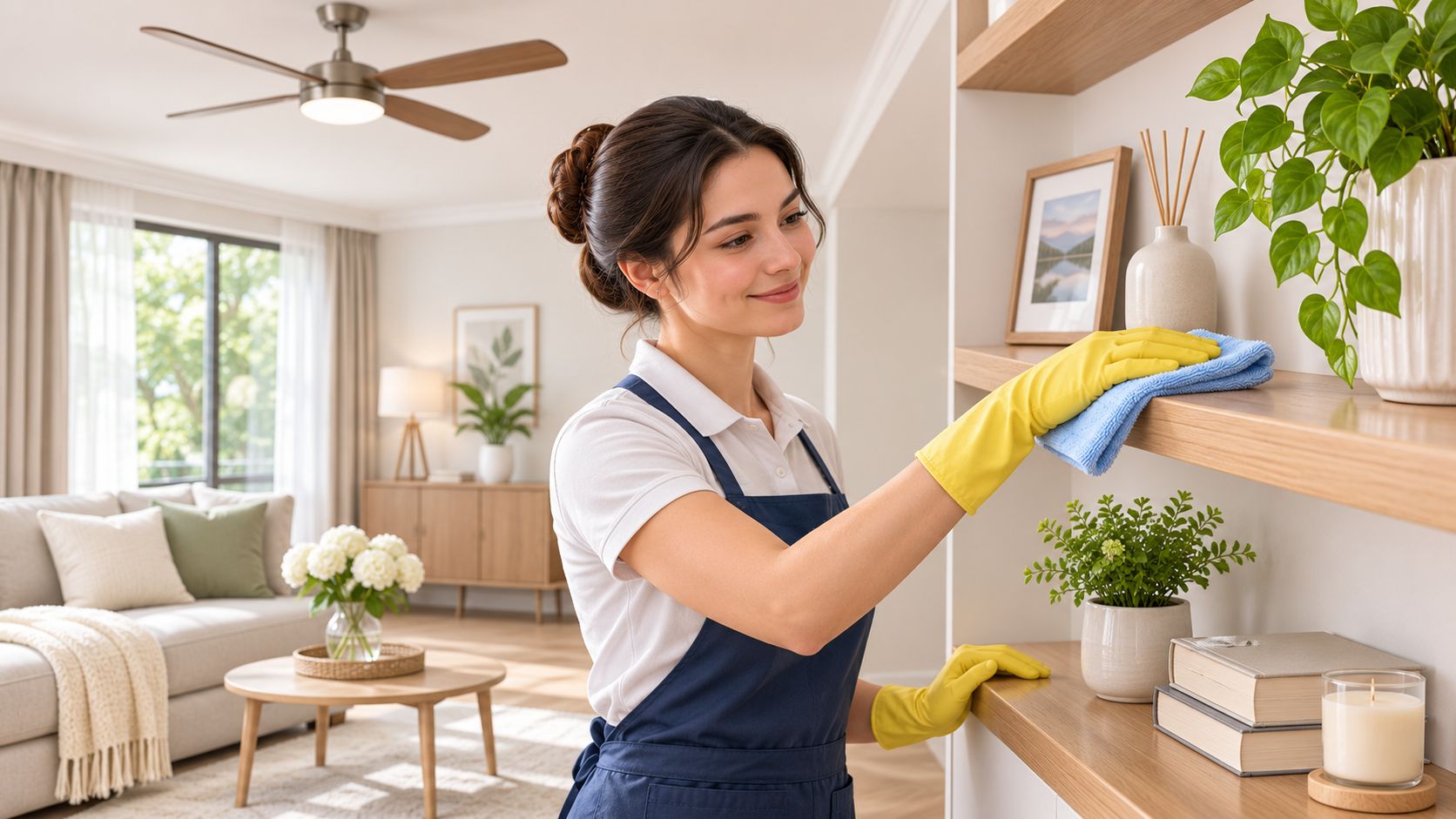
Gravity does the heavy lifting if you let it. Work the ceiling fan blades first with a long-handled duster and a drop cloth under them, then shelves and ledges, then furniture tops, then blinds and vents, which throw dust sideways when you disturb them. Slightly damp microfiber catches particles a dry cloth just pushes around. On upholstery and electronics, a soft brush attachment cleans without scratching.
Dust the fan before the shelf. Reverse the order and you clean the room twice.
Where a standard visit stops
Reachable surfaces are standard scope. The ledge above the kitchen cabinets, the top of a tall bookcase, and the interiors of glass-front cabinets are detail work that belongs to a deep clean. If dust returns within days of a visit, the cloth isn't the problem. Filtration, airflow and clutter are, and reducing dust in a house is a separate project from removing it. Take a house with ceiling fans in four bedrooms: the sequence is fans, blinds, furniture tops, vents, then floor, every visit, in that order.
2. Vacuuming Carpets and Hard Floors
Grit on a hard floor behaves like sandpaper under a shoe. Every pass of foot traffic grinds it into the finish, and on carpet it saws at the fibers at the base of the pile. Vacuuming removes that material before wet cleaning can turn it into mud, which is why it sits above mopping in the sequence rather than after it.
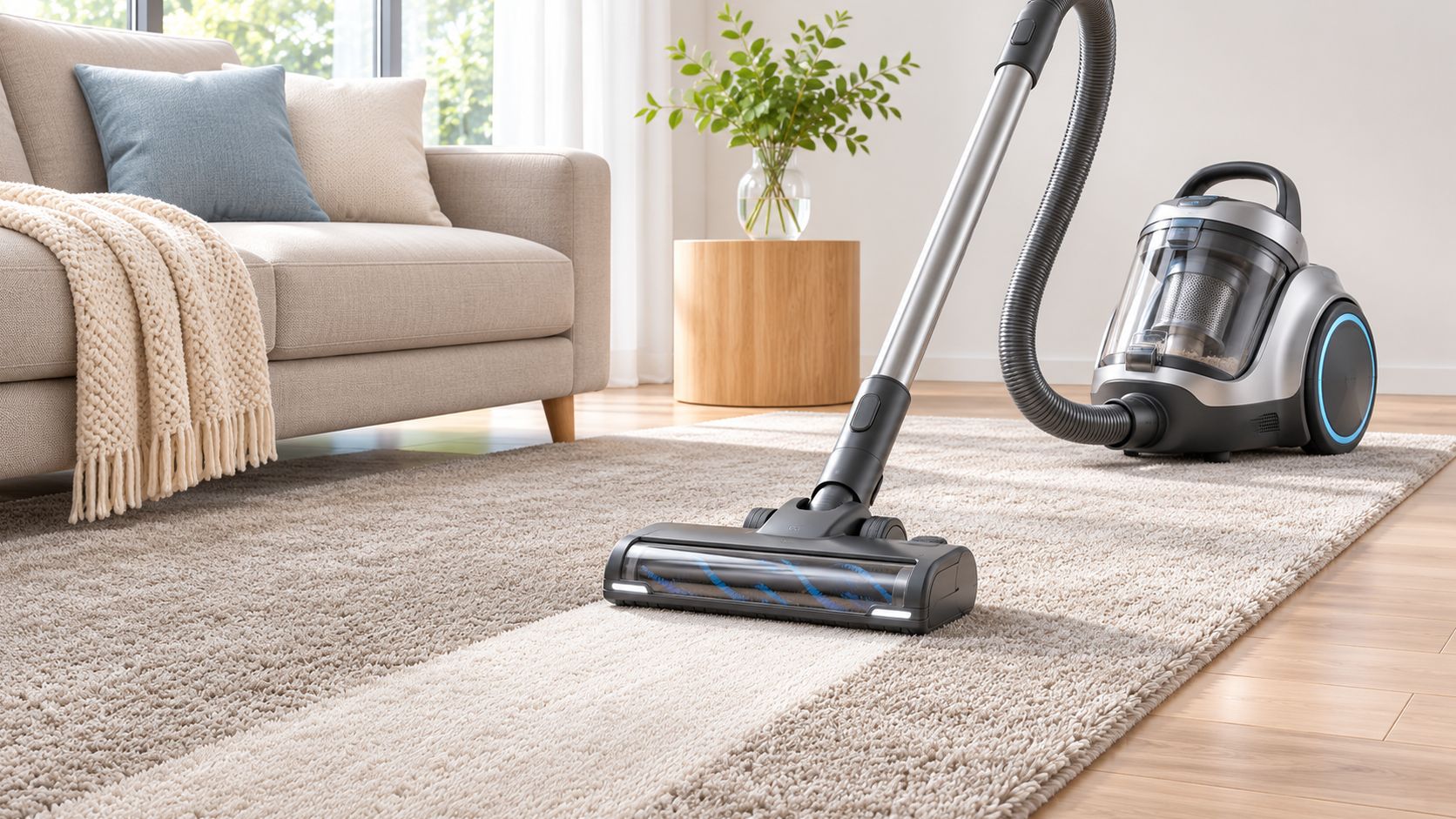
A vacuum doesn't need to be fast, it needs to be slow. Two overlapping passes in both directions lift far more from a traffic lane than one quick swipe, and edges need the crevice tool rather than a hopeful angle from the floor head.
- Traffic lanes get double passes: Doorways, the path from sofa to kitchen, and the strip beside the bed.
- Dry before wet: Vacuum or dry-sweep hard floors, then mop. Mopping loose grit just spreads a film across the room.
- Filters and bags on a schedule: A full bag or clogged filter cuts suction long before the motor complains. Check it between visits, not once a season.
- Along the baseboard line: Hair and dust collect in a strip that a floor head glides right past.
On tile and sealed hardwood, a hard-floor attachment or soft roller stops the brush from flinging debris into corners. For pet hair, a rubber squeegee edge pulls it out of carpet faster than suction alone. Take a house with two large dogs and wall-to-wall carpet: weekly vacuuming with a HEPA-filtered unit is the difference between carpet that lasts and carpet that mats.
Where standard stops
Exposed floor, reachable edges, and the area under the coffee table are standard. Moving a sectional, lifting a mattress, or hot-water extracting a carpet is a different service with a different machine.
3. Mopping Hard Floors
Mopping is where a good clean gets undone most often. A soaked mop pushes dirty water into grout lines and leaves a dull film on the finish, and the instinct is to add more product when the fix is using less water. A flat pad or mop head wrung until it's barely damp cleans sealed vinyl, tile, laminate and sealed hardwood without residue.
There's an air-quality cost most checklists ignore. Purdue researchers found that scented conventional and botanical cleaning products can react with indoor ozone and generate billions to trillions of ultrafine particles during routine mopping, spraying and wiping, commonly 1 to 30 nanometers across, small enough to penetrate deep into the respiratory system and easily missed by household air-quality monitors, as reported in the findings on scented cleaners and indoor particles. Botanical and essential-oil products formed particles too. A pleasant scent is not evidence of a clean floor.
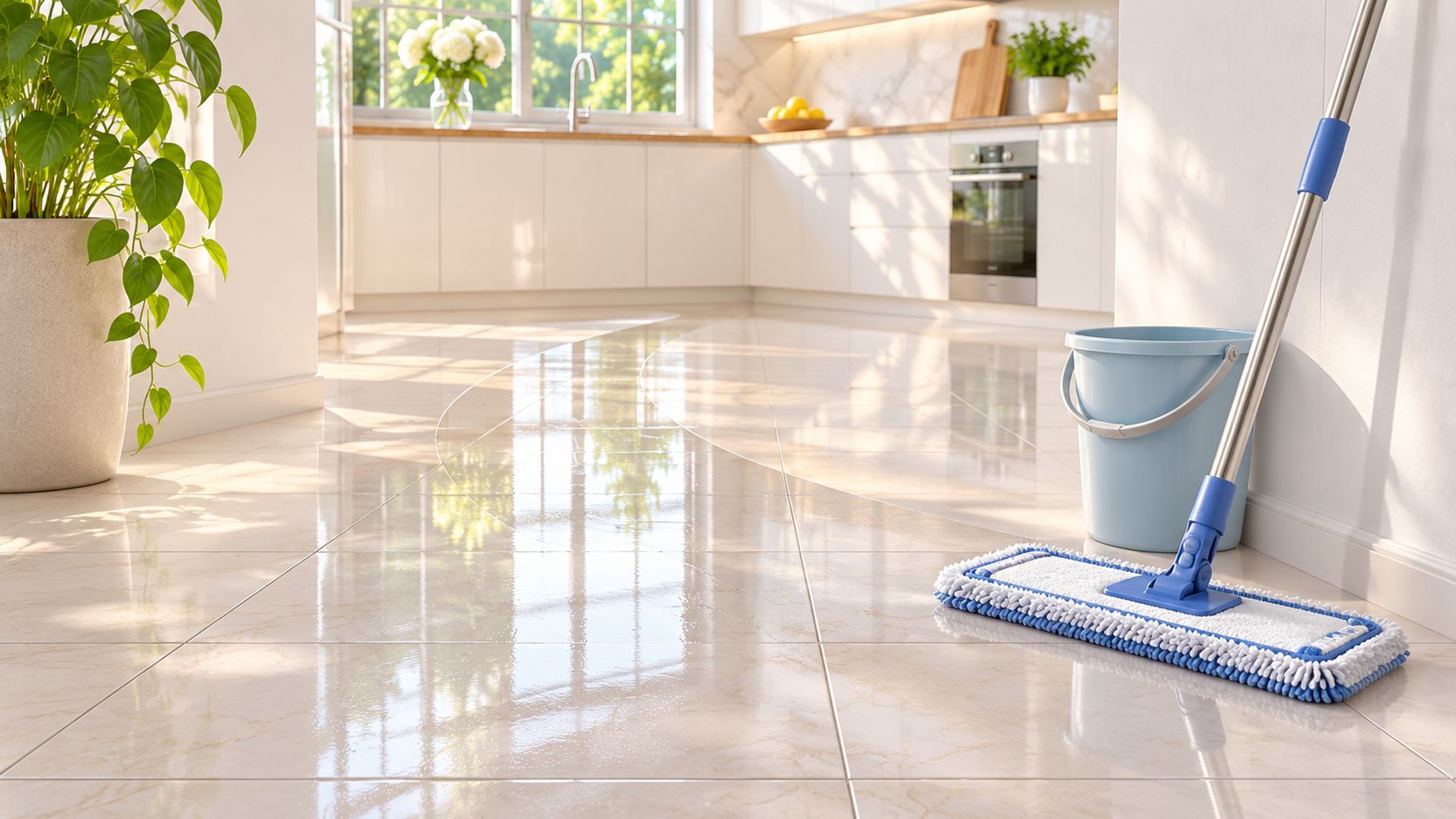
Practical rule: if water beads behind the pad, the pad is too wet. Wring it again.
Technique that holds up
- Change water often: Dirty water redeposits a film across every room you mop with it.
- Work from the far corner to the exit: You won't walk across the section you just cleaned.
- Follow the flooring maker's recommendation: Especially on hardwood, engineered floors and anything with a factory finish.
- Ventilate: Run the exhaust fan or open a window, and don't combine scented cleaners with an ozone-generating device in the same room.
- One scented product per session: Layering a floor cleaner, a spray and a fragrance plug in a small bathroom loads the air unnecessarily.
A ceramic tile kitchen floor takes a neutral cleaner and air drying. A sealed hardwood floor takes the barest damp pad and immediate drying. Same task, different water, and that difference is why grout that has darkened or a wax buildup on vinyl is deep cleaning floors work, not a maintenance visit.
4. Kitchen Countertop and Appliance Cleaning
The kitchen is where grease, food residue and hand contact stack up in the same square metre, and it's also where people reach for the strongest chemicals in the house. Both facts shape the checklist, in opposite directions.
Clean first, then decide whether disinfection is warranted at all. Most kitchen surfaces only need detergent and water to be hygienically clean, and the CDC guidance on when and how to clean and disinfect your home reserves disinfection for situations where someone is sick or has recently been in the home while sick. That distinction matters more than it sounds. The same guidance points to observational research in which people in the heaviest cleaning-product-use group, particularly those using bleach, sprays, polish, solvents and acids, had higher odds of current asthma (OR 3.24; 95% CI 1.19–8.77) and lower measured lung function than minimal users.
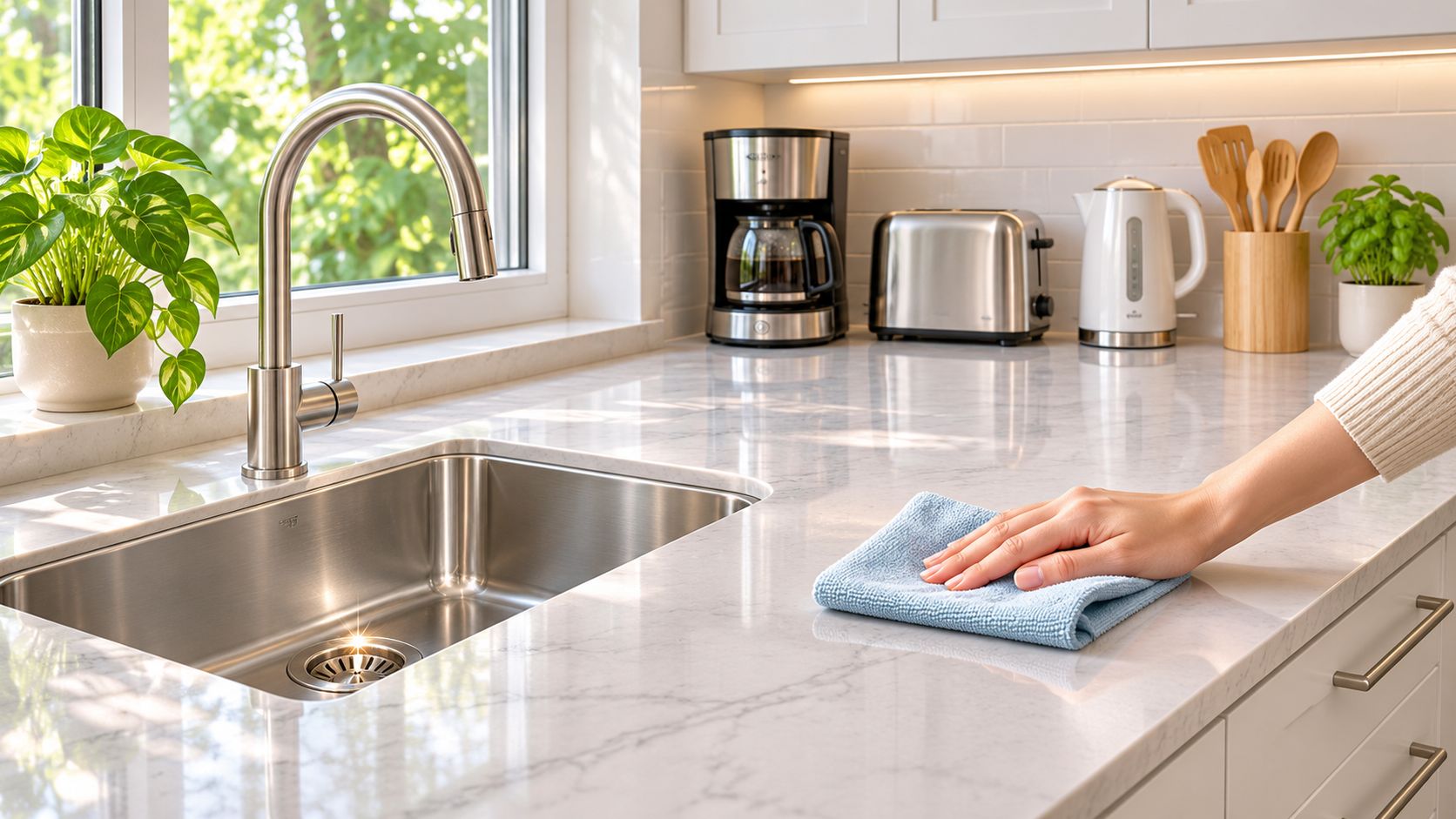
The order inside the kitchen
- Backsplash and cabinet fronts first: Work from the back of the counter forward so you're not wiping soil onto cleaned stone.
- Stovetop with a degreaser: Let it dwell a minute, then wipe. Scrubbing immediately just smears grease thinner.
- Appliance exteriors: Fridge and microwave handles and keypads take the most contact in the room.
- Sink and faucet last: The sink is the dirtiest surface in the kitchen, so it comes after the counters, not before.
Stone counters need a pH-neutral, stone-safe product. Acidic cleaners etch marble and travertine, and that damage is permanent. On granite and quartz, a damp microfiber and mild detergent do everything a specialty spray does.
Where standard stops
Counters, backsplash, stovetop, sink and appliance exteriors are standard. Oven interiors, fridge interiors and cabinet interiors are add-on lines. On a rental turnover, the stove needs a degreaser and the cabinet fronts need a wipe, but the oven interior is a separate scope item the landlord has to approve.
5. Bathroom Sanitation: Toilets, Tubs, and Sinks
Moisture plus body soil makes the bathroom the room where hygiene work matters, and it's where chemical mistakes happen most. Bleach is the usual culprit. The CDC cleaning and disinfection guidance gives a reference mixture of one-third cup of bleach per gallon of water when an approved disinfectant isn't available, and warns never to mix bleach with other cleaning products because dangerous fumes can result.
The order inside the bathroom
Mirrors and fixtures come first, before the room steams up and before splashes land on clean glass. Tubs and sinks come next, because soap scum needs dwell time rather than muscle. Then the toilet, exterior before bowl, with a dedicated cloth that goes nowhere else. Floors last, corners vacuumed or swept, mopping from the far wall to the door.
Contact time is where disinfection is won or lost. A product wiped off after ten seconds cleaned the surface and disinfected almost nothing.
Contact time and safe handling
Labels specify how long a surface must stay visibly wet, and many products call for several minutes. Read the label on the bottle you're holding rather than assuming, then dry the surface so liquid doesn't pool around the toilet base or under a bath mat. Gloves used for cleaning and disinfection should be dedicated to that purpose, not shared with other household chores, and surfaces should be dried thoroughly to keep liquid from collecting. Run the exhaust fan during and after, and keep the window cracked if there is one.
For households with young children or pets, that ventilation and rinsing discipline matters as much as the product choice. A tub that's been cleaned and rinsed is family-safe. A tub with a puddle of disinfectant sitting in the bottom is not.
Where standard stops
Tubs, toilets, sinks, mirrors, fixtures and floors are standard. Grout that has darkened, hard-water scale on shower glass, mold in caulk joints, and cabinet interiors belong to deep cleaning a bathroom, which is a longer visit with different chemistry.
6. Disinfecting High-Touch Surfaces
The useful question about any high-touch surface is whether it needs cleaning or disinfecting, because those are two operations and they aren't always both necessary. The CDC's household cleaning and disinfecting guidance identifies tables, doorknobs, light switches, handles, desks, phones, keyboards, toilets, faucets, sinks and other electronics as priority areas, recommends cleaning them regularly with daily cleaning as an example, and adds another clean after visitors have been in the home.
For ordinary household conditions, soap and water or another detergent removes most germs from those surfaces. Disinfection is generally reserved for when someone is sick or has recently been in the home while sick. Drawing that line protects the people living there as much as it protects the finish on a switch plate.
Clean first, always
Dirt and other impurities make disinfecting chemicals less effective, so a surface gets cleaned with detergent first and disinfected second. Skip the cleaning step and you waste both the product and the time.
- Doorknobs and handles: Both sides of every door, plus the latch edge people push with a finger.
- Light switches and outlet plates: The plate around the switch gets touched more than the switch itself.
- Remotes, phones and keyboards: Follow the manufacturer's instructions. Where none exist, an alcohol-based wipe is a reasonable option for glass touch screens, applied to a cloth rather than sprayed into a seam.
- Faucet levers and flush handles: Easy to miss because they're small and always in motion.
Say a stomach bug moves through a household in February. That's the week to disinfect doorknobs, switch plates and faucet handles after each cleaning, and to keep cleaning with detergent first rather than reaching straight for a stronger bottle. The rest of the month, those same surfaces need cleaning, not a chemical escalation.
Where standard stops
Wiping the high-touch points in every room is standard. A full disinfection protocol for a household in isolation, or for a property after a contamination event, is a separate arrangement with its own product list and contact times. A standard visit also shouldn't promise pathogen elimination. No routine clean does that.
7. Interior Glass and Mirror Cleaning
Streaks are the tell. A mirror wiped with too much product and buffed with a dirty cloth looks worse than one that was never touched, and interior windows show every finger and nose print at eye level. Glass work rewards a method more than it rewards a better bottle.
Work in shade or on a cloudy day. Direct sun dries the solution before the squeegee reaches it, and that's where the streaks come from. Wet the glass, run the squeegee top to bottom in overlapping strokes, and wipe the blade clean after every pass. Finish the edges and corners with a dry microfiber, then buff the whole pane with a second dry cloth.
Sequence and tools
- Tracks first, glass second: Vacuum or brush the tracks so debris doesn't get dragged up onto the pane.
- Two cloths, not one: One damp for the edges and frame, one dry for the buff. A single cloth just moves the film around.
- Squeegee over paper: A sharp blade with a clean edge leaves less lint and less waste.
- Frame and sill last: Water runs down, so the sill gets wiped after the glass, not before.
Say a listing goes live Friday and the sliding glass door has dog nose prints at knee height. That's an add-on conversation, not something a standard visit includes. Interior window washing, glass tabletops, and patio door panels are line items with time attached to them.
Where standard stops
Bathroom mirrors and reachable interior glass are standard scope. Full interior window washing, exterior glass, skylights, and window tracks with years of buildup are add-ons or a deep clean. On a move-out, washing the interior windows and sliding doors is often what makes a walkthrough look bright rather than merely tidy.
8. Baseboard, Door Frame, and Light Switch Detailing
Detailing separates a clean room from a finished one, and it's the first thing skipped when a visit runs long. Baseboards, door frames and trim, switch plates and outlet covers collect scuffs, dust and fingerprints in a way that's invisible until you crouch down.
The forgetting is measurable. In a 2025 nationally representative U.S. survey of 1,000 adults, 81% reported forgetting at least one area when cleaning, and the most frequently missed locations included light switches at 45%, doorknobs at 39% and vents at 39%, according to the ACI survey on cold-and-flu season hygiene gaps. That same survey found 72% changed cleaning habits in some way during cold-and-flu season, but only 22% proactively adjusted routines for the entire season, which is the difference between reacting to a sick household and preventing one.
That gap is the argument for a written checklist over visual inspection. You can't remedy what you forgot to look at.
Working the detail line
- Top to bottom, again: Drips from a door frame land on the baseboard you just wiped.
- Test before you scrub: Any cleaner on painted trim gets tested in a spot the light doesn't hit.
- Damp cloth before stronger product: Most scuffs lift with a barely damp microfiber and a little patience.
- Power off before outlet plates: No liquid near openings, ever.
The test: run a finger along the baseboard behind a sofa. If it comes up grey, the room wasn't detailed.
Where standard stops
Dusting baseboards is routine. Removing scuff marks, scrubbing soiled trim around a pet bowl, and wiping every switch plate and outlet cover in the house is detailing, and it's usually an add-on or part of a deep clean. For a listing or a post-construction handover, that detailing is often what a buyer or inspector notices first, because drywall dust settles on trim long after the floors look done.
How each standard cleaning task compares by surface, tools, and when to escalate
| Item | Main Surfaces Covered | Key Tools or Products | Deep Clean or Add-On Trigger |
|---|---|---|---|
| Dusting High-to-Low Surfaces | Fans, fixtures, shelves, furniture, décor, electronics, blinds | Microfiber cloths, extendable dusters | Routine maintenance; extra time for hard-to-reach areas |
| Vacuuming Carpets and Hard Floors | Carpets, rugs, hard floors, corners, stairs | Upright, canister, or cordless vacuum; HEPA filtration | Extra attention for pet hair or post-construction dust |
| Mopping Hard Floors | Sealed tile, vinyl, laminate, hardwood, and stone | Microfiber or string mop; suitable floor cleaner | Move-in cleaning or buildup of sticky residue |
| Kitchen Countertop and Appliance Cleaning | Counters, backsplashes, sinks, stovetops, cabinet fronts, appliance exteriors | Microfiber cloths, degreaser, surface-safe cleaner | Turnover or heavier grease and food residue |
| Bathroom Sanitation: Toilets, Tubs, and Sinks | Toilets, tubs, showers, sinks, faucets, mirrors, floors | Scrub tools, disinfectants, descalers | Move-out cleaning or stubborn scale and grout buildup |
| Disinfecting High-Touch Surfaces | Doorknobs, switches, remotes, handles, pulls, railings | EPA-registered disinfectant or appropriate bleach solution | Extra disinfection during illness or for shared spaces |
| Interior Glass and Mirror Cleaning | Windows, sliding doors, mirrors, glass tables, shower glass | Squeegee, microfiber cloths, glass-safe cleaner | Common add-on before gatherings or move-out |
| Baseboard, Door Frame, and Light Switch Detailing | Baseboards, frames, trim, switches, outlet covers, nearby walls | Microfiber cloths, gentle cleaner | Deep cleans, move-in or move-out, or listing preparation |
Turn This Checklist Into a Routine You Can Repeat
Print the room order and keep it where the supplies live. Check each room off in sequence: high surfaces first, then surfaces, fixtures, and floors. The list is short enough to memorize and specific enough to settle whether a room is done.
Once a month, scan for the signals that a standard visit is no longer enough. Grease on the stovetop that a degreaser won't lift, grout that has gone from grey to charcoal, soap scum that comes back within days, dust that returns a day after a clean. Those aren't motivation problems. They're buildup, and standard maintenance is designed to hold a baseline, not to create one.
The honest rule in this trade is that standard cleaning maintains a home that's already in reasonable condition. A house that hasn't had professional attention in over 30 days usually needs a deep clean first, and first-time visits typically start there before a recurring schedule takes over. Skipping that step is how people end up disappointed with a maintenance visit that was asked to do restoration work.
Two things make the checklist hold up over time. The first is sequence, because order prevents rework and rework is what makes a cleaning feel rushed. The second is scope clarity, because knowing that oven interiors, interior windows, and full baseboard detailing sit outside a routine visit means nobody is surprised on either side. If you'd rather hand off the list entirely, J&M Cleaning Team offers an instant online quote that shows the scope and flat-rate price before you pick a date.
---
If you want this checklist executed by a crew rather than carried around in your head, J&M Cleaning Team handles standard, deep, move in/out and post-construction cleaning across Orlando and the surrounding Central Florida metros, with family-safe supplies and background-checked technicians on every visit. Tell us the room count and the condition the house is in now, and we'll match the visit to it rather than selling you the biggest package. Start with the instant quote at J&M Cleaning Team and you'll see the flat rate and available dates in about a minute.