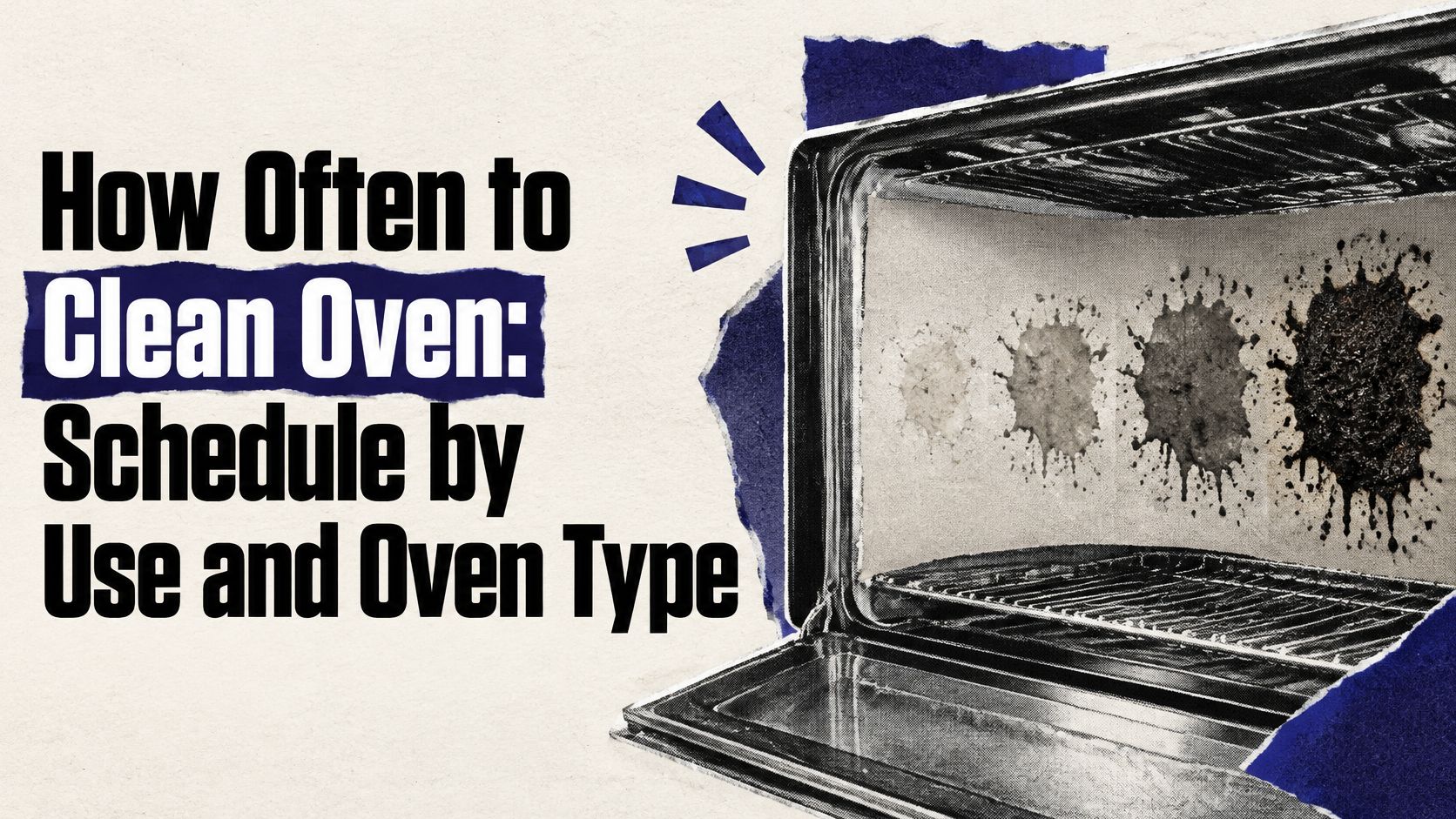
Deep clean most home ovens every 3 to 6 months. Shorten that to monthly if you roast or bake almost daily, wipe fresh spills as soon as the oven cools, and run a self-cleaning cycle only 2 to 3 times a year.
Most households already touch the oven more often than they realize. In a 2024 OnePoll survey commissioned by Whirlpool, 61% of respondents said they cleaned their stove or oven two or fewer times per month (Valdosta Daily Times report on the survey). A monthly wipe is a fine floor for light cooking. It stops being enough once the oven runs several times a week and nobody makes the jump from wiping to deep cleaning.
That jump is the whole task. An oven doesn't get ruined by one messy casserole. It gets ruined by a year of thin grease films that bake into a shell hard enough to need a chisel. Get the interval right, protect it with quick wipes, and the job stays small.
Why Oven Cleaning Frequency Matters
A 2025 survey of 2,000 UK adults, commissioned by SharkNinja and carried out by OnePoll, found that only 10% cleaned their ovens "very often" (SharkNinja cleaning survey). Treat that as a habit gap rather than a character flaw. Without a set schedule, the oven gets attention when it smokes, when something boils over, or when guests are coming.
The problem is that visible mess is a poor trigger. An oven in steady use collects a film of vaporized fat on the cavity walls, the racks and the inner door glass even when no single meal looks dramatic. Every preheat bakes that film a little harder, and the cycle compounds toward a Saturday afternoon of scrubbing.
What delayed cleaning costs you shows up in stages. First the smell: acrid smoke at preheat, stale odors drifting into the roast. Then the performance: uneven browning, longer cook times, a door window that never quite clears. Then the labor, when a job that would have taken twenty minutes takes three hours. A heavy enough grease load on the cavity floor is also a fire risk, which is the reason oven manufacturers care about this at all.
The useful reframe: oven care is a cadence, not a spring-cleaning event. Set an interval, defend it with quick wipes, and the heavy scrubbing never happens.
A schedule matched to how you cook does most of the work here. Pair it with our deep cleaning house checklist for the rest of the kitchen and you'll know when the oven is due without having to think about it.
How Often to Clean Oven
Deep clean a typical home oven every 3 to 6 months, wipe fresh spills once the oven is cool, and move to roughly monthly deep cleaning for heavy use such as weekly fatty roasts. Oven professionals gave Today that same 3 to 6 month baseline in 2023, with the interval tied to how frequently the oven is used.
The table below turns the baseline into rows. Find the row that matches your weekly oven use, take the interval from the third column, and treat the fourth column as the routine that keeps that interval realistic.
| Household profile | Oven use per week | Deep clean every | Between deep cleans |
|---|---|---|---|
| Occasional cook | 1 to 2 times | Every 6 months | Wipe spills once cooled |
| Average household | About 3 times | Every 3 to 6 months | Monthly wipe of door and racks |
| Frequent roaster | 4 to 6 times | Every 1 to 3 months | Check for grease after each roast |
| Heavy-use kitchen | Daily | Monthly | Weekly check of cavity floor and racks |
Reading the table correctly
A household that roasts a chicken on Sunday and reheats leftovers Monday through Thursday is average, not heavy. What pushes you up a row is repeated fat: two roasting pans a week, skin-on chicken, bacon on a sheet tray, pizza at high heat with oil on the stone.
Go down a row when the oven sits cold most of the week. An oven used twice a week for bread and a tray of vegetables can comfortably run to the six month end, provided spills get wiped while they're still soft.
What counts as a deep clean
A deep clean means racks out and soaked, the cavity degreased wall to floor, the inner door glass cleaned, and the heating elements left alone. It takes an afternoon or a professional visit. A quick wipe is a damp cloth over whatever spilled, done once the oven has cooled enough to touch, and it takes two minutes.
Those are different jobs with different rhythms, and confusing them is why ovens get skipped. Any fresh spill gets spot-cleaned once the oven is cool, no matter where you sit on the calendar. If you're unsure how much of the kitchen belongs in the same session, our breakdown of deep cleaning versus regular cleaning draws the line.
Rule of thumb: if a spill would stain a shirt, it will stain the oven floor. Deal with it the same evening.
How Cooking Habits and Households Set Your Row
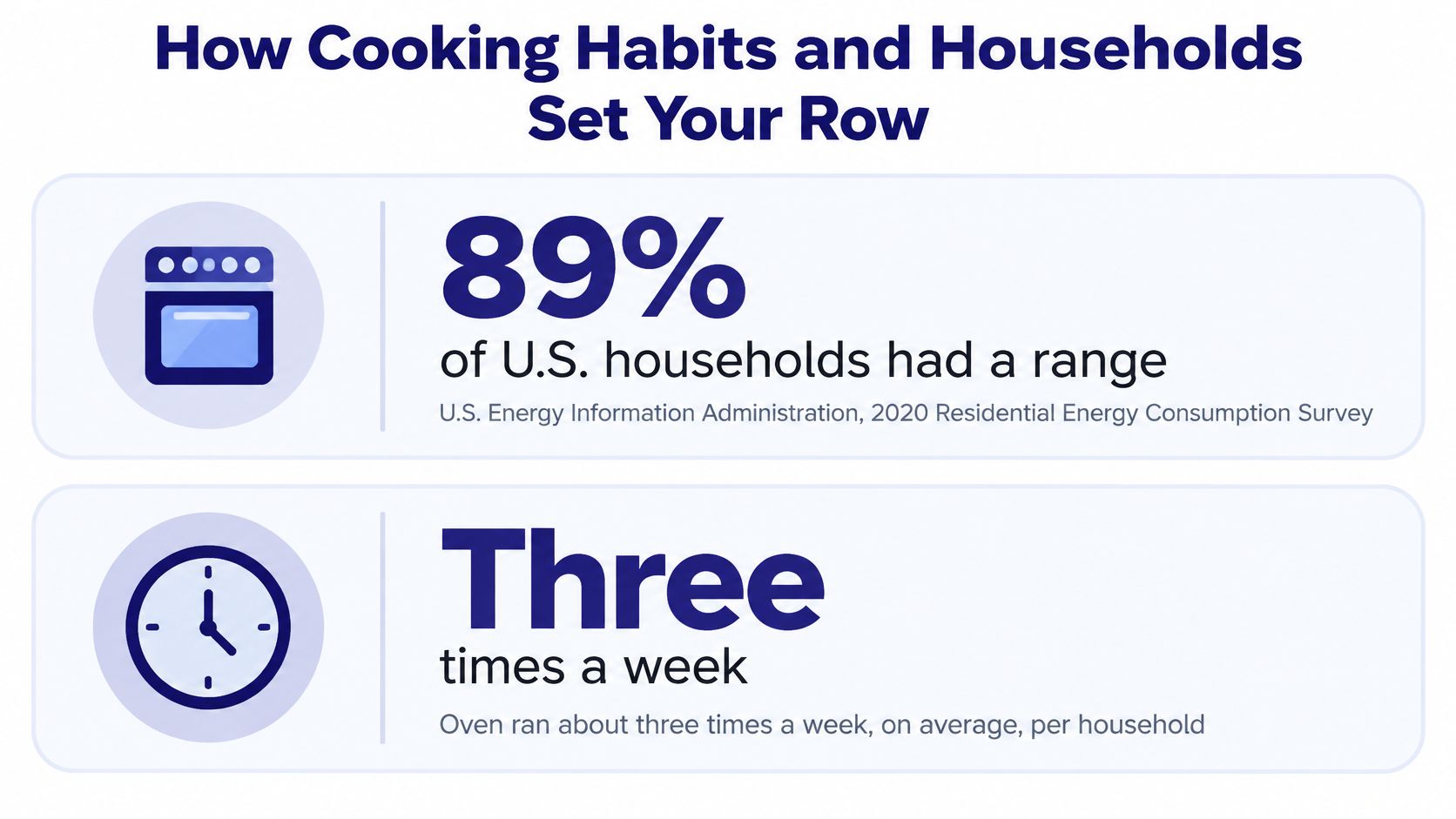
Household oven use clusters tightly, which is what makes a schedule possible at all. The U.S. Energy Information Administration's 2020 Residential Energy Consumption Survey found that 89% of U.S. households had a range combining a cooktop and oven, and among those homes the cooktop ran an average of eight times a week while the oven ran about three times a week, roughly 156 oven-use occasions a year (EIA Today in Energy).
That is 156 chances for a splatter, a drip or a plume of grease vapor to land on a surface that will be heated again tomorrow.
The same session count can mean very different soil loads. Two homes can both run the oven three times a week and still need different intervals, because a covered Dutch oven releases almost nothing while a tray of chicken thighs at 425°F coats the whole cavity. Oven grime works like coats of paint: one thin layer wipes away, but layer after layer bakes into a shell that takes real effort to remove.
What moves a household up a row
- What you cook: fatty roasts, skin-on poultry, sugary pies that bubble over the rim and cheese-heavy casseroles all leave far more residue than covered pots or steamed vegetables.
- How often you bake: regular bread and pastry work means flour dust, butter and sugar on the floor of the oven, which carbonizes into a hard brown glaze.
- Household size: feeding five from one oven means more trays, more racks in play and more spillovers than feeding two.
- Spill habits: a household that wipes while the oven is still warm at the edges stays on a longer interval than one that lets residue set overnight.
- Holiday cooking: late November and December push almost everyone up a row, which is why an extra clean in January earns its keep.
Three households, three rows
The Sunday roaster. A couple cooks a chicken most Sundays and bakes cookies a few times a month, so most sessions deposit fat. They wipe the cavity and door glass after each roast and book a deep clean every one to three months, timed for the weekend after a big dinner.
The family of five. Baked pasta on Tuesday, frozen snacks on Thursday, pizza on Friday, pancakes and brownies at the weekend. Four or five uses a week with a steady grease load puts them between the frequent-roaster and heavy-use rows, so a monthly deep clean anchored to the first Saturday of the month keeps pace. The oven never looks bad enough to feel urgent, which is exactly why the reminder does the deciding.
The occasional baker. Bread on Sunday, pizza once a fortnight, cold the rest of the week. Twice a year is plenty, with a wipe after every bake so the deep clean stays a half-hour job rather than an entire afternoon.
One household tip that saves arguments: put the reminder on a repeating calendar event with a note about what to buy, so nobody has to renegotiate the job each time it appears.
If you'd rather watch the sequence than read it, this walkthrough runs through a full manual clean from rack removal to the final wipe.
Cleaning Frequency by Oven Type
The calendar holds across oven types. What changes is who does the work and how much heat is involved. Consumer Reports, citing appliance-industry experts, calls a thorough clean every 3 to 6 months a general best practice and recommends more frequent deep cleaning when an oven is used often or carries substantial grease, noting that households which regularly roast fatty meats may need to clean about once a month (Consumer Reports).
Self-cleaning models follow a different clock. GE's appliance guidance, reported in the same source, finds that most owners run a self-clean cycle two or three times per year and describes that as adequate for typical soils and spills. GE also cautions that very frequent self-cleaning, more than once monthly, could add wear on components and controls. So even a heavy-use kitchen should stay at or below monthly on the self-clean setting.
| Oven type | How often | Method notes |
|---|---|---|
| Standard manual-clean oven | Deep clean every 3 to 6 months, monthly with heavy use | Baking-soda paste or oven cleaner with racks removed |
| Self-cleaning oven | Run self-clean 2 to 3 times a year, never more than once a month | Wipe out ash with a damp cloth after each cycle |
| Continuous-clean (catalytic) oven | Wipe spills promptly, no fixed deep-clean cycle | Soft cloth and warm water only to protect the lining |
What each type actually asks of you
A manual-clean oven is the most forgiving and the most work. Racks come out and soak in the tub with a couple of dishwasher pods, a baking-soda paste goes on the walls and floor while they soak, and the whole thing wipes down a couple of hours later. Keep scouring pads for the racks only, since abrasives dull the enamel inside the cavity.
A self-cleaning oven burns residue to ash at extreme heat, and the ash wipes out with a damp cloth once the oven has cooled. Between cycles, treat it like any other oven: wipe fresh spills, don't let grease layer up, and skip the cycle entirely if the cavity is already clean.
Continuous-clean linings break residue down slowly during normal cooking. They don't want abrasives or heavy chemical cleaners, which damage the porous surface and leave it less able to do its job. Warm water and a soft cloth are the whole toolkit.
Safety rules that apply to every oven type
- Ventilate before a self-clean cycle: open windows, run the hood fan, and keep children and pets out of the kitchen while the cycle runs.
- Take the racks out if your manual says to, because high heat can warp them and damage the sliding rails.
- Never combine chemical oven cleaner with a self-clean cycle, before or after, since the residue burns off into fumes you don't want in the house.
- Follow the manufacturer's instructions for your model. Cleaning chemicals and self-clean settings aren't interchangeable across brands, and the manual is the only document that describes yours.
Signs Your Oven Is Due for a Clean
Say you preheat the oven on a Tuesday evening and a thin haze of smoke curls out before the food goes in. The reminder on your phone says the next clean is two months away. The reminder is wrong.
An overdue oven tells you so, usually well before the calendar catches up. Run this check any evening, in about two minutes: open the door, look at the cavity floor and the inner glass, and pay attention at the next preheat.
| Sign | What it means | What to do |
|---|---|---|
| Smoke or burning smell when preheating | Grease or charred food burning off | Deep clean before the next use |
| Black flakes or greasy film on cavity walls or floor | Carbonized buildup from repeated cooking | Schedule a deep clean |
| Uneven browning or longer cook times | Heavy residue interfering with heat circulation | Clean the cavity and racks |
| Lingering off-odor while cooking | Old spills rewarming and releasing smoke | Spot-clean the affected area once cooled |
| Door glass stays greasy or fogged | Baked-on film on the inner glass | Degrease the glass; call a pro if residue sits between panes |
The signs beat the calendar because they respond to what happened. One casserole that bubbled over two weeks ago can put an oven out of spec months before its scheduled clean. A household that wipes diligently can stretch comfortably to the long end of its interval, because the surface it's stretching was never allowed to build.
There's a limit to what a cloth fixes, of course. Residue trapped between the panes of a door glass usually means the panel has to come apart, and that's a job for someone who has done it before or for the manufacturer's guidance.
If you can see a sign, you have a job. The date on the reminder is a backstop, not a permission slip.
Treat any row in that table as an immediate trigger. Months of runway don't matter when the oven is smoking.
Set Your Oven Cleaning Schedule
Three decisions, then the calendar runs itself.
1. Pick your row. Match weekly oven use to the frequency table, then adjust one step for cooking style. A kitchen running about three oven sessions a week, roughly 156 sessions a year, sits in a different row than one that bakes twice a month. Weekly roasts push you up; a mostly cold oven lets you slide down.
2. Put the deep clean on a repeating reminder. Choose a date you'll keep, such as the first Saturday of the month for heavy users or the start of a season for light ones. Wiping spills once the oven cools is what protects that interval.
3. Run the two-minute sign check monthly. Smoke at preheat, flakes on the floor, a fogged window or uneven browning all override the schedule and pull the next clean forward.
Some jobs are worth handing over. Heavy carbonized buildup across the cavity floor and door glass takes hours and strong chemicals, and a hot self-clean cycle in a Florida summer is a hard sell when it's already 95°F outside. A move-out inspection or a packed work month does the same thing to good intentions. A professional visit clears it in one appointment: our Seasonal Deep Clean Bundle includes deep kitchen sanitization with the inside of the oven, plus refrigerator degreasing, baseboards, switchplates and bathroom grout work. Deep Cleaning, which starts at $490, is built for a home that hasn't been professionally cleaned in one to two months, and it's the service we recommend for a first visit. The appointment just needs running hot water, working electricity and a climate-controlled house on the day. You can put the whole schedule on paper with our house cleaning planner and keep the oven on the same rhythm as everything else.
Pick your interval. Set the reminder. Wipe the spill tonight, while it's still soft.
---
J&M Cleaning Team handles the oven deep clean when buildup has gone past what a cloth and a Saturday can fix, along with the kitchen, bathrooms and living areas on the same visit. We serve Orlando and the surrounding Central Florida area with bonded, insured, background-checked technicians using family-safe supplies, and you can get an exact flat-rate quote online in about a minute. Visit J&M Cleaning Team to book your first clean and put the whole house on a schedule that holds.