
A studio move-in clean usually runs $150 to $250, a four-bedroom home $500 to $750, and larger homes in difficult condition can exceed $900. These are reported benchmarks rather than fixed prices, so use them to plan a budget, not to assume what a particular provider includes.
The more consequential figure for a rental owner may be the estimated $1,795 per month for each vacant unit, including lost rent, marketing, cleaning, and repairs, reported by Baselane. A cheaper cleaning appointment isn't necessarily the cheaper turnover if unfinished work holds up the handover.
For homeowners and renters, the same principle applies without the rent calculation: paying less doesn't help if you're wiping cabinet shelves after the moving truck arrives. Compare the scope first, then the completion commitment, then the price.
Typical Move In Cleaning Rates by Home Size
Typical move-in cleaning cost by home size
| Home size | Typical cost range | Main reason the price changes |
|---|---|---|
| Studio | $150–$250 | Light scope in a vacant unit |
| Four-bedroom home | $500–$750 | More rooms, bathrooms, and appliance interiors |
| Large home in difficult condition | Over $900 | Heavy soiling and extended labor time |
These turnover-cleaning benchmarks are a budgeting map, not a local price list. They don't establish that every studio qualifies for the lower band or that every large home needs extensive restoration. A published flat rate is a provider's price for a defined checklist under stated conditions.
An empty studio with accessible shelves and maintained fixtures presents a different job from a small apartment with greasy cabinets and a neglected shower. Conversely, a larger, well-maintained home can have straightforward bedroom work while its kitchen and bathrooms account for most of the detailed cleaning.
What home size tells the estimator
Bedroom count helps describe the amount of flooring, closet space, trim, and reachable surfaces. Bathroom count adds a different kind of work: fixtures, shower glass, toilet bases, tile edges, and buildup that doesn't come off with ordinary dusting.
That distinction matters when comparing move in cleaning rates. Floor area describes how much space exists, but it doesn't describe how much agitation, rinsing, drying, or interior detail the cleaner must perform.
Vacancy also needs a precise meaning. A home with empty rooms but full kitchen drawers isn't ready for the same workflow as a completely cleared property. Tell the estimator whether cupboards, closets, and appliances will be accessible when the appointment begins.
Budgeting rule: Match the condition of the home to the promised tasks before deciding whether a quote looks high or low.
Turnover work reaches places that routine service commonly leaves alone, including cabinet interiors, closets, appliance interiors, baseboards, and fixture details. Don't assume that the phrase move-in cleaning automatically includes every one of those surfaces.
Find the home-size row that fits your property, then identify whether the condition is light, maintained, or heavily soiled. Use those together as a reasonableness check, while treating the written scope as the actual offer.
How Cleaner Hours Build the Price
Total cleaner-hours, rather than square footage alone, provide the useful operational starting point. HireAHelper's move-out cleaning cost guide places typical move-out labor at approximately 4–8 cleaner-hours, says a bedroom generally adds about 1–2 hours, and reports cost bands of $150–$250 for a studio, $500–$750 for a four-bedroom home, and over $900 for larger homes in difficult condition.
The workflow below shows how labor assumptions become a price.
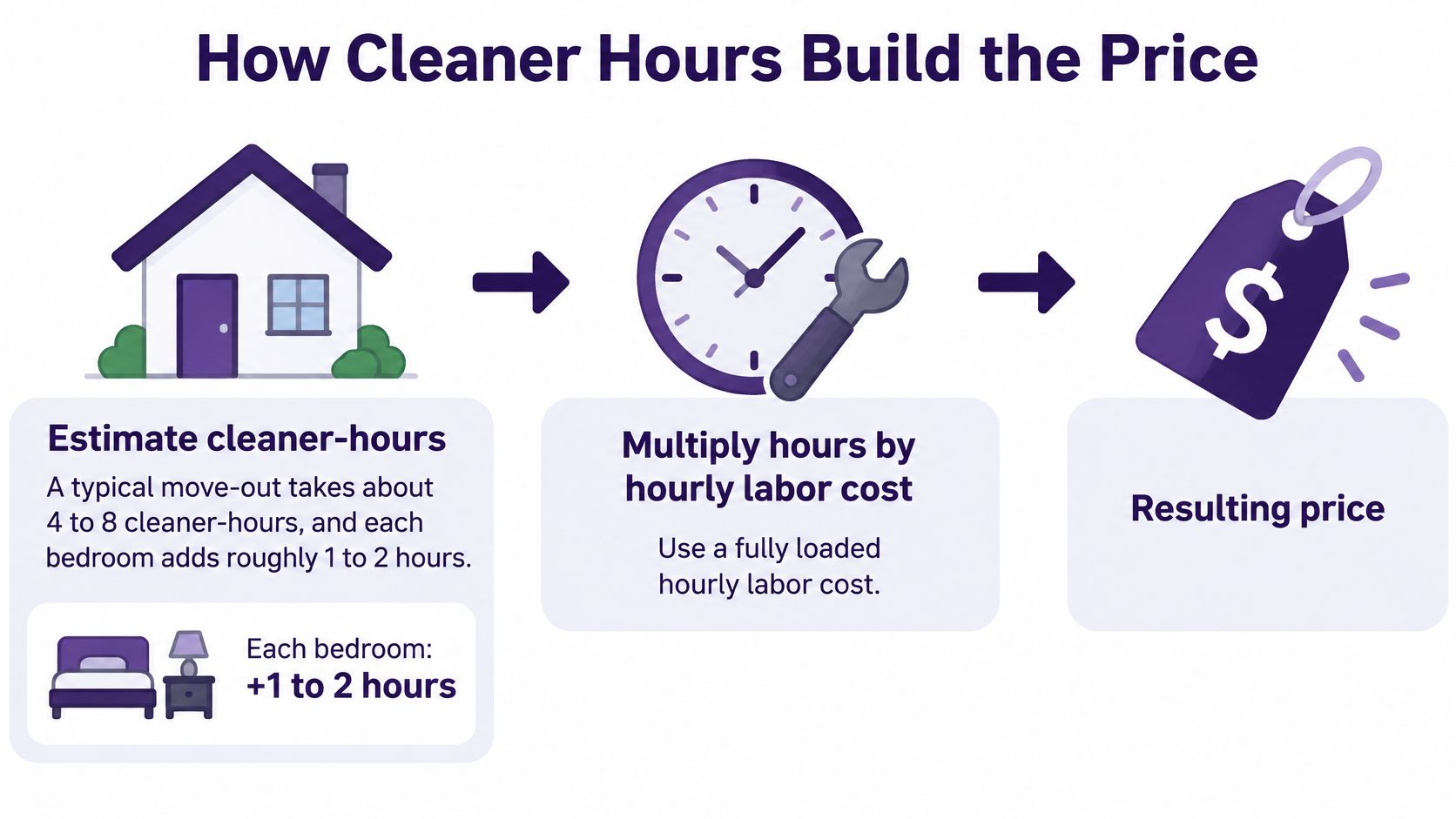
1. Estimate the work in cleaner-hours. List rooms, surfaces, interiors, and access restrictions. Cleaner-hours measure combined labor, not necessarily the time between arrival and departure.
2. Apply a fully loaded labor cost. Wages alone don't cover delivering the appointment. Payroll costs, insurance, supervision, equipment, and administration also need to be covered without double-counting expenses elsewhere.
3. Allow for supplies, travel, and uncertainty. These belong in the internal estimate even when the customer receives a single fixed total. A flat rate doesn't mean the business has no underlying cost calculation.
4. Document condition adjustments. Grease, pet residue, mineral deposits, belongings, and renovation dust change the required method and pace. Identify them before assigning the appointment window.
5. Present the fixed rate with its boundaries. Name what's included, what remains outside the job, and what would require authorization to change.
Why floor area can't do the whole job
Two homes with identical floor plans can require very different labor. One may have cleared shelves and maintained appliances; the other may need cabinets emptied, oven residue removed, and repeated bathroom scrubbing.
Don't automatically add a bedroom allowance to a whole-home estimate that already includes those bedrooms. The estimating method must say what its starting hours cover, or the calculation can count the same work twice.
This accompanying video provides another format for considering the cleaning-price calculation.
A fair quote identifies bedrooms, bathrooms, required interiors, and condition adjustments. Oven, refrigerator, window, and post-construction tasks should be explicitly included or separately priced, not left to interpretation.
Worked Example for a Two-Bedroom Home
Consider a hypothetical two-bedroom, two-bathroom apartment that's vacant, has maintained surfaces, and needs no special condition treatment. The useful question isn't what a two-bedroom clean costs. It's what work the provider has allowed for.
Start with a room-by-room labor worksheet. The kitchen needs accessible surface cleaning and whatever interiors are agreed; the bathrooms need fixture and floor detail; the bedrooms need closets, trim, and flooring addressed. The estimate must also allow for setup, equipment movement, and the final inspection.
A complete estimate without a made-up hourly rate
| Estimate component | How to build it |
|---|---|
| Base work | Identify whether the starting allowance covers the whole apartment or only shared spaces |
| Bedrooms | Add room labor only if it isn't already included |
| Bathrooms | Account for fixtures, shower condition, and requested detail |
| Labor subtotal | Multiply estimated cleaner-hours by the provider's internal labor cost |
| Other costs | Allow for supplies, travel, and contingency without counting them twice |
| Customer price | Present the fixed total alongside the agreed scope |
This produces a complete estimating method without inventing a local hourly charge. A provider may keep its internal cost structure private, but the customer still needs an intelligible explanation of the tasks and assumptions behind the total.
A whole-home labor estimate and a base-plus-bedrooms estimate are different methods. Don't combine them unless the starting allowance explicitly excludes bedroom work.
Now change the scenario: furniture remains, the range hood is greasy, and pet residue affects the living area. The estimator should revise the affected tasks, not merely attach an unexplained premium to the apartment's room count.
The vacant, maintained apartment should require less work than its obstructed, heavily soiled counterpart. But a quote outside an illustrative labor allowance isn't automatically unfair. Check whether it includes appliance interiors, difficult bathroom work, restricted access, or another clearly identified requirement before rejecting it.
Condition Factors That Raise the Quote
Conditions that change move-in cleaning labor
| Condition | Why it adds labor | Scope detail to share |
|---|---|---|
| Grease on range hood and cabinets | Long dwell time and repeated scrubbing | Photos of kitchen surfaces |
| Pet residue or heavy pet hair | Extra vacuuming, odor treatment, and rework | Number of pets and affected rooms |
| Hard-water scale in showers | Targeted descaling or scrub passes on fixtures | Bathroom count and fixture list |
| Construction dust or debris | Fine particulates, rinsing, and another pass | Whether the job is post-construction cleaning |
| Abandoned belongings | Removal time before cleaning starts | Whether the home will be vacant at the appointment |
| Fixed handover deadline | Limited opportunity for a correction visit | Access times and fallback date |
Buildup changes the method
Kitchen grease needs a surface-compatible degreaser, adequate dwell time, and controlled agitation. Scrubbing harder with an aggressive pad isn't a substitute for the right chemistry, especially on painted cabinets and coated appliance surfaces.
Pet hair requires attention to edges, corners, and places where airflow collects loose material. Odor treatment needs a separate discussion: removing surface residue doesn't necessarily resolve contamination in carpet backing, underlay, or another inaccessible material.
Hard-water deposits call for a suitable descaler and careful surface identification. Acidic products can damage natural stone and some finishes, so a cleaner must distinguish removable scale from etching or permanent damage before promising a result.
Obstructions and dust change the sequence
Construction residue isn't ordinary household dust. Fine particles need controlled removal, such as appropriate HEPA vacuuming followed by damp microfiber wiping, rather than dry sweeping that redistributes them. Active construction should be finished before final cleaning, or subsequent trades may undo the work.
Belongings create a different obstacle. A cleaner can't wash a drawer that's packed with utensils or reach a baseboard behind stacked boxes. Removal and disposal aren't automatically part of cleaning, and furniture movement needs an agreed boundary.
Scheduling pressure changes the recovery options more than the dirt itself. A fixed key handover doesn't make the shower harder to scrub, but it leaves less room to correct an overlooked task. Confirm the actual completion deadline rather than assuming an arrival window guarantees readiness.
At J&M Cleaning Team, heavy buildup, extensive pet hair, or undisclosed biohazards may require additional labor and an adjusted flat rate, with prior customer authorization. That makes honest condition reporting important before scheduling.
Photograph the worst areas, not just the neat rooms. Send wide views for context and close-ups of the affected surfaces; the resulting quote should name the condition, the area, and the adjustment instead of adding an unexplained surcharge at the door.
Compare Flat-Rate Quotes and Book With Confidence
A flat rate is valuable only when its scope is as transparent as its price. A lower total may describe fewer interiors, less detailed floor work, or no opportunity to address omissions after the walk-through.
Use the same comparison sheet for every offer. This visual summarizes the principle.

Compare tasks before totals
Mark each item included, excluded, or unclear for every quote. An unclear item isn't an inclusion.
- Rooms and fixtures: Confirm the bedroom and bathroom count, closets, shower glass, and accessible fixture detail.
- Cabinets and drawers: Distinguish interiors from fronts and handles.
- Appliances: Name the oven, refrigerator, and dishwasher individually, including whether interiors are covered.
- Windows: Separate interior panes from sills and tracks.
- Walls and trim: Identify baseboards and wall-mark treatment, without assuming cleaning can repair damaged paint.
- Debris and dust: Specify who removes belongings and whether renovation residue requires a post-construction service.
- Completion terms: Record the correction-visit policy, exclusions, and any guarantee.
- Access and add-ons: Confirm selected extras, arrival assumptions, parking, and key handling.
Only compare final totals once the task lists match. A broad description such as deep clean throughout doesn't resolve whether the cleaner will open the refrigerator or wipe the inside of a pantry.
Our guide to cleaning service estimates can help organize the information you submit. Send the same room counts, vacancy details, photos, handover date, and access instructions to each estimator so the comparison starts from the same property description.
Understand the service and the promise
J&M Cleaning Team's Move In/Out Cleaning starts at $630 as a one-time cleaning; the exact flat rate depends on square footage, bedroom and bathroom count, and optional add-ons selected before booking. Our separate Move-In VIP Package includes a top-to-bottom vacant-home scrub, kitchen and bathroom cabinet and drawer interiors, interior window panes, sills and tracks, major appliance interiors, and heavy-duty floor scrubbing with wall-scuff treatment. That package carries a turnover guarantee described as getting the full deposit back or welcoming the customer into a sterile home; review its terms before relying on the promise, and don't treat the wording as independent proof of a medically sterile environment or a landlord's deposit decision.
Guarantees need the same scrutiny as task lists. Establish how completion is checked, how an omission is reported, and what remedy applies. Don't assume every offer from the same business carries identical inclusions or conditions.
There's also a separate legal distinction between paying for cleaning and charging that expense to a departing tenant. California security-deposit guidance explains that cleaning deductions generally must be reasonably necessary to restore move-in cleanliness, while ordinary wear and tear isn't chargeable to the tenant; that's California-specific guidance, not a statement of Florida law.
Booking test: Every required task should be named, and every exclusion should be acceptable before you commit.
Request a revised scope when a condition or required interior is missing. Don't select the lowest figure and hope the crew will interpret an incomplete checklist generously.
Documentation and Deposit Rules for Renters
A cleaning invoice proves an expense, not automatically a valid security-deposit deduction. Whether a landlord can recover that expense depends on the applicable rules and the circumstances, not only on whether a professional performed the work.
For an Orlando rental, don't apply another state's deposit rules because they appeared in an online cleaning guide. Use your lease, condition records, and Florida-specific guidance when evaluating a disputed charge. A cleaning company's service guarantee doesn't replace those requirements.
Keep the budgets separate
- Tenant-paid preparation: Clearing belongings, removing rubbish, and arranging any cleaning the tenant chooses or is required to complete.
- Landlord turnover work: Cleaning the landlord arranges as part of preparing the property for its next occupant.
- Optional upgrades: Additional interior or detail work that needs its own agreed scope rather than an assumption about who pays.
These categories organize the discussion; they don't decide legal responsibility. The parties still need to distinguish cleaning from repairs and from the condition already recorded at move-in.
A low quote can become expensive if it leaves no useful record of what was completed. A receipt saying only cleaning service is harder to match to a contested oven, shower, or cabinet than an itemized scope with dated photographs.
Build the handover record
Photograph every room at handover, including the interiors covered by the appointment. Capture wider room views and close-ups of disputed areas, and keep the original files rather than relying only on compressed message attachments.
Agree the tasks in writing and retain an itemized invoice showing the service date. Separate cleaning from repairs and damage-related work so a broken fixture doesn't disappear into a general cleaning charge.
Use the Orlando move-out cleaning guide to organize the practical handover tasks, then compare them with your own condition records. A freshly cleaned surface doesn't erase evidence of an existing scratch or damaged finish.
If a deduction is disputed, request the itemized invoice and the move-in and move-out photographs. Compare the claimed work with the written scope and starting condition, then check the state's deposit rules before paying or contesting the charge.
Turnover Cost Math for Property Managers and Agents
For property managers and agents, the cleaning invoice is only part of the decision. The operational question is whether the unit will be ready for inspection, photography, and occupancy when those activities are scheduled.
The portfolio analysis published by Multifamily Insiders reports average base cleaning charges of approximately $148 for a studio or one-bedroom, $174 for a two-bedroom, and $218 for a three-bedroom-or-larger unit; in that dataset, 6.0% of 1,351 turns received an up-charge averaging about $105.
Those are multifamily turnover benchmarks, not retail quotes for a homeowner's customized appointment. Use them to understand the portfolio's operating context, not to demand an identical price for a different checklist, purchasing arrangement, or property condition.
Buy completion reliability
A missed refrigerator interior can hold up an inspection. An inspection delay can postpone photographs, and an unavailable correction crew can interfere with occupancy. The original omission may be small, but several people may need to change their schedules to resolve it.
Build the handoff around named responsibilities:
1. Confirm access and handover times. Ensure the cleaner can enter and that the property is released for cleaning.
2. Record pre-existing damage. Keep maintenance items separate from cleaning deficiencies during the walk-through.
3. Photograph exceptions promptly. Send actionable images and identify the room and surface.
4. Plan correction capacity. When handover timing is critical, establish whether a return visit can fit before occupancy.
An apartment turnover cleaning checklist gives maintenance, cleaning, and leasing staff a shared completion standard. Assign someone to accept the work rather than leaving approval scattered across messages.
Compare the premium with avoidable vacancy
Divide a quote's additional cost by the vacancy days that better scheduling could realistically save. Compare that amount with the property's actual daily vacancy exposure, using your own rent and carrying costs.
Don't credit a cleaner with days that depend on unfinished repairs or an unsigned lease. The stronger offer is the one that removes a genuine cleaning bottleneck, not merely the one that promises the fastest appointment.
---
J&M Cleaning Team offers customized move-in and move-out cleaning for homes that need to be ready for new owners or tenants in Orlando and nearby Central Florida communities. Visit J&M Cleaning Team with your room counts, condition photos, required interiors, and handover date to get a flat-rate quote for the work your property needs.