Eighty percent of surveyed U.S. adults planned to spring clean in 2024, and 45% said the process takes three or more days, according to a Wakefield Research survey published by the American Cleaning Institute. That split is the useful frame for deep cleaning vs regular cleaning. A periodic reset is a project. A maintenance visit is a habit. Treating them as rivals pushes households toward the wrong scope, the wrong chemical load, and the wrong yearly bill.
The practical question is a threshold. Has soil stayed on the surfaces you see every day, or has it moved into grout, appliance interiors, and trim? A deeper session isn't automatically the healthier one, because a heavier product load can raise indoor chemical levels for a while. Match the clean to the gap, the soil, and who lives in the home.
Deep Cleaning vs Regular Cleaning at a Glance
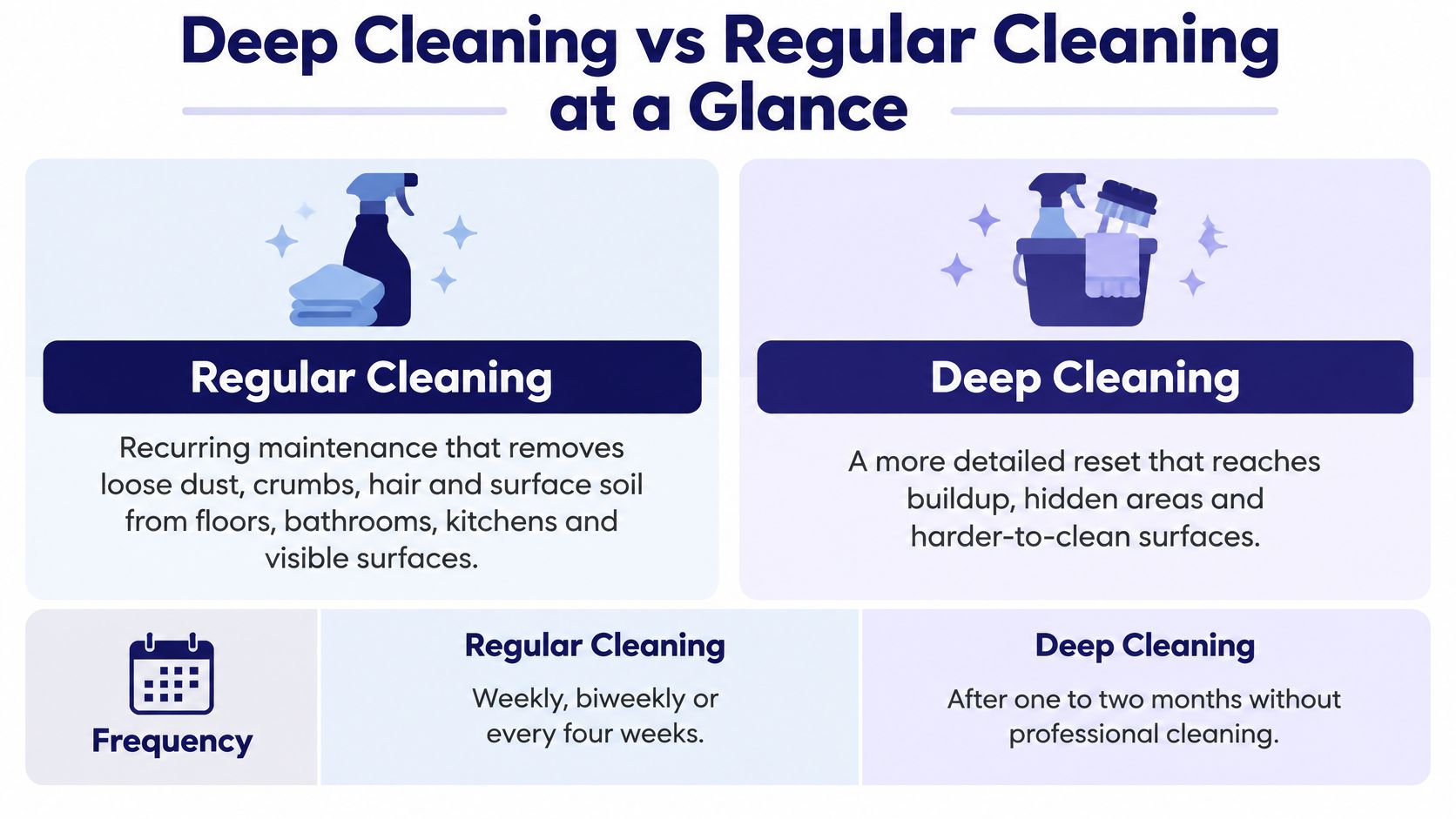
Regular cleaning is recurring maintenance that removes loose dust, crumbs, hair, and surface soil from floors, bathrooms, kitchens, and visible surfaces. Deep cleaning is a periodic reset for accumulated build-up and neglected zones. They differ in frequency, scope, and soil-removal intensity, not in a separate chemical category.
CDC home-hygiene guidance treats doorknobs, light switches, countertops, handles, toilets, faucets, sinks, tables, phones, and keyboards as routine priorities. That is the maintenance job. Schedule it before visible soil becomes entrenched. Use a reset when build-up has migrated into baseboards, fixture edges, grout lines, door frames, reachable vents, under or behind accessible furniture, or interior appliance surfaces, or when a home has gone about one to two months without professional service.
Standard Cleaning is the same recurring service. It is meant for routine upkeep once deep build-up has been removed, so the two work as a sequence. A first pass restores the baseline. Later visits protect it.
| Factor | Regular Cleaning | Deep Cleaning |
|---|---|---|
| Purpose | Ongoing maintenance of floors, bathrooms, kitchens and visible surfaces | Periodic reset of build-up and neglected areas |
| Typical interval | Weekly, biweekly or every 4 weeks | After 1-2 months without professional service, or on a first visit |
| Booking | Recurring plan that begins with a starter clean | One-time service |
| Best for | Keeping a home at a steady baseline | Resetting a neglected home or preparing a property for handover |
Maintenance versus restoration
A weekly or four-week visit that only chases crumbs will not degrease an oven. A full reset every month, when the counters were already fine, spends money and product on soil that isn't there. Recurring plans at our company begin with a starter clean, then shift to general maintenance of living areas. One-time options sit beside that plan: Standard, Deep, Move In/Out, and Post-Construction.
Find your home's current condition in the table. If the baseline is already acceptable, the recurring column is the fit. If the last professional visit is a memory, the reset column is the fit. The next section shows what each line includes, room by room.
What Each Clean Covers Room by Room
In the American Cleaning Institute's 2023 survey of 1,000 U.S. adults, 74% said someone in the household spring-cleaned at least once a year. Among those who did, the most reported tasks were washing windows (75%), cleaning behind furniture (74%), cleaning appliances (71%), washing bedclothes or linens (70%), and scrubbing floors (69%). The same survey put fabrics or upholstery at 55%, curtains at 52%, and garages at 52%.
Those shares describe a maintenance threshold, not a rivalry between two services. Routine work stays on the floor you walk on. Periodic work reaches windows, the gap behind a sofa, and the appliance cavity. Fabric, curtains, and garages sit past the rooms tidied for guests.
Standard Cleaning is that baseline: dusting baseboards and ceiling fans, vacuuming carpets, mopping hard floors, cleaning mirrors and glass, sanitizing countertops and sink basins, and wiping the exterior of appliances. A return visit, weekly, biweekly, or every four weeks, repeats vacuuming, mopping, dusting, bathroom sanitization, kitchen cleaning, and general tidying of living areas. The pass covers floors, bathrooms, the kitchen, and visible surfaces. It does not open every crevice.
Deep Cleaning covers living spaces, the kitchen, bathrooms, and bedrooms, and the full checklist is customized to the home. The Seasonal Deep Clean Bundle is the periodic layer: top-to-bottom dusting and vacuuming, kitchen sanitization including the oven interior, an interior refrigerator scrub and degreasing, detailed baseboards, switchplates and door frames, and a complete bathroom grout scrub and descaling. Specialists arrive with professional-grade products, microfiber cloths, HEPA vacuums, and specialized tools. Microfiber lifts film that a dry rag smears. A sealed HEPA vacuum matters when the soil is fine dust rather than crumbs.
A deeper clean is not automatically healthier. Heavier product use on neglected surfaces can temporarily raise indoor chemical levels while it removes the soil those products target.
Where the extra work sits
| Area | Regular Cleaning | Deep Cleaning |
|---|---|---|
| Living areas | Dusting of baseboards and ceiling fans, vacuuming, mopping, mirrors and glass, general tidying | Top-to-bottom dusting and detailed baseboard work on the customized checklist |
| Kitchen | Countertops, sink basins, appliance exteriors | Oven interior plus refrigerator interior scrub and degreasing |
| Bathrooms | Sanitization of fixtures and visible surfaces | Grout scrub and descaling |
| Bedrooms | Dusting and vacuuming of sleeping areas | Sleeping areas included when the deep checklist is set to the home |
| Doors and trim | Not on the routine list | Door frames, detailed baseboards, and switchplates |
| Windows | Visible glass already on the standard pass | Not a default line; included only if the customized checklist calls for it |
A routine kitchen stop covers counters, the sink basin, and appliance exteriors. The reset opens the oven cavity and degreases the refrigerator interior. Bathrooms split the same way: fixtures and visible surfaces on the routine visit, grout and scale on the reset. Switchplates and door frames stay on the deep list. Ceiling fans, mirrors, and ordinary baseboard dusting do not, because Standard Cleaning already includes them.
If the shower is the only failure point, how to deep clean a bathroom shows what a grout and fixture pass covers before a whole-home reset is the right scope.
How Often Each Clean Fits Your Home
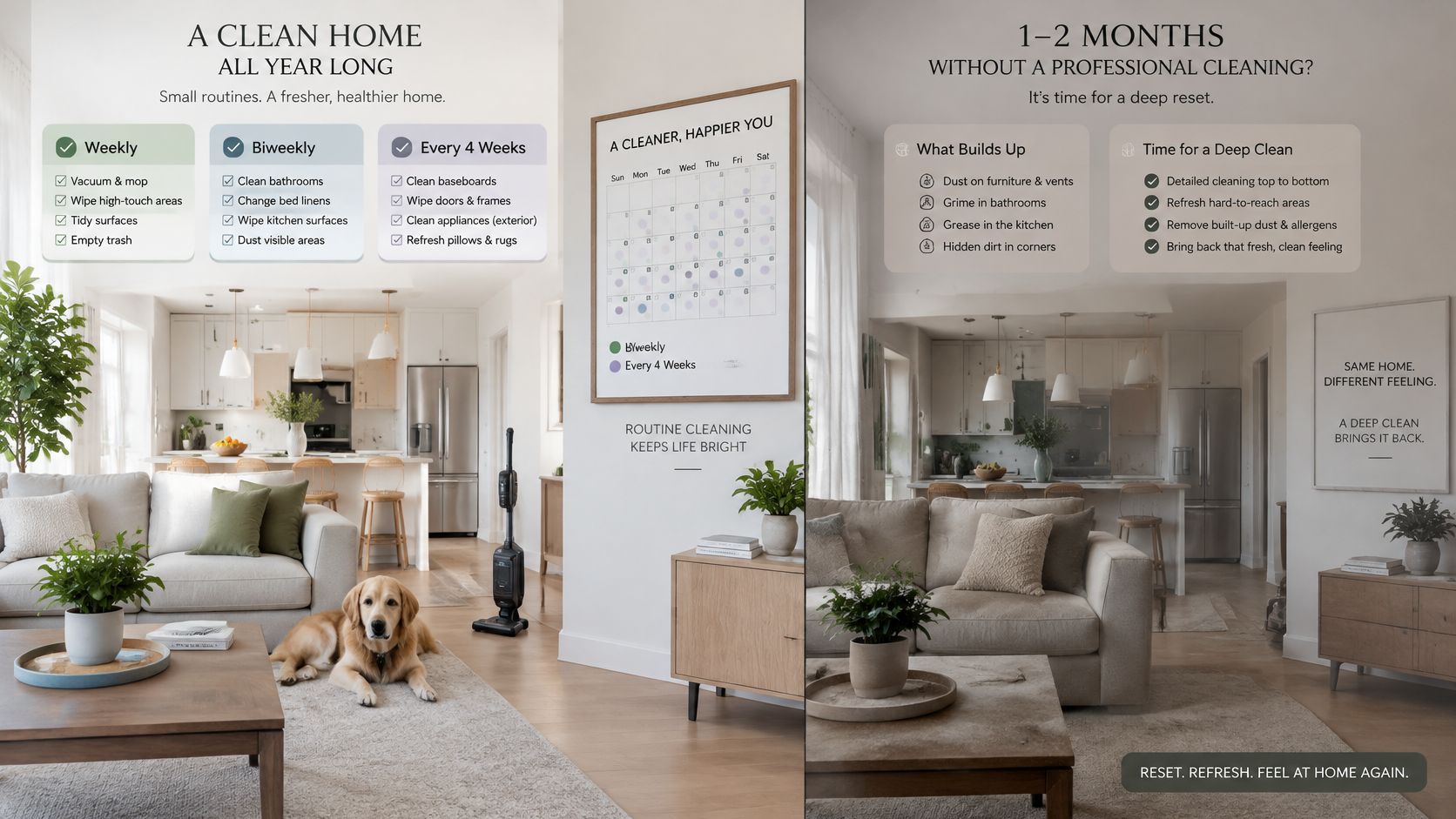
Most homes need regular cleaning on a weekly, biweekly, or every-four-weeks cadence, and a deep reset only for a first visit, a move-in or sale, a gap of more than 30 days, or a home that hasn't been cleaned for one to two months.
Use one self-check. If visible build-up returns within a week of a visit, the cadence is too long. If surfaces still look acceptable at the end of the interval, the cadence fits.
- Weekly: Busy households, pets, heavy foot traffic, or clutter that reappears before the next weekend.
- Biweekly: Moderate use, where kitchens and baths stay acceptable for about two weeks.
- Every four weeks: Low traffic, where floors and fixtures don't slide between monthly visits.
Recurring maid service starts with a starter clean, then maintains living areas on the cadence you picked. A first visit, or a home not professionally cleaned in over 30 days, gets the deep reset before that rhythm starts. A move-in or a sale needs a readiness pass, not a light tidy the night before keys change hands. Deep Cleaning is built for a thorough job on a home left for one to two months, and it is the option we book first in those cases.
Hours at home don't equal coverage
A March 2018 American Cleaning Institute survey of 1,000 adults found respondents spent approximately 6 hours per week cleaning. Yet 74% said light cleaning was what they did most often, and only 26% said deep cleaning was their most frequent pattern. In that same survey, 34% worried they weren't cleaning enough and 31% questioned whether they were cleaning correctly.
Six hours of wiping the same counters can still miss grout and the oven. Frequency isn't coverage. Match the interval to how fast soil returns, not to a habit you copied from a neighbor.
The short video below walks through how a maintenance rhythm and a reset sit on the same calendar instead of competing for it.
What Each Option Adds Up To
Price is easier to judge as a year, not a single invoice. These figures are starting-rate calculations. Recurring visits change with home size and bathroom count. The flat rate for Deep Cleaning and Move In/Out Cleaning depends on square footage, bedroom and bathroom count, and any add-ons selected before booking. The final flat rate comes from home size and bathroom count, with no surprise travel fees.
| Option | Starting Price | Billing | Cost at Starting Rate |
|---|---|---|---|
| Standard Cleaning | $350 | One-time | $350 per visit |
| Deep Cleaning | $490 | One-time | $490 per reset |
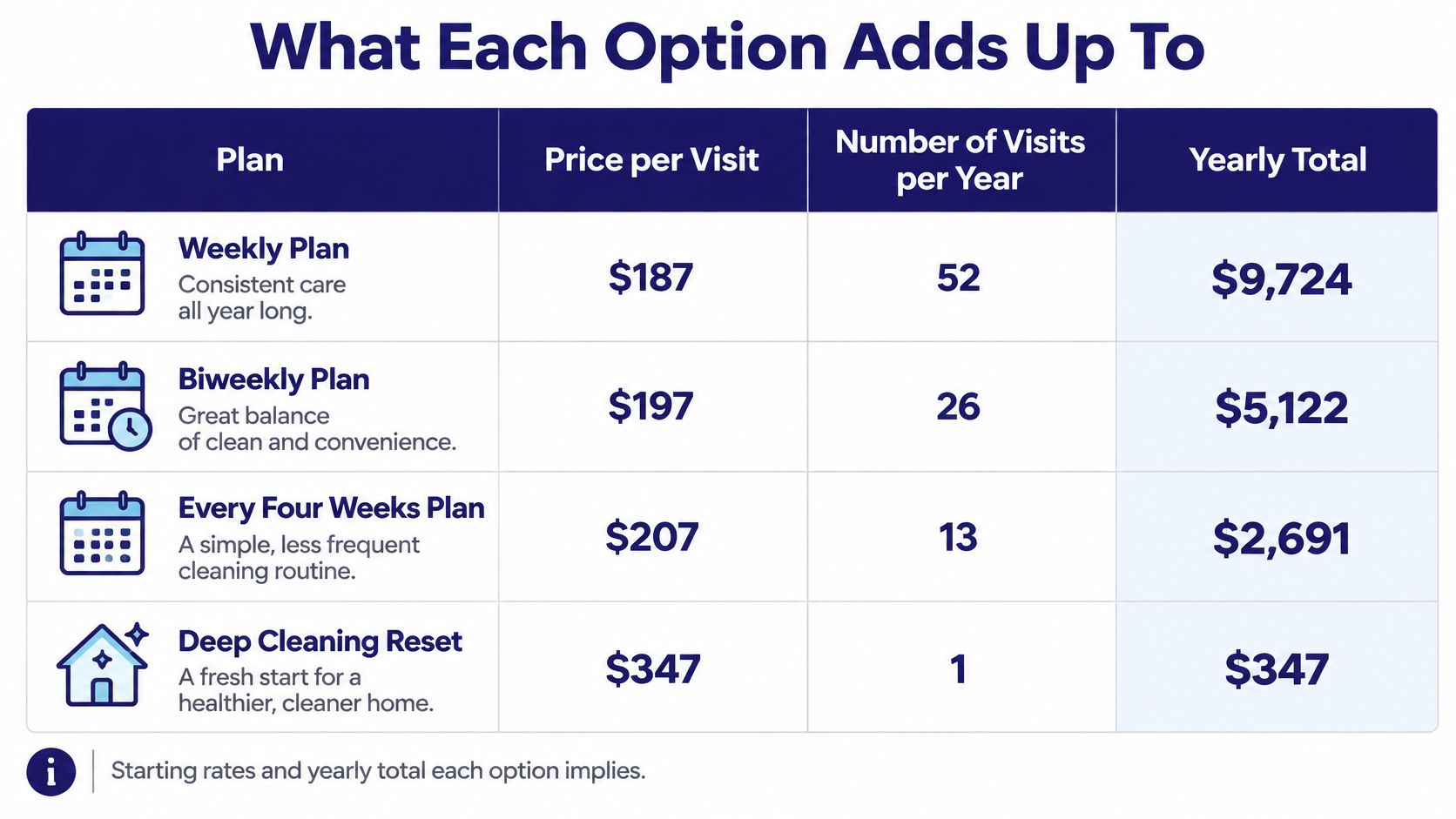
| Weekly recurring | $187 per visit | 52 visits | $9,724 per year |
| Biweekly recurring | $197 per visit | 26 visits | $5,122 per year |
| Monthly recurring | $221 per visit | 12 visits | $2,652 per year |
Deep Cleaning, the most booked one-time option, starts at $490 and fits a home left for one to two months. Standard Cleaning starts at $350. At the published starting rates, weekly service is $187 times 52 visits, or $9,724. Biweekly is $197 times 26, or $5,122. Monthly is $221 times 12, or $2,652. A single deep reset at the starting rate is $490.
The yearly trade-off
Recurring plans cost less per visit and commit the household to a steady annual total. A one-time reset costs more up front and can suit a home that stays tidy between occasional visits. Biweekly at the starting rate is a bit more than half the weekly total, because you buy 26 visits instead of 52, not because each visit is half the work. Monthly is the smallest recurring total and the longest gap, so it only holds if the self-check still passes at week four.
Don't guess hours from a national average. A deep clean takes longer because the checklist is broader: oven interior, refrigerator interior, grout, and trim on top of the surface work. Compare that list with the evening or weekend you have. Our house cleaning cost breakdown is the place to line starting rates up against home size before you lock a cadence.
Health Trade-offs of a Deeper Clean
Environmental health research finds that cleaning can temporarily raise certain indoor compound levels. A deeper clean brings more product, more scrubbing, and often more time with the windows shut. Floors can look better while those compounds stay higher for a stretch. Cooking and materials that emit all day still tend to dominate a home's overall chemical load. Thoroughness and air quality are different measures. A reset past the maintenance threshold is not a health upgrade by default.
That threshold is about build-up, not a contest over cleaner air. Once soil that routine visits cannot reach is gone, repeating the heavy scope adds product exposure without a matching gain in air. Standard upkeep, aimed at floors, bathrooms, the kitchen, and visible surfaces, usually needs less chemistry than a reset that also opens the oven, the refrigerator, and the grout.
Ventilation, labels, and who is in the room
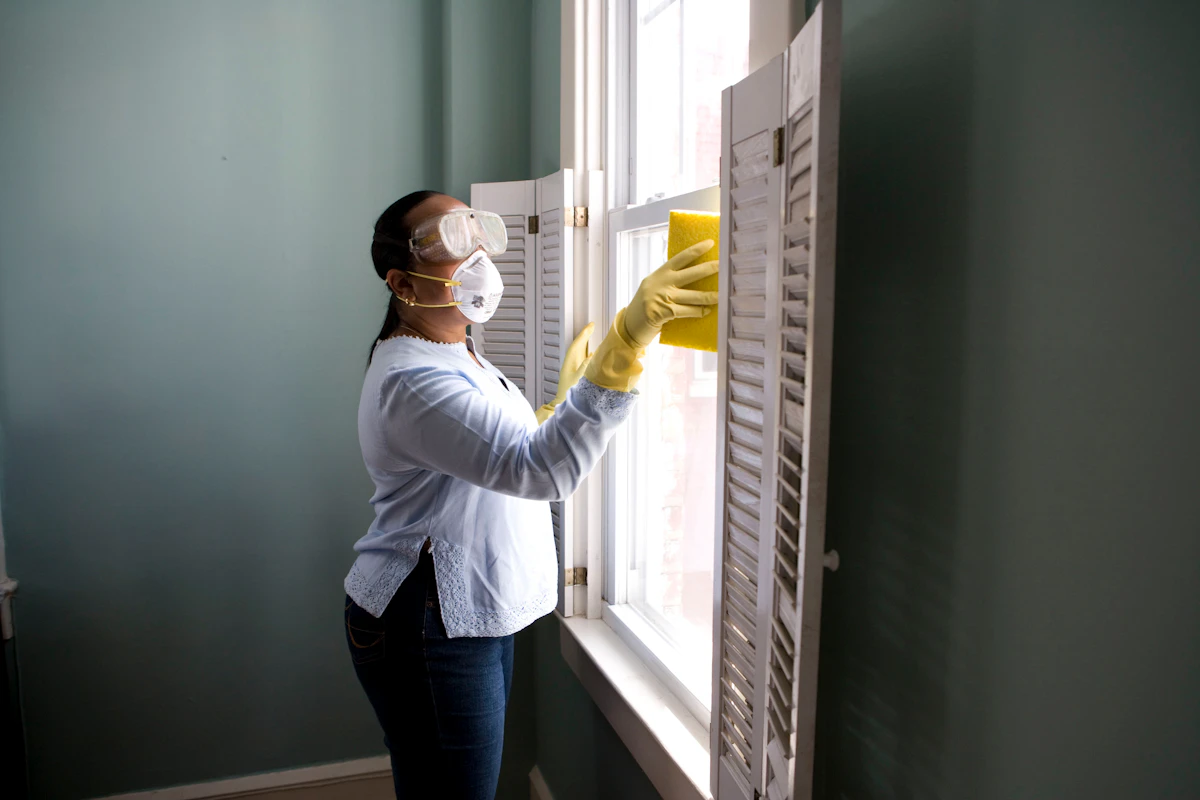
EPA guidance screens Safer Choice products against human-health and environmental criteria. Screening is not the same as zero residue. Fumes can linger and aggravate asthma or other respiratory conditions. The label, not a guessed hour count, sets drying and ventilation time. Open windows when the label or the technician says to, even if the air conditioning is already running. Keep children and pets out of treated rooms until surfaces are dry.
A house kept shut against heat, humidity, or poor outdoor air holds those fumes longer than a house with a cross-breeze. The ventilation plan then matters more than one extra task on the checklist.
On the day of a heavier clean, four checks cut exposure:
1. Read the label for ventilation and drying time before anyone returns to cook or sleep.
2. Open windows when the label or the technician directs it.
3. Keep children and pets out of treated rooms until surfaces are dry.
4. Ask which products go on which surfaces, and how long drying and ventilation take, before the crew starts.
Specialists arrive with their own professional-grade cleaning products, microfiber cloths, HEPA vacuums, and specialized tools. Product grade does not replace the label or the airflow plan. If everyday dust, not chemical build-up, is the problem, dust-reduction steps are a lighter first move than a product-heavy reset. A targeted regular clean with labeled products and real airflow can beat an unnecessary deep clean on air quality, even when the deep clean wins on visible soil.
Matching the Clean to Your Situation
The split between deep cleaning and regular cleaning is a maintenance threshold, not a rivalry. Four questions set it. Is the soil visible, or hidden in grout and appliance cavities? Was the last professional visit recent, or was the gap one to two months? Is the dust ordinary household dust, or renovation residue? Is the job routine upkeep, or a move-out or inspection?
A full reset is a poor fit when the only failures are the oven, the refrigerator, interior windows, or baseboards. Those are add-ons on a regular visit. A steady cadence, kept consistent, cuts how often another intensive reset is needed. More visits are not automatically better air. Vacuuming can temporarily stir fine particles back into the room, so frequency, the machine, ventilation, and timing matter more than cleaning constantly. A deeper clean is not automatically healthier either. Heavier product use can temporarily raise indoor chemical levels even when the surfaces look cleaner.
| Situation | Recommended Clean | Why It Fits |
|---|---|---|
| First visit to a home of unknown condition | Deep Cleaning | Establishes a clean baseline before recurring service |
| Home not professionally cleaned in over 30 days | Deep Cleaning | Removes build-up that routine visits cannot reach |
| Home with steady upkeep and a recent clean | Recurring weekly, biweekly or monthly | Preserves the baseline on a predictable cadence |
| Move-in or move-out handover | Move In/Out Cleaning | Meets turnover and readiness expectations |
| After renovation or construction | Post-Construction Cleaning | Removes fine dust and debris before inspection or occupancy |
| Household with asthma, infants or pets | Targeted regular clean with ventilation | Limits chemical load; deep clean only when needed |
| Only a few neglected areas | Targeted add-ons on a regular visit | Costs less than a full reset |
Post-Construction Cleaning removes dust and debris after renovations or construction. It is recommended for contractors, property managers, and home owners, and it also fits move-in ready units and final inspections. Move In/Out Cleaning is the handover job. J&M Cleaning Team offers those one-time services alongside Standard Cleaning and Deep Cleaning, plus Weekly, Biweekly, and Monthly Recurring Cleaning. For asthma, infants, or pets, keep the regular visit, ventilate, and save the deep clean for a real gap or a real layer of soil.
For most homes the working default is recurring maintenance, with a reset only after a gap over 30 days, a one-to-two-month lapse, or a major event such as a move or construction. Weekly, biweekly, or monthly then follows occupancy, pets, allergies, clutter, and how much visible build-up is acceptable. There is no universal deep-clean interval.
Confirm Your Clean and Book the Right Scope
A first visit, or more than 30 days since the last professional clean, is the threshold that selects Deep Cleaning. Homes left one to two months sit in the same reset category. Steady upkeep after that reset is a regular clean. A deeper service is not automatically healthier, because extra product can temporarily raise indoor chemical levels when the soil does not call for it.
1. Match the home to its condition: first visit, long gap, steady upkeep, handover, construction dust, a sensitive household, or a few neglected spots.
2. Check the date of the last professional clean. A gap over 30 days, or a home left for one to two months, points to a deep reset before any recurring plan.
3. If upkeep is already steady, choose weekly, biweekly, or monthly. The one-week return of visible soil is the test that the gap between visits is too long.
4. If only a few areas failed, book add-ons (oven interior, refrigerator, interior windows, or baseboards) on a regular visit instead of a whole-home reset.
5. Before the quote, write down square footage, bedroom count, bathroom count, and the date of the last clean. An instant online price takes under 60 seconds, with zero commitment, and a schedule can be selected in the same pass. The flat rate is calculated from home size and bathroom count, with no surprise travel fees.
6. If the home sits between two service types, confirm the scope with the company before booking. A quote that names the rooms and the add-ons costs less than a reset the soil does not require.
Scope follows condition and cadence. The quote locks that scope before a vacuum comes through the door.
J&M Cleaning Team handles one-time resets and weekly, biweekly, or monthly maintenance for Orlando and nearby Central Florida homes, including move-in, move-out, and post-construction work, with flat rates shown before scheduling. If the question is deep cleaning versus regular cleaning, the online quote is the fastest way to see which scope fits the gap since the last professional visit. Visit J&M Cleaning Team to price the clean and pick a time.