Move out cleaning is a turnover clean of an empty home, done after the belongings are gone and before the handover, inspection, listing or new occupant, and its job is to restore the property to the documented cleanliness it had at move-in. The finish line is whatever your move-in report recorded, which is why a $630 flat-rate turnover clean and a half-day of scrubbing can both be the right answer depending on what that paperwork says.
Most advice about this topic gets the goal wrong. Search "move out cleaning" and you'll find page after page promising the deepest clean possible, the kind of reset that makes an empty apartment look better than it ever did while you lived there. That advice sounds generous and it sells services. It also pushes you to spend money on the wrong things and to argue with a landlord about the wrong standard.
The standard is comparative, and the law often says so directly. California Civil Code §1950.5 is the clearest example on the books: a landlord may deduct cleaning costs from a security deposit only when cleaning is reasonably necessary to return the unit to the same level of cleanliness it had at the beginning of the tenancy, excluding ordinary wear and tear.
Read that again. You are chasing as clean as move-in day, nothing more.
The paperwork matters more than the effort here. A renter who documents the unit's condition at move-in, then cleans back to that exact condition, holds the evidence in any deposit dispute. A renter who scrubs harder but never photographs the result has only a memory. The documented baseline decides what you owe, and the documented final condition decides what you get back.
What Move Out Cleaning Actually Means
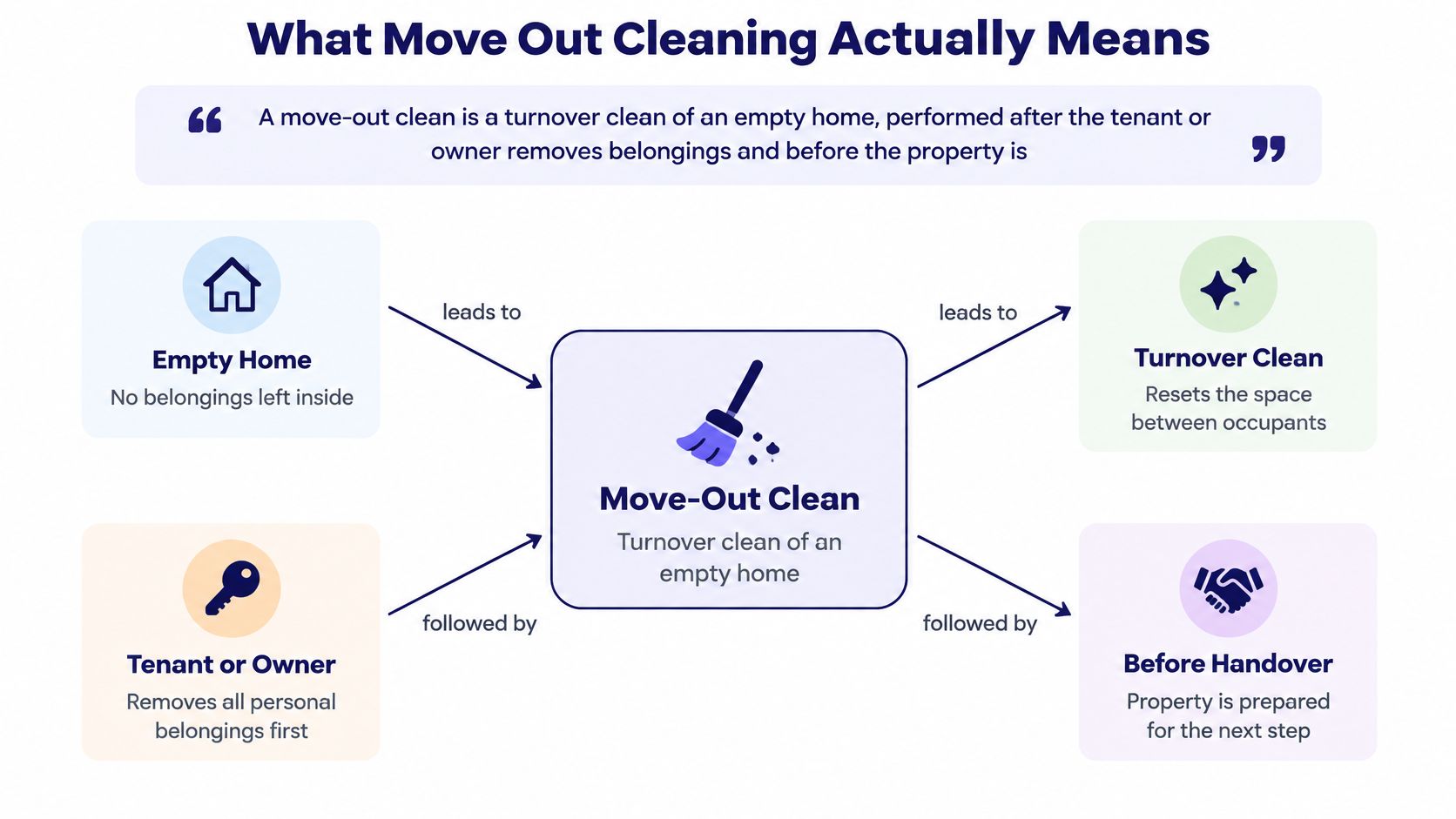
A move-out clean is a turnover clean of an empty home, performed after the tenant or owner removes belongings and before the property is inspected, handed back, listed, sold or re-occupied.
That definition carries a phrase worth slowing down on: documented baseline. The target isn't a feeling about how the place looks. It's the condition someone wrote down, photographed or signed off on when you took the keys. If your move-in report notes a scuffed hallway wall and a slightly tired tub seal, a move-out clean that leaves those exactly as they were has hit the standard. A clean that goes beyond and buffs them to new is fine, but you didn't owe anyone that, and you shouldn't be charged for skipping it.
Think about returning a rental car. You don't hand back a showroom-detailed vehicle. You hand back the car you received, fuel matched, no new damage, no sand in the footwells. Move-out cleaning works on the same logic. The California Civil Code framing is the rental agreement's version of that counter clerk with a clipboard.
Here is what the comparison really reveals. Once furniture and boxes leave, a home exposes surfaces nobody touched during occupancy:
- Cabinet and drawer interiors, including the shelf liner dust and the crumbs behind the cutlery divider
- Appliance interiors, meaning the oven cavity, racks, broiler drawer, refrigerator shelves and the rubber gasket on the dishwasher door
- Baseboards, door slabs and frames, which collect a film you only notice at eye level when the room is bare
- Closet shelving, the wire or melamine that held a year of hanging clothes
- Floor under where the bed, sofa and bookshelf stood, usually a lighter rectangle of untouched finish ringed by traffic dirt
- Edge dust along the wall-floor joint and in corners the vacuum never reached
None of that is deep-cleaning heroics. It's the soil that a furnished home hides and an empty one puts on display, and it's the reason a move-out clean can't be done two weeks early while you're still living there.
Move-out cleaning is also not three things people routinely confuse it with: recurring housekeeping, which maintains a home you're living in; post-construction cleaning, which targets drywall dust and adhesive residue rather than household grease; and repair. Cleaning removes soil. It doesn't repaint a chipped door or re-caulk a tub.
One test settles most scope arguments. Would a condition report, filled out candidly by someone comparing this room to move-in day, show this home as clean as it was then? If yes, stop cleaning and start photographing.
How It Differs From Standard and Deep Cleaning
People compare these three services by effort. That's the wrong axis. The difference is occupancy. Standard cleaning maintains a home someone lives in, deep cleaning resets a home that has gone a month or two without professional care, and move-out cleaning restores a home nobody is living in. Only the third one has an audience of a landlord, agent or buyer judging the result instead of you.
| Service | Typical trigger | What the crew cleans | Home state on arrival | Typical time on site |
|---|---|---|---|---|
| Standard cleaning | Weekly or monthly upkeep on a maintained home | Floors, bathrooms, kitchen counters and sinks, visible surfaces, trash out | Occupied and furnished | 2-3 hours |
| Deep cleaning | No professional clean in 1-2 months, or a seasonal reset | Standard tasks plus detail dusting of doors, frames, light switches, window sills and baseboards, plus buildup on tile and fixtures | Occupied and furnished | 3-6 hours |
| Move-out cleaning | Lease end, closing date, or turnover before a new occupant | Everything above plus inside cabinets and drawers, inside oven, refrigerator and dishwasher, ceiling fans, light fixtures, interior window panes and tracks, scuff removal, floors under where furniture stood | Vacant and empty | 4-8 hours |
| Post-construction cleaning | After a renovation or new build | Fine dust on every surface, paint flecks, adhesive residue, vents and sills | Vacant and dusty | 4-8 hours, often split across two visits because fine dust resettles |
Read the middle row and the fourth row together. On a furnished home, the crew's vacuum can't get behind the refrigerator, the cabinet fronts are blocked by a chair, and nobody is pulling out drawers full of someone's utensils. So the surfaces that define a move-out scope are physically unreachable in an occupied house. That's the whole reason this service exists as its own line item, and why deep cleaning versus regular cleaning is a different conversation from this one. A vacancy-stage restoration process isn't priced on elbow grease. It's priced on access.
The overlap that trips people up is real. A deep clean and a move-out clean can look identical on bathroom tile, on a stovetop, on a baseboard run. The distinction only shows up in the places a deep clean doesn't reach: inside the oven cavity, inside the refrigerator's crisper drawers, along the dishwasher's door gasket, inside closet shelving, and in the tracks under sliding windows. If your quote mentions room count and nothing else, you don't know which of those you bought.
Scope by surfaces, not by rooms. A move-out quote should name access areas, exclusions and acceptance criteria. "Three bedroom, two bath" describes a floor plan. It doesn't describe an oven interior.
One more scheduling consequence falls out of the occupancy difference. Standard and deep cleans can slot into a busy week, because the resident is there to move a chair when asked. A move-out clean has a hard window that opens when the last box leaves and closes at photography, inspection or key handover. Book it into that gap, not before it.
The Room by Room Tasks a Move Out Clean Covers
Turn any quote into a task inventory and hold it against these areas. The kitchen list alone runs to three categories in our own move-out scope: countertop and sink work, cabinet drawers, and the interior, exterior, underneath and behind of appliances. A kitchen checklist built that way isn't padding. An oven interior is the single most skipped job in a do-it-yourself move-out and the first door an inspector opens.
| Area | Core tasks normally included | Often an add-on |
|---|---|---|
| Kitchen | Countertops, sink and faucet, cabinet fronts and interiors, drawers, oven and refrigerator interiors, dishwasher, exterior and under and behind appliances, backsplash | Range hood filter, self-clean oven residue, coil cleaning |
| Bathrooms | Showers, tubs, toilets including base and floor behind, sinks, mirrors, fixtures, soap scale and grout, exhaust fan cover | Grout brightening, mold treatment, hard-water film removal |
| Bedrooms and living areas | Dusting all surfaces, ceiling fans, light fixtures, baseboards, doors and frames, window sills, closet shelving, accessible under and behind furniture | Wall spot washing, carpet shampoo |
| Whole home | Switch plates and handles, corners and cobwebs, interior window glass, sills and tracks, wall and baseboard scuffs | Full interior window washing, blinds, patio and balcony, garage |
| Closets and storage | Shelving wiped, drawers emptied and wiped, floors vacuumed inside | Storage unit or garage shelving |
| Floors | Vacuum all carpet and edges, mop hard floors, remove scuffs, clean under where furniture stood | Waxing, tile and grout steaming |
| Odor and air | Ventilation during work, removal of trash and food residue that causes odor | Ozone treatment, pet enzyme treatment |
The areas that decide the outcome
Kitchens and bathrooms carry the inspection weight, because that's where the expensive dirt lives. Degreasing baked-on oven residue and stained grout takes real labor, so it's exactly where a landlord's walkthrough spends its attention. In a move-out scope, the bathroom list runs to six named tasks: showers, tubs, toilets, sinks, mirrors and fixtures. Soap scale on a shower door and the film on a faucet base come off with a chelated descaler and dwell time, not a stiff brush and muscle.
Living areas and bedrooms look easier than they are. The work is five categories of detail: dusting every horizontal surface, baseboards, doors and their frames, ceiling fans, plus the whole-home pass that covers light fixtures, sills, accessible corners and accessible areas under and behind furniture. Ceiling fans deserve the specific mention. Blades collect a greasy dust that falls straight onto a freshly made bed if you leave them for last.
Floors come last, always: vacuum throughout and around the edges, then mop hard surfaces, working toward the door so you don't step back into a wet room. That's the floor task in our move-out scope, and it happens after everything above it stops shedding.
The question to ask: not "what's included" but "what's excluded." Every provider says yes to the standard list. The exclusions are where quotes diverge.
Grout brightening, carpet shampoo, full interior window washing, blinds, patios, garages and ozone or enzyme odor treatment are priced separately almost everywhere. None of them is dishonest as an add-on. All of them are dishonest when folded into a vague promise of being "fully deep cleaned" and priced by bedroom count.
The Order of Work That Gets an Empty Home Ready
Sequence isn't aesthetic. Doing the floors before the ceiling fans means cleaning the same floor twice.
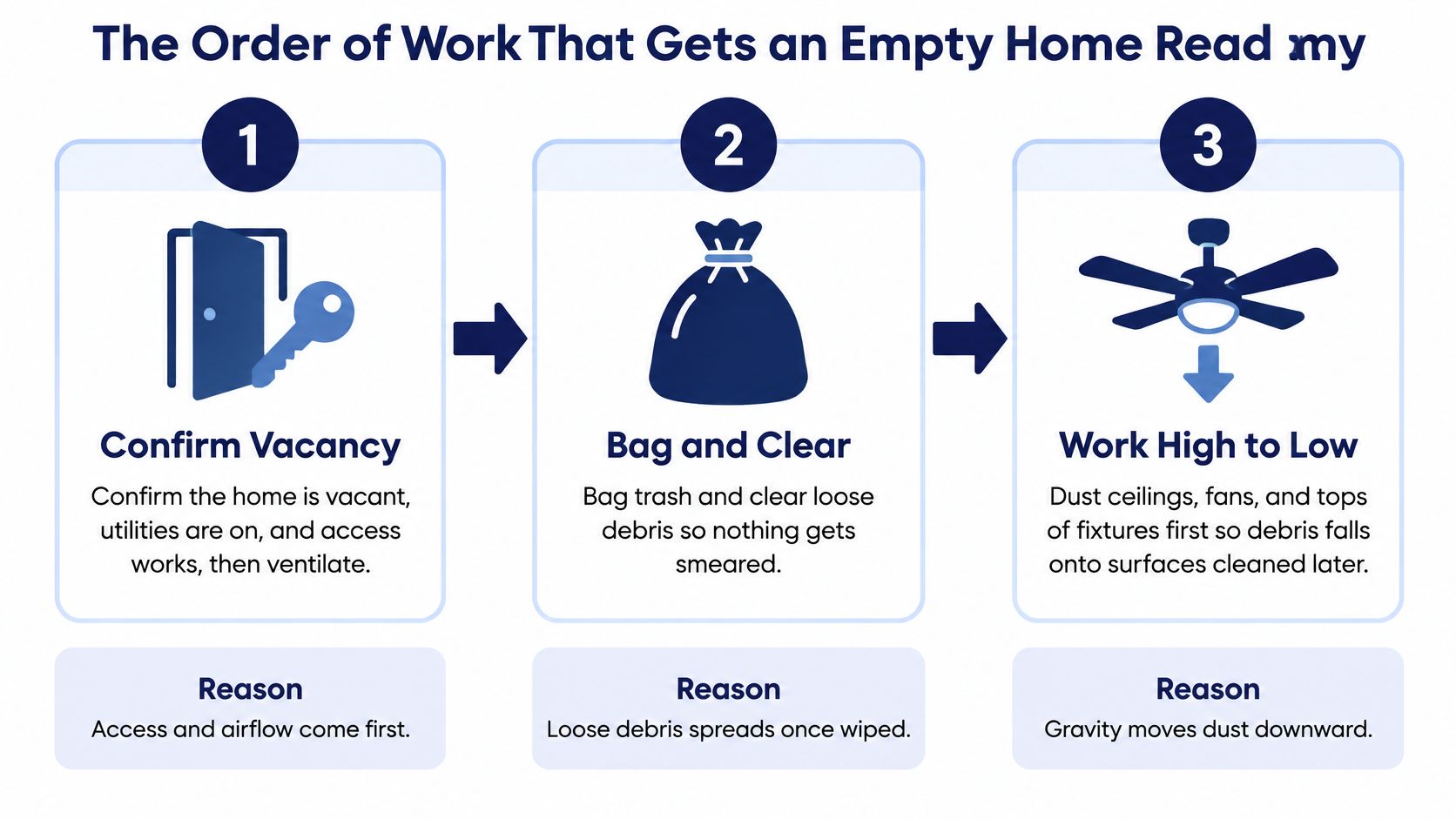
1. Confirm vacancy, utilities and access. Walk the home before the crew loads in. Confirm the power and water are still on, keys or lockbox work, and nothing is left in a closet. Then ventilate: open windows and run fans where outdoor conditions allow.
2. Bag trash and clear loose debris. Every wrapper, hanger and forgotten cleaning bottle goes out first. Loose debris smears when it's wiped, and then you're spot-cleaning a stain you created.
3. Work high to low. Damp-microfiber dust the ceiling fans, light fixture bodies, corners and cobwebs before touching anything below. Gravity is going to move that dust down regardless, so let it land on surfaces you haven't done yet.
4. Empty and wipe cabinet interiors, then exteriors. Drawers out, crumbs vacuumed, interiors wiped, then fronts and edges. Doing fronts first means greasy fingerprints get re-smeared when the interior work starts.
5. Clean appliance interiors, then outer surfaces. Oven cavity, racks and broiler drawer, refrigerator shelves and drawers, dishwasher gasket, then the fronts, sides, and the floor underneath and behind. A slide-out refrigerator reveals a decade of debris.
6. Dwell, agitate, rinse, dry in wet rooms. Apply descaler or grout cleaner to showers, tubs and toilets, give it the labeled dwell time, agitate, rinse and dry. Scale releases with chemistry. Hard scrubbing takes the glaze with it.
7. Wipe doors, frames, baseboards, switch plates and sills. This pass is what makes a bare room read as finished rather than merely swept.
8. Do interior window panes, sills and tracks. Tracks are where a move-out clean visibly separates from a deep clean, and a vacuum nozzle plus a damp cloth gets the grit out faster than a spray bottle.
9. Vacuum edges and under-furniture zones, then mop hard floors last. Vacuum the carpet and the wall-floor joint, then mop, moving toward the exit.
10. Walk the checklist room by room and photograph the result. Same angles as your move-in photos, interior of the oven and refrigerator included.
Why damp cloths and vacuums beat a broom
Settled dust is a carrier for pollen, mold spores, pet dander, dust mites, cockroach debris and skin cells, and walking, sweeping, dusting and vacuuming can temporarily put those particles back into the air, according to the EPA's guidance on indoor particulate matter. Dry dusting and dry sweeping relocate the load rather than remove it. The agency recommends damp-cloth dusting, frequent vacuuming and consideration of HEPA filtration to reduce dust buildup. Our crews arrive with professional supplies, microfiber cloths and HEPA-filtered vacuums for exactly that reason.
Ventilation and filtration aren't substitutes for removal, either. Cleaning itself stirs particles, so open a window before you start, keep airflow going while you work, and treat a running HEPA unit as backup rather than the plan. Here's the sequence in practice, from a walkthrough of an empty home:
The wrong order has a price you pay in labor. Floors mopped at hour one get re-soiled by ceiling fan dust at hour three and mopped again. Cabinet fronts wiped before the interiors get re-smeared. Oven cleaner applied after the final rinse means the whole kitchen gets one more pass. Each of those is a paid hour spent twice.
One stop rule matters more than any step above. If you see visible moisture damage or suspect mold, surface soil removal is where routine cleaning ends. Escalate it for specialized assessment. Scrubbing and painting over it is the one thing that turns a cleaning job into a dispute.
What Cleaning Fixes and What Needs a Repair
A scorched laminate countertop can be clean and still be damaged. That distinction matters at handover: more scrubbing won't restore the surface, and a cleaning charge should describe soil rather than a repair.
Cleaning removes grease, dust, soap scale, hair, food residue and surface scuffs. It does not repair damaged paint, failed caulk, burns in flooring or countertops, broken hardware, or permanent stains. Mold requiring remediation also falls outside routine cleaning. The finish line is the documented move-in cleanliness, not a surface made new.
Where wear and tear sits
Faded paint on a sunny wall and worn carpet along the route between door and sofa show how everyday use changes a home. Minor scuffs, small nail holes and a tired tub seal also need to be assessed against the original condition, the lease and local rules, rather than automatically labeled dirt or tenant damage.
A grease film on the range hood is a cleaning issue. A mark that remains after cleaning may need a different assessment: stained grout, for example, shouldn't automatically be treated as removable soil.
Rules vary by state and province, so the lease and local tenancy law are the first documents to check rather than a universal standard you can quote at a walkthrough in Orlando. In California, cleaning deductions are limited to restoring move-in cleanliness, professional cleaning cannot automatically be required, and deductions must be itemized, as explained in the California Department of Real Estate moving-out guide.
Two different sentences, two different outcomes. “The home is dirty” calls for evidence of cleanliness, including photos and a cleaning receipt. “The home is damaged” calls for comparison with the move-in condition report.
Keep that comparison concrete. Photograph rooms before and after cleaning, retain the move-in report, and ask for an itemized deduction statement rather than a rounded total. For a cleaning charge, ask which surface needed work, what soil remained and how its condition differed from move-in. A receipt documents the service; dated photos help document the result. Together with the original report, they keep the discussion focused on condition rather than an undefined expectation of showroom shine.
What Drives the Price of a Move-Out Clean
Price on this service moves with four variables, and none of them is how hard anyone scrubs.
Home size and bedroom count set the base labor, because more rooms mean more of everything: more cabinet interiors, more fixtures, more floor. Occupancy is the second lever, and it's the one people miss. A furnished home usually costs more, since a crew either moves items or can't reach the surfaces the quote assumed. Most quotes assume an empty property, and a crew that arrives to a full one faces a scope mismatch on the doorstep.
Add-ons each carry their own charge: oven interior, refrigerator interior, carpet shampoo, interior window washing, blinds, garage, ozone or enzyme odor treatment, grout brightening. Construction dust after a renovation is priced as a different job entirely, because drywall dust behaves nothing like household soil. Timing matters too. A same-day or short-window handover may carry a rush charge, so ask directly whether one applies before you book.
For a sense of scale, DataIntelo reports that standard U.S. turnover cleaning for a vacation rental in 2025 typically ran $75-$160 per session for one-bedroom units and $130-$230 for two-bedroom units, according to DataIntelo's vacation rental cleaning market report. Those figures describe short-term-rental turnovers, not move-out quotes for a family home, so use them only as a rough shape of the market rather than a number to hold a local provider to.
Our move-out service is flat-rate and starts at $630, with the exact rate shown in the online quote tool before you schedule, and that structure exists so cleaning service estimates can be compared line by line instead of on a headline total.
Ask every provider for a line-item quote. Two quotes at the same total can cover different work, and the only fair comparison is scope against scope.
Matching the Clean to the Handover and Booking Checks
A move-out clean works like a final comparison, not a beauty contest. The finish line is the move-in condition recorded at the start of the tenancy, supported by dated photos and the condition report. The room may still look ordinary at the doorway, but the decisive question is whether each surface, appliance and floor matches the evidence a landlord or manager can inspect.
Request the pre-move-out inspection your jurisdiction allows, so problems surface while you can still fix them. That step protects the renter from discovering a disputed mark after the keys are gone. It also gives the cleaner a clearer target than a vague request to make the place “spotless.”
The same home can need three different standards. For deposit recovery, the judge is the move-in record and the final inspection. For tenant-to-tenant turnover, the judge is the next resident with a lease start date and a manager trying to keep the unit ready. For move-in readiness or listing turnover, the judge is often a camera or a booking calendar, where appliance interiors, scuff treatment, odor concerns and post-renovation dust matter before guests or buyers arrive.
Think of the checklist as the handover script. A kitchen counter can pass one standard and fail another when the oven interior, cabinet drawers and appliance edges are part of the comparison. A bathroom mirror may look clean in daylight, while the shower, tub, toilet, sink and fixtures decide whether the room is ready for inspection. The standard changes before the cleaning crew changes.
The six things to confirm in writing
- Vacant and accessible. The home is empty, keys or lockbox work, and nothing is stored in a closet or garage bay.
- Deadline and inspector. The date the clean must be finished, and who walks through afterwards.
- Utilities on. Water and power are live, or the clean cannot happen.
- Scope lines. Appliance interiors, carpet and windows are explicitly in or out.
- Construction dust. Yes or no, because it changes the job category.
- Guarantee. Whether the provider stands behind the result, and what that covers.
A vague “deep clean” quote usually hides a scope mismatch you will pay for twice. Our Move-In VIP Package includes a top-to-bottom vacant-home detailed scrub, inside all kitchen and bathroom cabinets and drawers, interior window panes, sills and tracks, inside the oven, refrigerator and dishwasher, and a heavy-duty floor scrub with wall scuff treatment. That makes the expensive items visible before booking, instead of leaving them as surprise additions later.
If you are comparing providers, these questions to ask before hiring a house cleaner separate cleaners who scope by surface from those who scope only by bedroom count. Ask how the clean is documented, who accepts the finished work, and which tasks are included in the quoted rate.
Book the clean after the last box leaves and before the inspection. Then compare each room against the move-in record, doorway angle, oven door open, closet shelf visible. That habit keeps the conversation on evidence rather than effort, which is where move-out disputes are usually decided.