Clients often book a cleaning assuming the visit will match the list in their head. Then the crew arrives, works four hours, and the kitchen counters look great while the shower grout and the inside of the oven look exactly as they did before. What went wrong wasn't the cleaning. It was the scope.
The better question isn't "what does a maid service do" in the sense of a chore list. It's what decisions does a maid service make about your home, and which of those do you control before anyone touches a door handle. A professional visit is a bundle of choices about three things: how far the cleaning reaches, what gets used on your surfaces and into your air, and who gets access to your home when you aren't standing there. Get those three right and the task list becomes predictable. Get them wrong and you'll pay for a deep clean every other month because the routine visit never fit the house.
The process unfolds room by room, visit type by visit type, and where the surprises hide.
What a Maid Service Covers Room by Room
A maid service keeps a home clean, orderly and usable through recurring or one-time labor. The U.S. Bureau of Labor Statistics describes maids and housekeeping cleaners as workers who perform combinations of light-cleaning duties in private households and commercial establishments, from making beds and replenishing linens to cleaning rooms, halls and vacuuming, per the BLS occupational factsheet. That wording matters more than it looks. The job is a combination of duties, not one universal checklist, and it's defined by cleanliness and order rather than by repair, renovation or installation.
Walk the house in the order a cleaner usually walks it and the shape of a standard visit becomes clear.
| Area | Standard visit | Deep clean adds |
|---|---|---|
| Kitchen | Sanitize countertops and sink basins, wipe appliance exteriors, clean floors | Oven and refrigerator interiors are add-ons, not part of the base visit |
| Bathrooms | Sanitize toilets, tubs, sinks and visible surfaces, clean floors | Resets surfaces and fixtures that have built up over time |
| Living areas and bedrooms | Dust, tidy, vacuum and mop | Detail dusting and wiping of all surfaces |
| Whole home | Vacuum and mop all floors, wipe high-touch points | Cleans doors, door frames, light switches, window sills and other overlooked areas |
In the kitchen, the routine work stops at the outside of things. Counters get sanitized, the sink basin gets scrubbed, the appliance exteriors get wiped, floors get mopped, and the oven interior stays exactly as it was. Bathrooms follow the same logic at close range: toilets, tubs, sinks and visible surfaces, then the floor. Living areas and bedrooms get dusted, tidied, vacuumed and mopped.
Practical rule: if a room appears on the standard list, a routine visit covers it. If it shows heavy build-up, ask for a deep clean instead of hoping the crew will absorb it.
Exact inclusions vary by provider, home size and condition. A smaller condo and a five-bedroom house with three bathrooms can't share the same time budget, so check the package rather than the promise.
Service Types Compared by Scope and Price
Service types differ by scope and current condition, not only by square footage. That's the confusion most new clients hit: they compare a standard clean against a deep clean as if they were two quality levels of the same job. They're two different jobs aimed at two different starting states.
Standard cleaning covers floors, bathrooms, kitchen and visible surfaces, and it suits a home that's already regularly maintained. Deep cleaning fits a house that hasn't had professional cleaning in one to two months, because it includes vacuuming and mopping of all floors plus detail work on the areas routine visits skip. Move in and move out cleaning prepares a property for incoming owners or tenants and covers the whole home, which is what turnovers and handovers need. Post-construction cleaning clears dust and debris after renovations, supporting final inspections and move-in readiness. Recurring maintenance starts with an initial reset and then runs weekly, biweekly or monthly.
| Service type | Typical scope | Starting price |
|---|---|---|
| Standard cleaning | Floors, bathrooms, kitchen and visible surfaces | $350 |
| Deep cleaning | Full home including all floors, doors, light switches, window sills and overlooked areas | $490 |
| Move in/out cleaning | Whole-property turnover for incoming owners or tenants | $630 |
| Post-construction cleaning | Dust and debris removal after renovations for inspections and occupancy | $665 |
| Recurring maintenance | Weekly, biweekly or monthly visits after an initial starter clean | From $187 per visit, varies by home size and bathrooms |
Those are starting rates, not final quotes. The number moves with home size, condition and bathroom count, which is why two neighbors in the same subdivision can get different figures for what looks like the same clean.
The distinction between a deep clean and a maintenance visit is worth understanding before you price anything, and this breakdown of deep cleaning versus regular cleaning explains which one a house needs. Choose the service type by the condition the home is in and the job it has to do, never by the lowest starting price on the page.
How a Typical Visit Runs Step by Step
A professional visit is a structured sequence: soil removal, surface-specific chemical selection, mechanical agitation, and only when justified, disinfection. CDC guidance collected in this cleaning and disinfecting guidance document lays out the order plainly. Visibly dirty surfaces should first be cleaned with soap or detergent, because organic soil interferes with disinfectant performance. Disinfection is a separate step using an EPA-registered product appropriate to the surface, applied according to its label, including the required contact time.
The order below is the one that produces consistent results, and each step carries a reason.
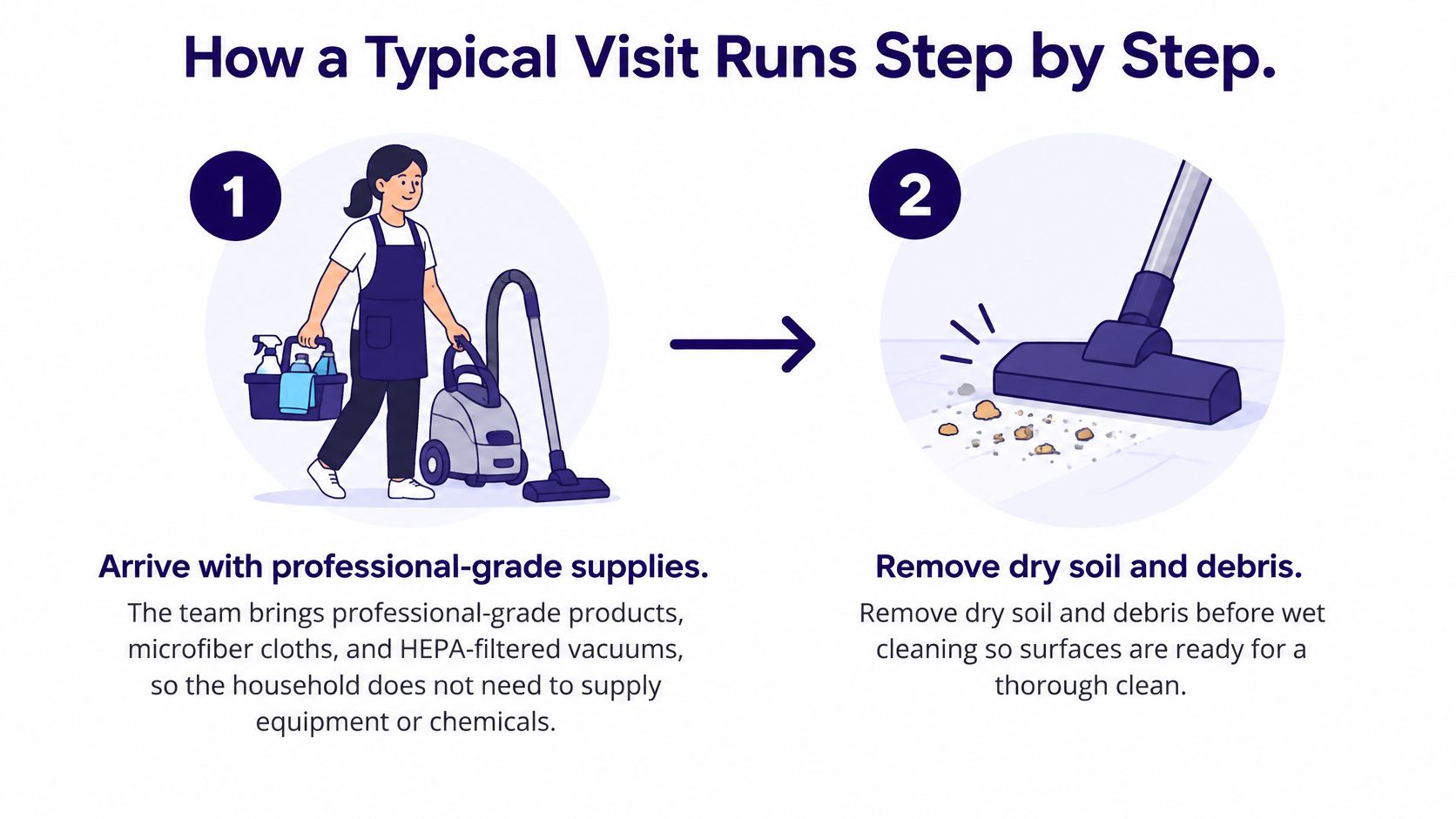
1. Arrive with the right equipment. The team brings its own commercial-grade vacuums, fresh microfiber mop heads and sanitizing supplies, so you don't supply equipment or chemicals. Household tools rarely match the soil type in front of them.
2. Remove dry soil and debris first. Loose crumbs, grit and pet hair spread and turn into muddy streaks if wet cleaning starts too early.
3. Work from the least soiled areas to the most soiled. A fresh damp microfiber cloth or mop head traps dust on hard surfaces instead of pushing it into corners.
4. Vacuum carpets and rugs. Suction pulls embedded particulate out of the pile; a broom only lifts what sits on top.
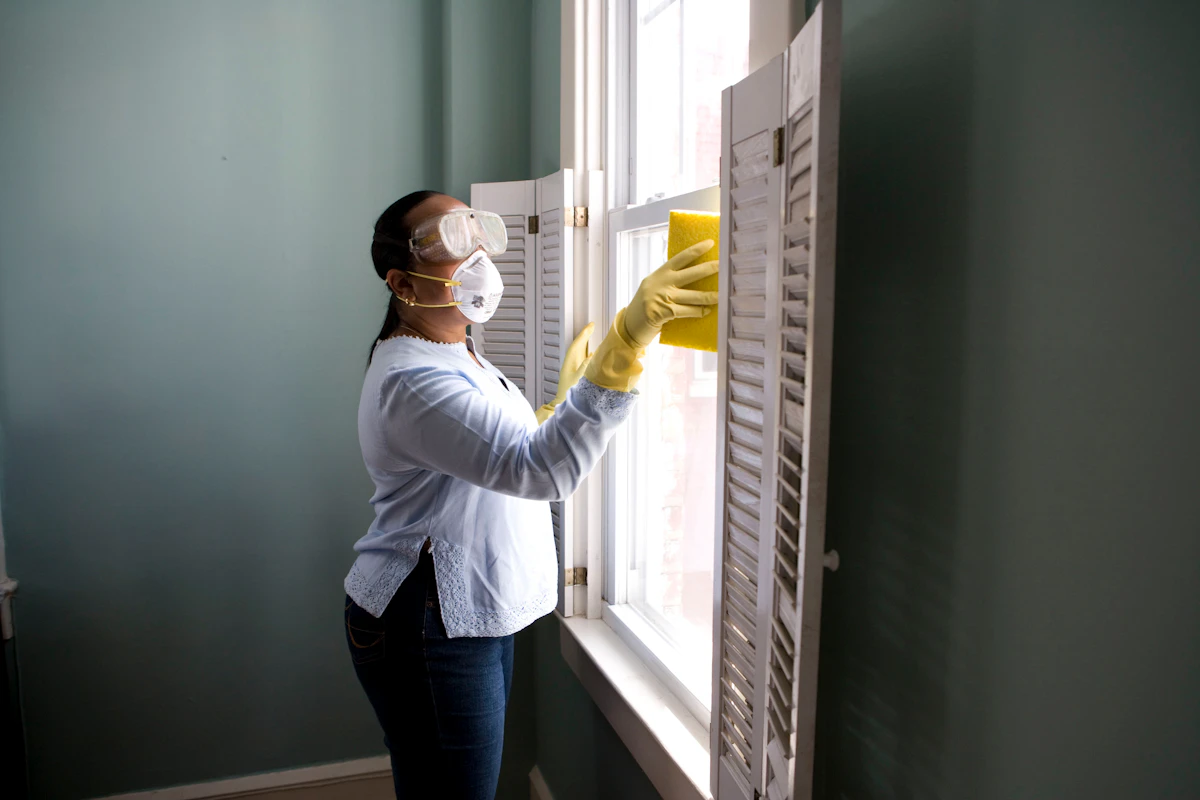
5. Match the product to the surface. Stone, wood, glass and stainless steel each need a compatible product. Never mix chemicals or guess at concentrations, and ventilate while wet surfaces are being worked.
6. Disinfect only where the risk justifies it. High-touch points such as doorknobs, handles, light switches, faucets, phones, keyboards and remote controls get regular cleaning; disinfection matters most when someone is sick, at increased risk, or recently visited while ill.
7. Walk the job at the end. Check for streaks, residue and missed edges before the crew packs up.
Here's the process in motion, if you want to see the sequence rather than read it.
A finished visit has a specific feel: dry floors, clean high-touch points, no residue film on the counters, and no strong chemical smell hanging in the air an hour later. If the house smells like a laboratory, something was over-applied.
Routine cleaning and infection control aren't the same job. Treating every surface with disinfectant adds exposure without adding protection.
Scheduling Options From One-Time to Monthly
The first real fork in the road is one-time versus ongoing. A single visit suits a reset: a move, a renovation, or a long stretch where nobody got to the floors. Recurring service starts with a starter clean, which is followed by general maintenance of living areas, so the first visit does the heavy lifting and later visits keep the standard.
Recurring visits transfer labor that households currently do themselves. American Time Use Survey data for 2025 from the BLS time-use activity charts show that people age 15 and older spent an average of 1.99 hours per day on all household activities, cooking, cleaning, laundry, management and maintenance included. Interior cleaning alone accounted for 0.33 hours per day, roughly 20 minutes, for the population as a whole, and 23.4% of people performed interior-cleaning activities on an average day, at a participation rate of 15.5% for men and 31.0% for women.
Twenty minutes a day is the maintenance number, not the reset number. That's the distinction a cadence decision turns on.
| Cadence | Interval | Best fit |
|---|---|---|
| One-time | Single visit, no repeat | Move, renovation or long gap in care |
| Weekly | Every 7 days | Heavy daily use or large households |
| Biweekly | Every 14 days | Families needing a steady baseline |
| Monthly | Every 4 weeks | Light upkeep between deeper cleans |
Monthly recurring cleaning is a routine service every 4 weeks that includes vacuuming, mopping, dusting, bathroom sanitization, kitchen cleaning and general tidying of living areas. Weekly and biweekly visits carry the same core work at a tighter interval.
Cadence matters because of what accumulates. Dust, soap scum and kitchen grease build into deposits that need stronger chemistry, longer dwell time and more labor to remove. A weekly visit never lets the shower reach that point. A monthly visit keeps a lightly used home steady but won't rescue a busy kitchen floor. For current weekly pricing and what drives it, this guide to weekly maid service cost breaks down the variables.
Rule of thumb: pick the cadence that holds your home at the standard you want between visits. If you find yourself needing a deep clean more than twice a year, shorten the interval.
Add-Ons and Move-In Extras Clients Request
Add-ons are tasks outside the base visit, and the decision isn't whether they sound nice. It's whether the task is due and visible right now. Oven interiors, refrigerator deep cleans, interior windows and baseboard detailing sit outside routine upkeep because they consume time and product a standard visit doesn't budget for. A crew that scrubs an oven interior in the middle of a routine clean is either running late or skipping something else.
So use a filter. Book the add-on when the surface has visibly built up, when it's part of a handover, or when a specific event demands it. Skip it when a recurring visit already touches that surface at the frequency you need. The oven interior is the classic example: nobody notices it until they're cooking for twelve people.
The Move-In VIP Package shows what a fuller one-time job looks like. It includes a top-to-bottom detailed scrub of a vacant home, cleaning inside all kitchen and bathroom cabinets and drawers, interior window panes, sills and tracks, cleaning inside major appliances including the oven, fridge and dishwasher, and a heavy-duty floor scrub with wall scuff treatment. Empty rooms make that possible. Nobody clears a cabinet for a cleaner on a Tuesday afternoon.
That package fits property handovers, where readiness matters more than maintenance. For owners, agents and property managers prepping a listing, the standard core tasks still apply on top of it rather than instead of it.
List your add-ons when you request the quote, so the price and the job match. Ask for them as a separate line item, which makes each extra task visible before you commit and easy to drop if it seems unnecessary.
Product and Air Quality Questions to Ask
Here's the assumption worth challenging: that a "natural" or "family-safe" product means zero exposure. It doesn't. The California Department of Public Health's guidance on cleaning products and indoor air quality notes that cleaning products can release volatile organic compounds and other chemicals into indoor air, potentially irritating the eyes, nose, throat and lungs, and that children, older adults and people with asthma or heart disease may be more vulnerable.
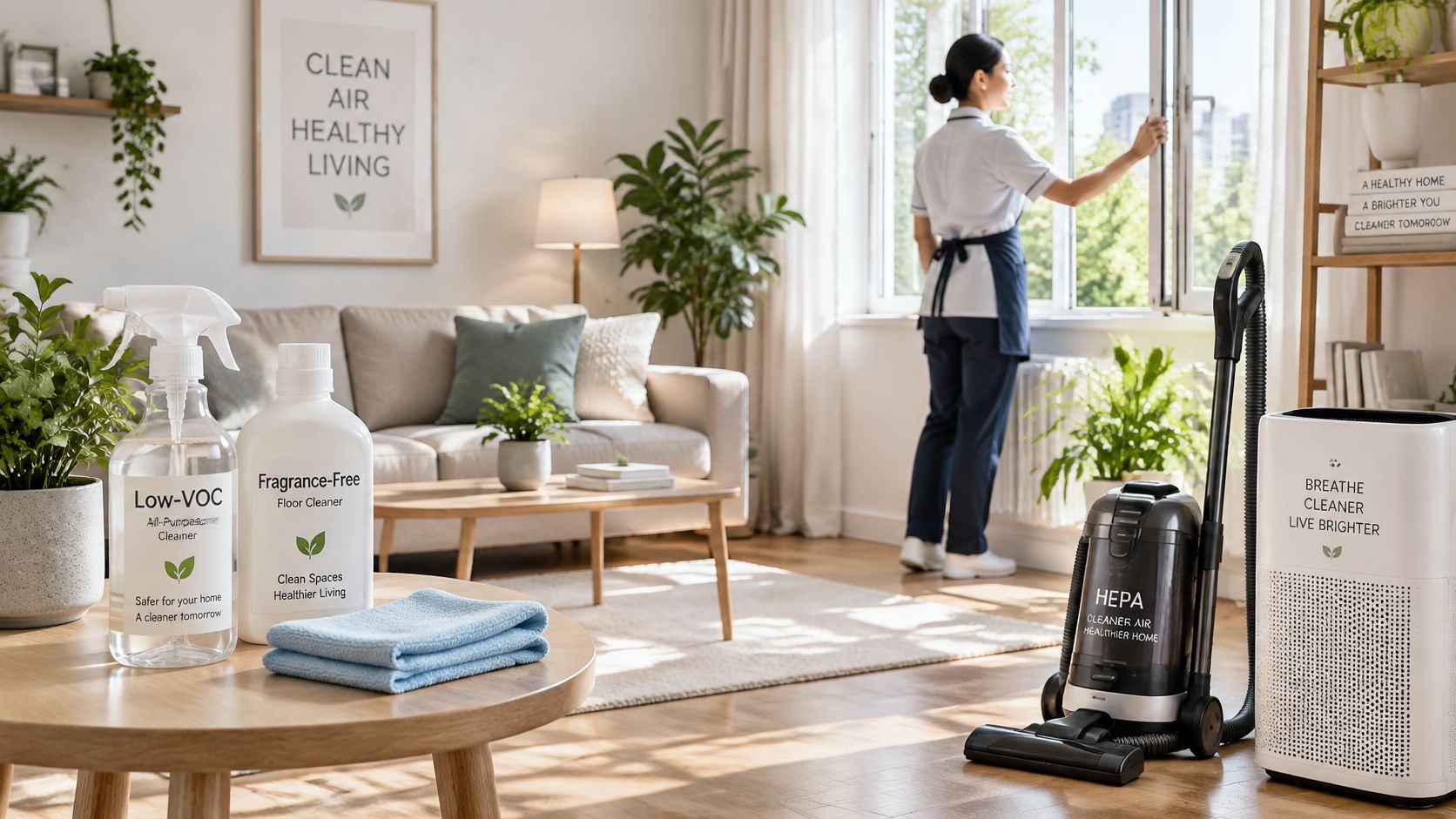
That doesn't argue against professional cleaning. It argues for asking better questions before the first visit. A family- and pet-safe supply policy means something specific only once you know the operational details behind it.
Cleaning and disinfecting aren't the same exposure event. Routine cleaning with detergent and water does the ordinary work. Disinfectant, applied with a label-mandated contact time, is for higher-risk situations. If a company plans to spray every surface, ask why.
Ask these before booking:
- Do you bring your own products, or does the household supply them?
- Can I request fragrance-free or low-emission alternatives for a specific room or the whole visit?
- Are products mixed on site, or used exactly as labeled? Dilution guessed by eye is where over-concentration happens.
- How are wet surfaces ventilated while the crew works?
- Should people or pets leave during the visit?
Open a window or run mechanical ventilation during and after the clean if anyone in the home is sensitive. Ask for product names or safety information before the first visit, not after.
Who Enters Your Home and How Trust Is Checked
Task lists tell you what happens. They don't tell you who's standing in your kitchen. That question has its own evidence base: a 2024 survey of 2,000 U.S. adults found that more than 85% considered background checks important when using online marketplaces, while nearly seven in ten users expressed concern about sharing personal information with home-service platforms, according to the Trua survey on trust and safety in online marketplaces. Convenience and low price aren't the only criteria people weigh.
Three terms get used interchangeably in this industry and they cover three different risks:
- Bonded protects against certain losses, such as theft.
- Insured covers damage that happens to your property during the work.
- Background-checked screens the individual worker before they enter your home.
Ask which of the three applies, and get an answer to each rather than a single reassuring sentence. Then ask the operational questions: are cleaners employees or contractors, can you request the same cleaners for recurring visits, and how are complaints and property damage documented.
Access needs a plan too. Keys, alarm codes, cameras, valuables and pets should all be discussed before the first visit, not discovered on the day. Every team member at J&M Cleaning Team is background-checked before cleaning a client's home, and clients don't need to be home during a cleaning, which means access arrangements matter as much as the cleaning itself. If the assigned cleaner changes, ask how you'll be notified and whether the replacement has been briefed on your keys, alarm and pet notes before arriving.
The test that matters: would you hand this person your spare key and leave for six hours? If the answer needs more information, ask for it now. This guide on how to hire a house cleaner walks through the vetting questions in order.
Booking the Right Visit for Your Home
Booking well is a short decision path, not a longer task list.
1. Pick the visit type by purpose. One-time for a reset, a move or post-renovation dust. Recurring for ongoing upkeep.
2. Match the service type to condition. Check the scope table against what your home looks like today, not what it usually looks like.
3. Get the quote before you compare anything else. An instant online quote returns flat-rate pricing in about a minute, with no in-home estimate needed.
4. Confirm add-ons and get your answers. Settle product questions, access arrangements and cleaner assignment before the first visit, not during it.
5. Choose a schedule window. Recurring clients can be given dedicated windows, which is what makes the service predictable instead of a monthly negotiation.
Pricing is flat-rate and shown upfront with zero hidden fees, so the quoted figure is the figure you pay. If something still isn't clear after the quote, call (407) 668-0041 and ask a person.
The one-sentence test: if the visit would leave your home in the state you need it to be in the next time someone walks through the door, the scope is right. If not, you picked the wrong service type, not the wrong company.
---
J&M Cleaning Team has cleaned Orlando-area homes since 2006, with one-time visits for moves and renovations and recurring weekly, biweekly or monthly service that starts with a starter clean and settles into maintenance. Every visit arrives with commercial-grade vacuums, fresh microfiber mop heads and family-safe supplies, performed by technicians who are background-checked, bonded and insured. Start with an instant flat-rate quote at J&M Cleaning Team, and get the scope settled before anyone touches a door handle.