Post construction cleaning rates per square foot run $0.10 to $0.30 for rough cleaning, $0.30 to $0.75 for final cleaning, and $0.10 to $0.20 for touch-up cleaning, according to the ZTERS construction cleanup guide, across a published span of about $0.10 to $0.75. The phase you buy matters more than the headline number, because the same floor area can carry very different labor.
A 2,000 square foot final clean shows what that spread means in dollars. The GMAIDS post-construction cleaning cost guide gives a broad benchmark of $600 to $1,500 for a 2,000 square foot Central Florida renovation requiring a final clean, before unusual conditions. That gap reflects scope. The low end covers debris removal and surface dust; the high end brings glass, fixtures, cabinets, and floors to inspection condition.
Treat every rate as the first line of a quote, not the quote itself. A complete bid does three things with it: converts it into a dollar total, shows the crew hours that total buys, and names the items excluded from the price. A bid that stops at the rate gives you a multiplier. A bid that shows the math gives you a price you can actually compare.
Table of Contents
- [Rates Per Square Foot by Cleaning Phase](#rates-per-square-foot-by-cleaning-phase)
- [What Each Phase Actually Buys](#what-each-phase-actually-buys)
- [Why the Same Area Produces Different Totals](#why-the-same-area-produces-different-totals)
- [Total Project Costs by Home Size](#total-project-costs-by-home-size)
- [Why Published Project Bands Sit Higher](#why-published-project-bands-sit-higher)
- [How to Use the Totals](#how-to-use-the-totals)
- [Residential Versus Commercial Rate Benchmarks](#residential-versus-commercial-rate-benchmarks)
- [Commercial Work Carries Different Cost Drivers](#commercial-work-carries-different-cost-drivers)
- [Factors That Move a Rate Up or Down](#factors-that-move-a-rate-up-or-down)
- [Factors That Raise the Quote](#factors-that-raise-the-quote)
- [Factors That Lower or Floor the Quote](#factors-that-lower-or-floor-the-quote)
- [Labor Hours Behind Every Square Foot Rate](#labor-hours-behind-every-square-foot-rate)
- [The 2,000 Square Foot Test](#the-2000-square-foot-test)
- [How to Test Any Quote](#how-to-test-any-quote)
- [How to Calculate a Quote with Worked Examples](#how-to-calculate-a-quote-with-worked-examples)
- [The Seven-Step Calculation](#the-seven-step-calculation)
- [Worked Examples](#worked-examples)
- [When Cleaning Alone Will Not Make a Site Ready](#when-cleaning-alone-will-not-make-a-site-ready)
- [The Decision Rule](#the-decision-rule)
- [Confirm the Scope Before You Book](#confirm-the-scope-before-you-book)
<a id="rates-per-square-foot-by-cleaning-phase"></a>
Rates Per Square Foot by Cleaning Phase
The cleanest starting point is phase-based pricing. The ZTERS construction cleanup guide reported in 2026 that post-construction cleanup typically costs $0.10 to $0.75 per square foot, with rough cleaning at $0.10 to $0.30, final cleaning at $0.30 to $0.75, and touch-up cleaning at $0.10 to $0.20. Those are the benchmark ranges to use when you're testing whether a quote is in the right territory.
Wider published ranges explain why two companies can both sound market-based while quoting different numbers. The GetBidClean post-construction cleaning bids guide places rough cleaning at approximately $0.10 to $0.40 per square foot, final or detail cleaning at about $0.25 to $0.85 per square foot, and touch-up cleaning at around $0.06 to $0.25 per square foot. The wider bands don't invalidate the narrower ones. They capture heavier debris, more sensitive finishes, harder access, and more urgent schedules.
<a id="what-each-phase-actually-buys"></a>
What Each Phase Actually Buys
Rough cleaning removes large debris, packaging, scrap materials, and coarse dust. It makes the site workable and safe for the next trade, but it doesn't make surfaces presentable. Crews are bagging offcuts, clearing protective material, sweeping or vacuuming heavy dust, and removing the bulk that would interfere with flooring, paint, or fixture installation.
Final cleaning is the detail phase. Floors, glass, fixtures, restrooms, baseboards, window tracks, cabinet faces, and visible residue all come into scope. This stage is when adhesive spots, paint specks, grout haze, fingerprints, and fine dust on horizontal surfaces get addressed, usually working high to low so dust doesn't resettle on finished work.
Touch-up cleaning happens after punch-list work, a walkthrough, or a few days of settled dust. It's lighter because the heavy soil is already gone. The crew is spot-cleaning glass, wiping fixtures, damp-mopping floors, and removing the thin film that appears after HVAC systems run or trades make final adjustments.
| Cleaning phase | Typical rate per sq ft | Wider range in sources | Typical scope |
|---|---|---|---|
| Rough cleaning | $0.10 to $0.30 | $0.10 to $0.40 | Large debris, packaging, scrap, coarse dust |
| Final (detail) cleaning | $0.30 to $0.75 | $0.25 to $0.85 | Floors, glass, fixtures, restrooms, baseboards, visible residue |
| Touch-up before inspection, handover or move-in | $0.10 to $0.20 | $0.06 to $0.25 | Settled dust and spot cleaning after a walkthrough |
| All phases combined | $0.10 to $0.75 | $0.15 to $0.80 | Span from a rough clean to a detailed final clean |
<a id="why-the-same-area-produces-different-totals"></a>
Why the Same Area Produces Different Totals
Do the basic math before you judge any bid. A 2,000 square foot home at $0.15 per square foot gives a $300 base estimate. That same home at a final-clean rate of $0.60 per square foot gives $1,200 before extras. Neither figure is automatically wrong, because they describe different scopes of work.
Practical rule: Pick the phase first, then read the rate for that phase. A low rate attached to the wrong phase isn't a discount. It's a scope mismatch.
These figures are U.S. market guidance, not legally fixed rates. Renovation intensity, finish sensitivity, access, scheduling urgency, and property type all move a real quote inside or outside the benchmark band. Your job as a buyer isn't to force every bid to the midpoint. It's to make each bidder state the phase, the included surfaces, and the site condition the price assumes.
<a id="total-project-costs-by-home-size"></a>
Total Project Costs by Home Size
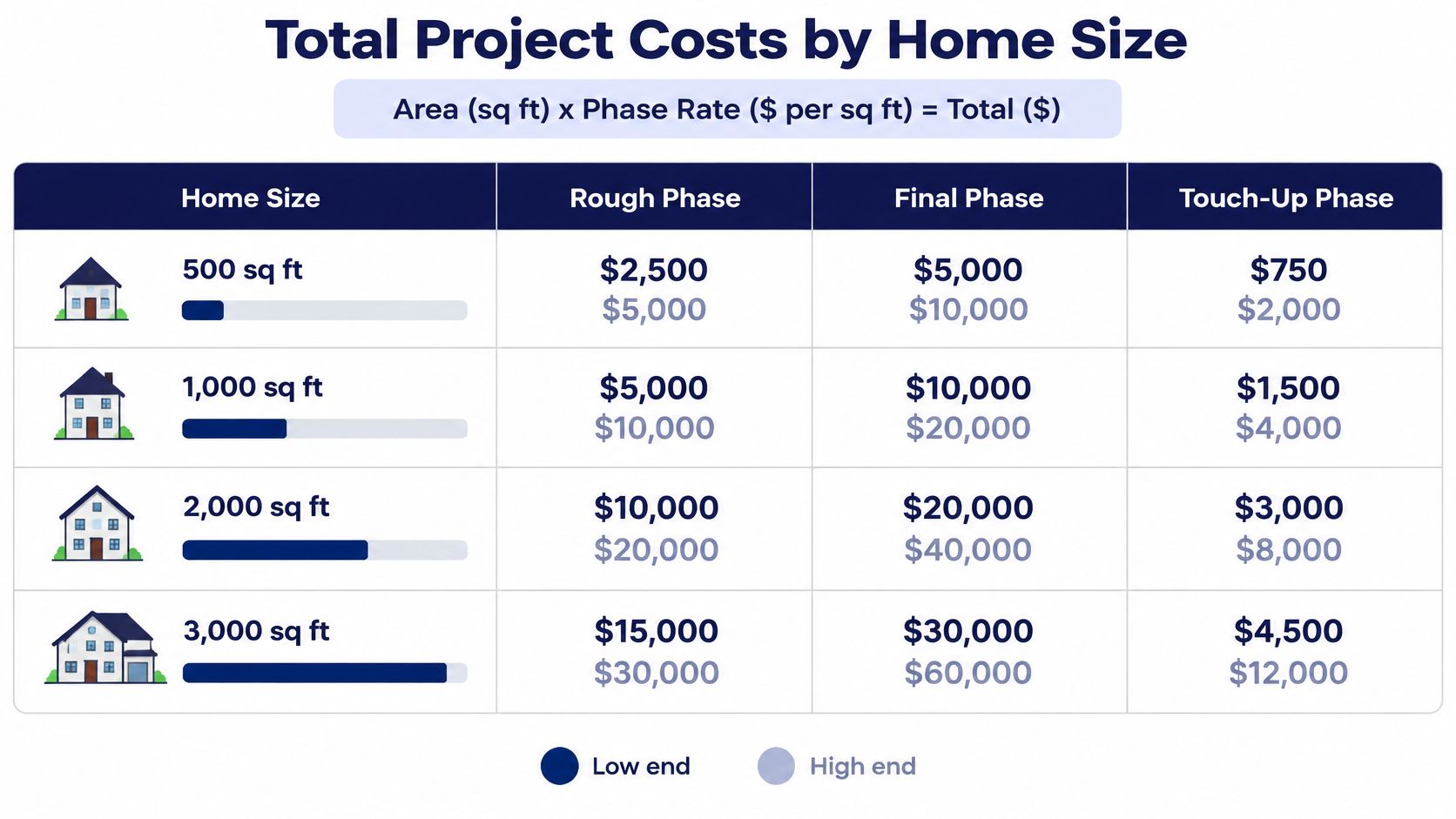
Multiplying area by a phase rate gives you a fast sanity check. It won't replace a site-specific quote, but it tells you whether a number deserves a closer look or a hard question. Use the low end of the rate for the low total and the high end for the high total, then compare that range with what's in front of you.
The table below works as a lookup for common residential sizes. Read across the row for your size, then down the column for the phase you're buying. If you're buying two phases, such as a rough clean followed by a final clean, add the relevant ranges together.
| Size | Rough clean | Final clean | Touch-up |
|---|---|---|---|
| 500 sq ft | $50 to $150 | $150 to $375 | $50 to $100 |
| 1,000 sq ft | $100 to $300 | $300 to $750 | $100 to $200 |
| 2,000 sq ft | $200 to $600 | $600 to $1,500 | $200 to $400 |
| 3,000 sq ft | $300 to $900 | $900 to $2,250 | $300 to $600 |
<a id="why-published-project-bands-sit-higher"></a>
Why Published Project Bands Sit Higher
Pure multiplication understates small jobs. The Smart Janitorial construction cleanup pricing guide published 2025 project-size estimates of $375 to $1,000 for 500 to 1,000 square feet and $1,000 to $1,500 for 1,000 to 2,000 square feet. Those bands sit above the low end of the rate math because a real visit carries fixed costs that don't shrink with floor area.
Travel, equipment setup, loading HEPA vacuums and supplies, walkthrough time, and a crew's minimum visit length all create a floor. A 1,000 square foot final clean computes to $300 to $750 on rate alone, but it can legitimately be quoted closer to $1,000 once a minimum charge and setup time are applied. The smaller the job, the larger that fixed-cost share becomes.
<a id="how-to-use-the-totals"></a>
How to Use the Totals
- Start with the computed range: Multiply your finished area by the low and high rate for your phase.
- Check for a minimum: Ask whether a minimum charge replaces the computed total on small jobs.
- Confirm single-phase assumptions: These totals assume one phase, no hauling, no add-ons, and no repeat visits.
- Question below-range quotes: If a quote falls below the computed low end for its phase, ask which scope items are excluded before you accept it.
The same discipline helps when you're comparing a construction cleanup with other one-time services. If you're also budgeting a turnover clean, a move-out cleaning cost calculator can help you keep the scopes separate instead of blending two different jobs into one vague allowance. Separate scopes produce cleaner comparisons and fewer change orders later.
<a id="residential-versus-commercial-rate-benchmarks"></a>
Residential Versus Commercial Rate Benchmarks
Property type changes the benchmark before phase does. The FlexCrew USA post-construction cleaning cost guide places U.S. residential interior cleaning at approximately $0.15 to $0.60 per square foot, with reported residential project totals commonly ranging from $274 to $707 and labor estimated at roughly 90% of the final bill. A broader national range in that same guide runs $0.15 to $0.80 per square foot, with many residential projects totaling $500 to $2,500.
That wide residential spread makes sense once you work an example. A 1,500 square foot home at $0.15 to $0.60 implies a base range of $225 to $900. The low figure usually reflects a lighter rough clean with little residue, while the high figure reflects a detailed final clean with bathrooms, kitchen fixtures, glass, and baseboards all in scope. Room count matters here, because a small home with three bathrooms can take longer than a larger open-plan space.
<a id="commercial-work-carries-different-cost-drivers"></a>
Commercial Work Carries Different Cost Drivers
Commercial work in that guide often runs $0.30 to $0.75 per square foot because of larger spaces, higher finish standards, ceiling height, and more complex access requirements. Apply that to a 3,000 square foot commercial floor and you get $900 to $2,250 before ceiling work, access constraints, or after-hours scheduling. A warehouse shell and a glass-heavy office fit-out may share the same area, but they don't share the same detailing burden.
Access is often the hidden commercial variable. Loading dock rules, elevator reservations, security check-ins, and restricted work windows all consume paid crew time before cleaning starts. Ceiling height adds ladder or lift work for vents, light fixtures, and high glass. Those aren't padding. They're labor hours that a residential benchmark doesn't capture.
Match the property type to the right benchmark first, then choose the phase inside that benchmark. Reversing that order is how a commercial final clean gets compared against a residential rough-clean rate.
If you're an Orlando homeowner trying to place a construction cleanup alongside regular house cleaning costs, local house cleaning price benchmarks can give you a useful reference point for ordinary maintenance. Don't use maintenance pricing to judge construction work, though. Fine dust, residue removal, and inspection readiness put post-construction cleaning in a different labor category.
<a id="factors-that-move-a-rate-up-or-down"></a>
Factors That Move a Rate Up or Down
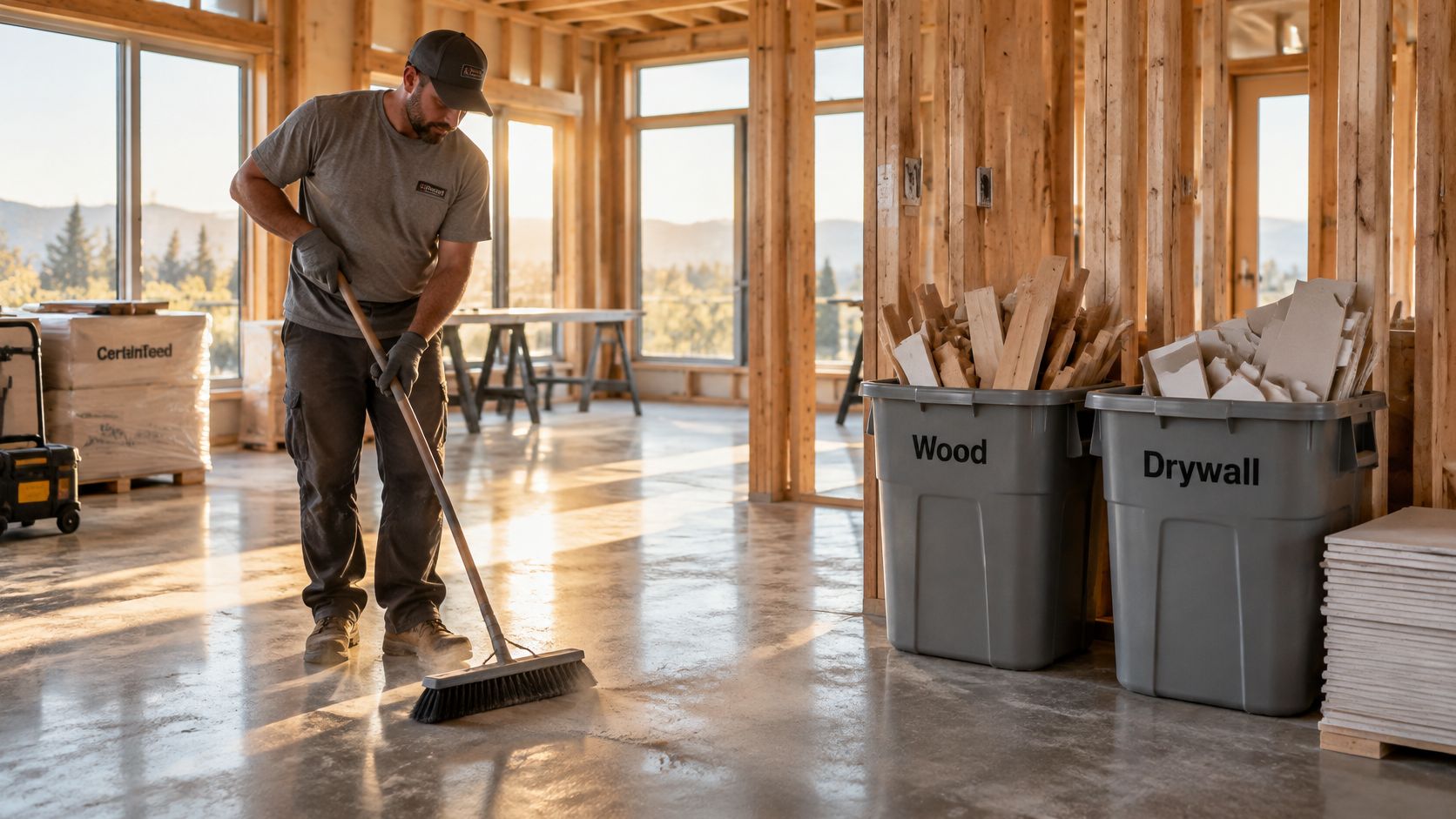
Debris volume and hauling surprise buyers more than any other line item. Hauling is labor, vehicle time, and disposal, not floor area, so it shouldn't hide inside a square foot rate. If a contractor left packaging, offcuts, old fixtures, and bagged waste across the site, the crew spends paid hours moving material before any surface gets cleaned.
Ask for hauling as its own line. That single change makes bids comparable, because one company may include two disposal trips while another assumes the builder's dumpster is still on site. The cheaper rate often belongs to the company that assumed less work.
<a id="factors-that-raise-the-quote"></a>
Factors That Raise the Quote
Fine dust and residue control adds hours when the crew needs HEPA vacuuming, wet cleaning instead of dry sweeping, or careful adhesive and paint removal. Drywall dust behaves differently from ordinary household dust. It settles into window tracks, cabinet interiors, grout lines, and textured surfaces, and it reappears if it's pushed around with the wrong equipment.
Bathroom, kitchen, and fixture counts concentrate labor into small areas. Tile, grout, faucets, mirrors, appliance fronts, and cabinet hardware take more minutes per square foot than an empty bedroom floor. Two homes with identical area can price differently for this reason alone.
Interior windows, cabinets, and appliances are detailing tasks, not automatic inclusions. Window interiors mean glass, tracks, sills, and frames. Cabinets mean vacuuming construction dust from boxes and drawers, then wiping shelves. If those items matter for handover, name them in the scope instead of assuming they're covered.
Stairs, multi-level layouts, and difficult access slow every trip between the vehicle and the work area. Crews carry vacuums, mop systems, ladders, and waste bags repeatedly. Ceiling height adds ladder work for vents, fans, beams, and high dusting, plus the extra care needed around new finishes.
Compressed schedules raise cost through larger crews, overtime, or after-hours work. Repeated return visits add mobilization each time, because the crew has to travel, set up, walk the site, and pack out again. Price return visits per visit so a punch-list delay doesn't turn into a billing dispute.
The video below shows the kind of on-site conditions that drive these adjustments, so you can connect each factor to visible work rather than abstract surcharges.
<iframe width="100%" style="aspect-ratio: 16 / 9;" src="https://www.youtube.com/embed/mN45v3Btcxo" frameborder="0" allow="autoplay; encrypted-media" allowfullscreen></iframe>
<a id="factors-that-lower-or-floor-the-quote"></a>
Factors That Lower or Floor the Quote
A clean, lightly used space with little debris can be quoted at a lower phase or the low end of the range. If the builder kept up with daily cleanup and protected floors and fixtures, the final crew inherits less corrective work. Minimum charges work in the opposite direction by setting a floor. They don't raise the rate, but they prevent small jobs from pricing below the cost of sending a crew.
| Factor | Direction | Typical effect | How to quote it |
|---|---|---|---|
| Debris volume and hauling | Raises | Added labor and disposal trips | Separate hauling line item |
| Fine dust and residue control | Raises | HEPA vacuuming, wet cleaning, adhesive or paint removal | Name the method in the scope |
| Bathroom, kitchen and fixture count | Raises | Fixtures and grout take more hours per sq ft | Count fixtures in the quote |
| Interior windows, cabinets, appliances | Raises | Extra detailing time and equipment | Priced as add-ons unless included |
| Stairs, multi-level or difficult access | Raises | Slower carrying, setup and movement | Access adjustment line |
| Ceiling height | Raises | Ladders and high dusting | Stated in the scope |
| Compressed schedule | Raises | Larger crew or overtime | Rush or after-hours charge |
| Repeated return visits | Raises | Each visit adds mobilization time | Priced per visit |
| Clean, lightly used space | Lowers | Less debris and residue | Quoted at a lower phase or range end |
| Minimum charge | Sets a floor | Small jobs priced to a minimum | Shown as a stated minimum |
Each factor should appear as its own line with a stated method or count. That's how you see what's been priced and what's been left out.
<a id="labor-hours-behind-every-square-foot-rate"></a>
Labor Hours Behind Every Square Foot Rate
A square foot rate hides the crew hours it represents. Good estimates price productivity and risk, not just floor area, because a dusty, fixture-heavy final clean moves at a completely different speed from a rough debris pull. Once you convert a quote into implied hours, thin scopes become easy to spot.
The Engineers Views post-construction cleaning calculator gives approximate production speeds of 150 to 200 square feet per labor-hour for rough cleaning, 100 to 150 square feet per labor-hour for standard cleaning, and 80 to 120 square feet per labor-hour for detailed final cleaning in residential work. Commercial final cleaning in those benchmarks falls to about 70 to 100 square feet per labor-hour, with specialist environments slower still.
<a id="the-2000-square-foot-test"></a>
The 2,000 Square Foot Test
At 2,000 square feet, a detailed residential final clean requires roughly 17 to 25 labor-hours before travel, setup, waste handling, inspection, and rework. That's the cleaning time alone. A two-person crew would need most of a full working day, and that's assuming the site is genuinely ready for a final clean when they arrive.
Now convert hours into dollars. The GetJobber house cleaning pricing guide reported in 2026 hourly rates of $30 to $50 per cleaner alongside its construction cleanup range. At those rates, 17 to 25 labor-hours imply roughly $510 to $1,250 in direct cleaning labor for that 2,000 square foot final clean. A quote far below that band has to explain where the hours went.
<a id="how-to-test-any-quote"></a>
How to Test Any Quote
1. Divide area by production rate: Use the phase benchmark to estimate labor-hours for your space.
2. Multiply by the crew rate: Apply an hourly rate per cleaner to get an implied labor cost.
3. Compare with the quote: If the price implies far fewer hours than the phase requires, the scope is probably thin.
4. Ask what's compressed: Find out whether windows, cabinets, residue removal, or the final walkthrough were cut to reach the number.
A quote that only works if the crew cleans at rough-clean speed during a final clean isn't efficient. It's under-scoped.
Those hours also cover work the rate alone doesn't describe. High-to-low dust removal, HEPA vacuuming where appropriate, wet cleaning of fine particulate, removal of adhesive or paint residue with surface-compatible methods, and a documented final walkthrough all take time. So do ladder work, inspection readiness, and return trips when dust resettles. That's what separates a legitimate post-construction rate from ordinary maid-service pricing, and it's why the production check belongs in every bid review.
<a id="how-to-calculate-a-quote-with-worked-examples"></a>
How to Calculate a Quote with Worked Examples
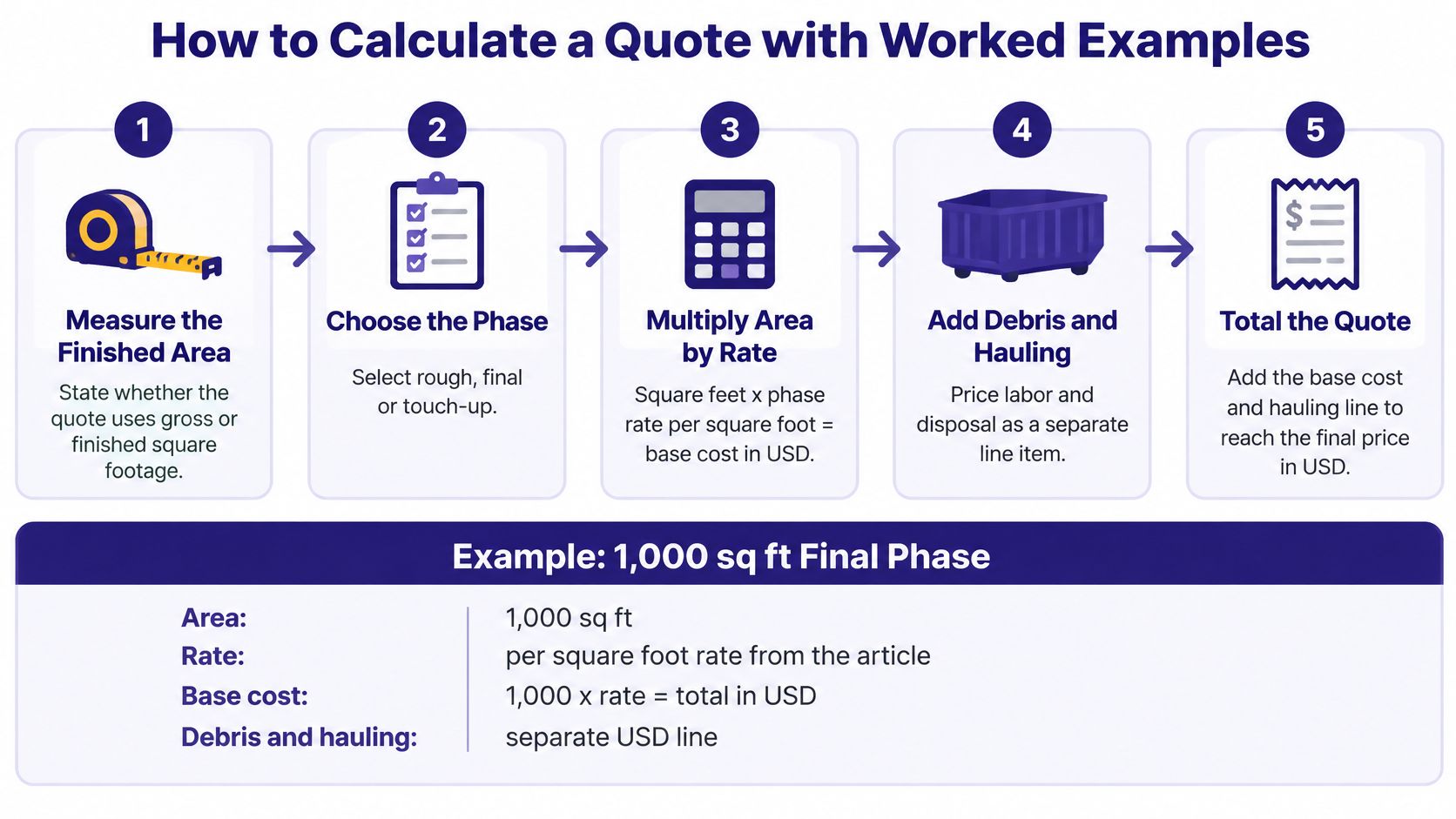
You can build a defensible estimate in seven steps. The method works whether you're a homeowner checking a bid, a builder building an allowance, or a property manager comparing vendors across several units. What matters is that every assumption gets written down so the total can be audited later.
<a id="the-seven-step-calculation"></a>
The Seven-Step Calculation
1. Measure the finished area. State whether the quote uses gross or finished square footage, because unfinished garages, mechanical rooms, and exterior areas shouldn't inflate the base unnoticed. Measure the area that will be cleaned.
2. Choose the phase. Decide whether you need rough, final, or touch-up cleaning, or a sequence of phases. This choice sets the rate band and the production speed.
3. Multiply area by the low and high rate. That gives you a base range instead of a false-precision single number. Ranges are honest at the estimating stage because site condition hasn't been verified yet.
4. Apply the minimum charge. If the base falls below the company's minimum, the minimum becomes your starting total. Note it explicitly so small jobs don't look artificially cheap.
5. Add each factor as its own line. Hauling, interior windows, cabinets, appliances, stairs, ceiling work, rush scheduling, and extra visits each get a line. Bundled allowances hide the disagreements that surface later.
6. Check the labor hours. Divide area by the production rate for your phase, then compare the implied hours and crew cost with the price. If the hours don't support the scope, revise one or the other.
7. Write down every assumption. Record the phase, area basis, included surfaces, debris condition, and number of visits. A quote with stated assumptions can be compared fairly, and it can be adjusted cleanly when conditions change.
<a id="worked-examples"></a>
Worked Examples
Say a 1,500 square foot rental just had drywall sanded throughout. It needs a rough clean to pull heavy dust and debris, then a touch-up after the remaining trades finish. The rough phase computes to $150 to $450 and the touch-up to $150 to $300, for a combined base of $300 to $750. A complete quote then adds hauling, HEPA-controlled dust work, and sanding residue in tracks, cabinets, and vents.
A 2,000 square foot new build needing a final clean produces a base of $600 to $1,500. That base assumes the site is ready for detailing. Interior windows, cabinet interiors, paint overspray on glass or fixtures, and stairs between levels all sit on top of it unless the bidder states they're included. This is the example where buyers most often mistake a base range for an all-in price.
A 3,200 square foot commercial office final clean computes to $960 to $2,400 on the final-clean band. After-hours scheduling, high ceilings, protected existing finishes, and elevator or loading restrictions can push a real quote toward or past the high end. An 800 square foot condo handover touch-up computes to just $80 to $160, which means a minimum charge will almost certainly set the actual price.
| Project | Area and phase | Base estimate | Adjustments to add |
|---|---|---|---|
| Rental after drywall sanding | 1,500 sq ft, rough then touch-up | $300 to $750 | Hauling, dust control, sanding residue |
| New build final clean | 2,000 sq ft, final | $600 to $1,500 | Interior windows, cabinets, paint overspray, stairs |
| Office renovation final clean | 3,200 sq ft, final | $960 to $2,400 | After-hours scheduling, ceiling height, protected finishes |
| Condo handover touch-up | 800 sq ft, touch-up | $80 to $160 | Settled dust on fixtures and glass |
If you're building estimates across multiple properties, a structured cleaning services estimate framework helps you keep the same line items in the same order every time. Consistency is what turns individual quotes into a pricing system you can learn from. After a few projects, you'll know which assumptions kept breaking, and you'll price them correctly from the start.
<a id="when-cleaning-alone-will-not-make-a-site-ready"></a>
When Cleaning Alone Will Not Make a Site Ready
The most expensive mistake in this category is pricing remediation as cleaning. A site can look clean and still not be ready for occupancy. Visual cleanliness tells you surfaces are presentable. It tells you nothing about moisture inside a wall cavity, particulates in an air system, or mold growth after a leak.
The image below shows the kind of condition that should stop a cleaning quote cold, because wiping the surface doesn't address what's feeding it.
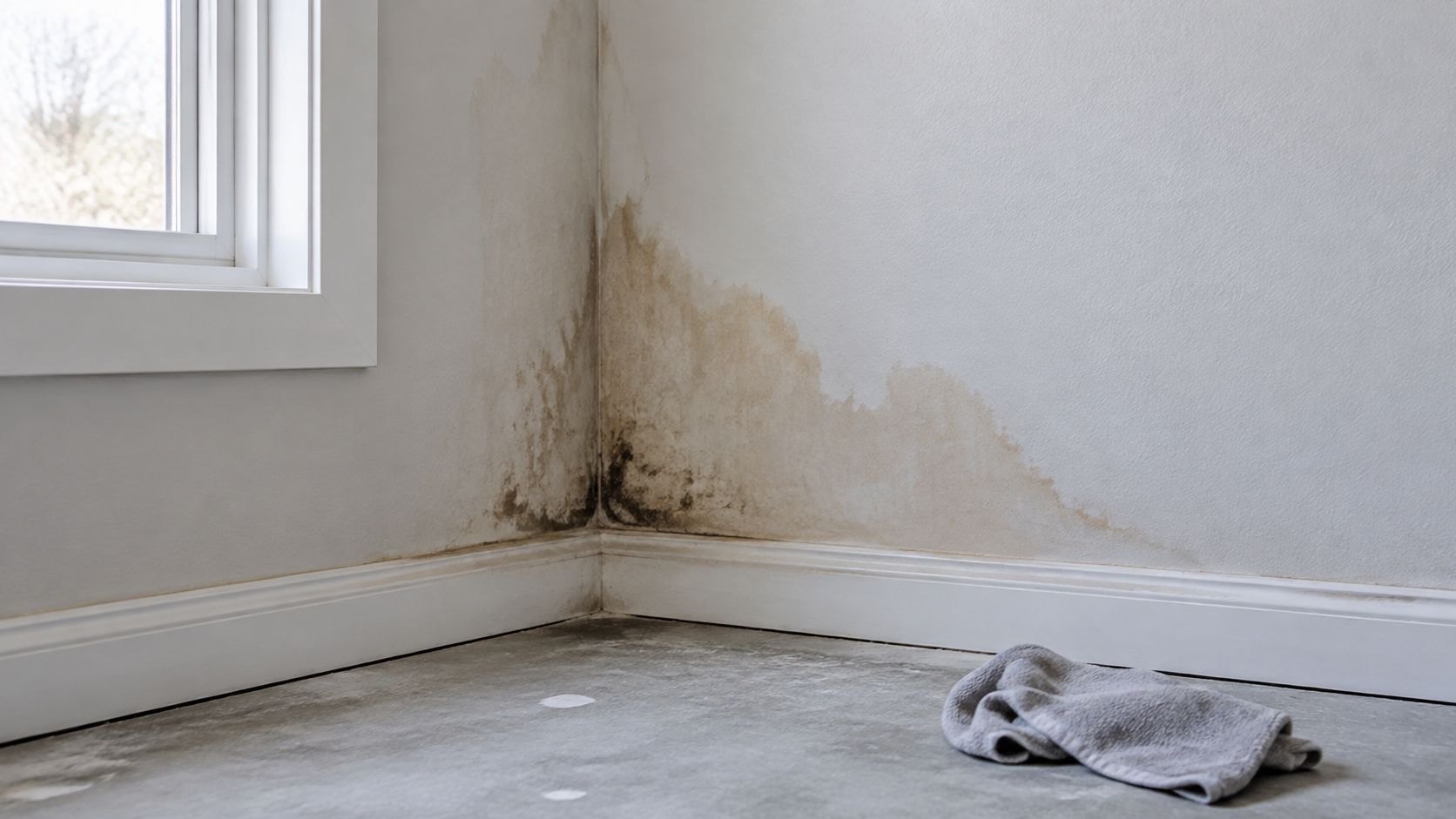
Renovation work can distribute fine particulates, volatile organic compounds, and mold throughout a building. The U.S. General Services Administration indoor environmental quality guidance recommends construction or renovation planning that addresses indoor air quality, plus post-project flush-outs to remove gases and particulates before occupancy. That's a higher bar than a dust-free countertop, and it's the right bar when people will live or work in the space.
<a id="the-decision-rule"></a>
The Decision Rule
Routine dust and surface residue can be quoted by scope and square footage. Suspected mold, hazardous materials, contaminated air systems, or substantial water damage require qualified specialists first.
Water intrusion needs drying and a moisture assessment before anyone seals the problem behind a clean surface. Extensive drywall sanding usually can be handled with HEPA-controlled cleaning, but HVAC filters and ducts deserve a check because fine dust migrates through the system. Visible or suspected mold calls for a remediation specialist, and suspected hazardous materials call for environmental testing before any cleaning disturbs them.
| Condition | Cleaning alone enough? | Next step |
|---|---|---|
| Routine construction dust and surface residue | Yes | Quote by phase and square footage |
| Extensive drywall sanding | Usually, with HEPA-controlled cleaning | Check HVAC filters and ducts |
| Water intrusion or leaks | No | Drying and moisture assessment first |
| Visible or suspected mold | No | Qualified remediation specialist, then cleaning |
| HVAC contamination | No | Filter replacement and duct assessment |
| Suspected hazardous materials | No | Environmental testing before any cleaning |
| Air quality concerns before occupancy | Not alone | Post-project flush-out and indoor air testing |
A low per-square-foot quote should never stand in for remediation. If a bidder prices a mold or water-damage condition as ordinary cleaning, that bid isn't a bargain. It's a liability with a discount attached. For Orlando-area homeowners and builders, move-in ready should mean an air-ready building, not just a clean-looking one.
<a id="confirm-the-scope-before-you-book"></a>
Confirm the Scope Before You Book
Before you sign anything, run the factor checklist against the quote in front of you. Hauling, dust control method, fixture counts, windows, cabinets, access, ceiling work, scheduling, and return visits should each be visibly priced or visibly excluded. Then confirm three booking-only items that rate tables can't answer for you.
1. The phase named on the quote: Rough, final, or touch-up should be written on the document, not implied by the price.
2. The square footage basis: Gross and finished area produce different bases, so the quote should state which one it uses.
3. The minimum charge and visit count: Confirm the minimum and exactly how many visits the price includes.
Check the site conditions too. Water intrusion or suspected mold needs a specialist first step, not a cleaning booking. A fair quote states its assumptions and shows the total as a range until the site has been seen, because nobody can accurately price unseen residue, debris volume, or access from a floor plan alone.
For our own offer, Post-Construction Cleaning starts at $665 as a one-time cleaning that removes dust and debris after renovations, suited to final inspections and move-in ready units for contractors, property managers, and homeowners. Estimates are based on the square footage and room counts you provide, and final pricing reflects the actual labor required. Our instant online quote returns flat-rate pricing in about a minute, and phone support is available at (407) 668-0041.
Your next action is simple. Take any quote you've received, run it against the phase table, the labor-hour test, and the three checks above, and ask about every line that's missing. The quotes that survive that process are the ones worth signing.
---
Renovation dust doesn't have to be the last thing standing between your project and move-in day. J&M Cleaning Team provides one-time Post-Construction Cleaning in Orlando and Central Florida with transparent flat-rate pricing shown before you book, so you can compare our quote against the phase rates and labor checks in this guide. Visit J&M Cleaning Team to get your instant quote in about a minute and schedule a cleaning that's ready for final inspection.