The moving truck is loaded, but opening the empty refrigerator reveals a sticky shelf, the bathroom still has soap scum, and dust outlines where the sofa used to sit. You've got keys to return and a deposit you'd rather not argue over. The useful question isn't whether the home looks better than it did yesterday. It's whether you've addressed the conditions an inspector can reasonably identify and documented what remains.
Good move-out cleaning in Orlando starts with an agreed scope and ends with a clear handover record. Spend your effort on removable soil, avoid trying to scrub away damage, and don't confuse a strong cleaning-product smell with a finished home.
Table of Contents
- [Room-by-Room Move-Out Cleaning Checklist](#room-by-room-move-out-cleaning-checklist)
- [Kitchen and appliance checks](#kitchen-and-appliance-checks)
- [Bathrooms and the final floor pass](#bathrooms-and-the-final-floor-pass)
- [What Changes a Move-Out Cleaning Quote in Orlando](#what-changes-a-move-out-cleaning-quote-in-orlando)
- [Compare the work, not just the flat rate](#compare-the-work-not-just-the-flat-rate)
- [What to send before booking](#what-to-send-before-booking)
- [Florida Deposit Deadlines and What Cleaning Protects](#florida-deposit-deadlines-and-what-cleaning-protects)
- [Match the notice to the condition](#match-the-notice-to-the-condition)
- [Sort soil from damage before paying for more work](#sort-soil-from-damage-before-paying-for-more-work)
- [Schedule around possession and access](#schedule-around-possession-and-access)
- [How to Sequence Soil Removal Before Disinfection](#how-to-sequence-soil-removal-before-disinfection)
- [Work from loose debris to targeted treatment](#work-from-loose-debris-to-targeted-treatment)
- [Judge the result without guessing](#judge-the-result-without-guessing)
- [Indoor Air and Low-Residue Handoffs](#indoor-air-and-low-residue-handoffs)
- [Reduce sources instead of masking odors](#reduce-sources-instead-of-masking-odors)
- [Account for the next occupant](#account-for-the-next-occupant)
- [Book Your Orlando Move-Out Clean](#book-your-orlando-move-out-clean)
- [Arrange access without staying at the property](#arrange-access-without-staying-at-the-property)
- [Finish the booking arrangements](#finish-the-booking-arrangements)
<a id="room-by-room-move-out-cleaning-checklist"></a>
Room-by-Room Move-Out Cleaning Checklist
Start the final walkthrough in the kitchen, with the cabinets empty and the appliances accessible. Carry a checklist, a flashlight, and a phone for photographs. Mark incomplete work immediately rather than trying to remember it after checking another room.
HUD's maintenance guidance supports post-vacancy inspections and written inspection forms, with a general public-housing maintenance benchmark of three to five working days after vacancy. That's a useful turnover-planning reference, not a cleaning deadline for every Orlando rental. For a private rental, coordinate completion with the actual possession and inspection arrangements.
<a id="kitchen-and-appliance-checks"></a>
Kitchen and appliance checks
Degrease before polishing. Use a surface-compatible detergent on the range hood, stovetop, backsplash, and cabinet fronts. Give the cleaner time to loosen the film, then wipe with a clean microfiber cloth rather than spreading grease across adjacent doors.
Empty every drawer and cabinet, including the narrow drawer beside the oven. Vacuum crumbs with a crevice attachment before wiping the interiors.
Remove refrigerator shelves for washing, allowing cold glass to warm before exposing it to warm water. Follow appliance instructions for oven liners, dishwasher filters, seals, and removable parts. Don't spray cleaner into controls or dismantle components that aren't intended for routine removal.
Move-out cleaning checklist by area
| Area | Tasks | Inspection Focus |
|---|---|---|
| Kitchen | Degrease range hood, stovetop and backsplash; empty and wipe cabinets and drawers inside and out | Grease films and food residue on cabinet fronts and drawers |
| Appliance interiors | Clean inside oven, refrigerator and dishwasher; remove washable shelves | Food spills, baked-on residue and dirty seals |
| Bathrooms | Descale faucets and tub; scrub grout, toilet base and vanity; wipe exhaust fan covers | Soap scum, hard-water staining and grout discoloration |
| Floors | Vacuum, mop hard floors, clean baseboard edges; treat carpet spots | Debris and scuffs along edges and corners |
| Walls, doors and hardware | Wipe light switches, door handles, scuffs and fingerprints | Marks on high-touch points |
| Windows and tracks | Clean interior panes, sills and tracks when included in scope | Dust and debris in tracks |
| Closets and storage | Empty shelves, vacuum floors, wipe interior doors | Forgotten debris and cobwebs |
| Trash and debris | Remove all bags, boxes and left-behind items | Items left in garage, closets or cabinets |
<a id="bathrooms-and-the-final-floor-pass"></a>
Bathrooms and the final floor pass
Use a non-scratch pad and a compatible descaler for bathroom buildup. Keep acidic products away from acid-sensitive stone, and distinguish stained grout from loose grout or failed caulk. Our bathroom deep-cleaning guide gives a more detailed task sequence for fixtures and difficult corners.
Vacuum floors before damp mopping, including closet corners and the space behind open doors. Test carpet spot treatments discreetly, and don't soak the backing. Spot-clean painted surfaces gently because aggressive scrubbing can remove the finish.
Final inspection test: Can you find a visible mark, leftover item, or dirty edge that has no corresponding task on the checklist?
Photograph each completed room, then capture close-ups of any remaining defects. Keep the finished checklist with those images so an owner or agent can distinguish completed cleaning from work that needs repair.
<a id="what-changes-a-move-out-cleaning-quote-in-orlando"></a>
What Changes a Move-Out Cleaning Quote in Orlando
Two homes with similar floor area can require very different work. A vacant apartment with lightly dusty surfaces isn't the same job as a townhome with greasy cabinets, pet waste, and renovation dust.
Consider a hypothetical comparison: a two-bedroom apartment with light soil versus a four-bedroom townhome with three bathrooms, a pet, and oven cleaning requested. The larger property adds floor area and fixtures, but the condition and appliance work can be just as important. Scraping baked-on oven residue takes a different approach from wiping an already maintained appliance.
<a id="compare-the-work-not-just-the-flat-rate"></a>
Compare the work, not just the flat rate
Our exact flat rate reflects square footage, bedroom and bathroom count, and optional add-ons selected before booking. We regularly clean Orlando single-family residences, gated subdivisions, townhomes, and apartments, so access information matters alongside the room count.
A gate authorization problem or an unavailable elevator can disrupt an otherwise sensible schedule. Tell us how the crew will enter and whether the building has parking or access restrictions.
Factors that change a move-out cleaning quote
| Factor | Why It Changes the Quote | What to Tell Your Provider |
|---|---|---|
| Home size | More floor area and fixtures require more cleaning work | Square footage and bedroom and bathroom count |
| Add-on tasks | Oven, refrigerator, interior windows and baseboard detailing add labor | Each requested add-on, listed by name |
| Property type | Single-family homes, gated subdivisions, townhomes and apartments differ in access and layout | Building type and access instructions |
| Condition | Heavy grease, pet waste or renovation dust need additional labor and suitable products | Known problem areas with photos |
| Handover timing | A tight date can limit crew availability | Move-out date and key-return time |
Don't assume that every company includes appliance interiors or window tracks in its headline price. Use the move-out cleaning cost calculator to organize the home's details, then compare quotes against the same written scope. A lower total isn't a saving if it leaves required tasks unfinished.
<a id="what-to-send-before-booking"></a>
What to send before booking
- Property details: Address, approximate floor area, and bedroom and bathroom count.
- Requested extras: Name appliance interiors, interior windows, or other detailed work.
- Condition evidence: Send clear photos of grease, pet-related soil, and renovation residue.
- Handover arrangements: Provide the target date, access instructions, and key-return time.
Ask for each add-on to be identified separately. The scope should be settled before the crew arrives, not negotiated while someone is waiting to inspect.
<a id="florida-deposit-deadlines-and-what-cleaning-protects"></a>
Florida Deposit Deadlines and What Cleaning Protects
Professional cleaning is evidence of work performed, not proof that every deposit deduction is improper. A clean home can still have damaged flooring, missing property, or other issues unrelated to housekeeping. The practical goal is to remove avoidable cleaning disputes while preserving a useful record of the home's condition.
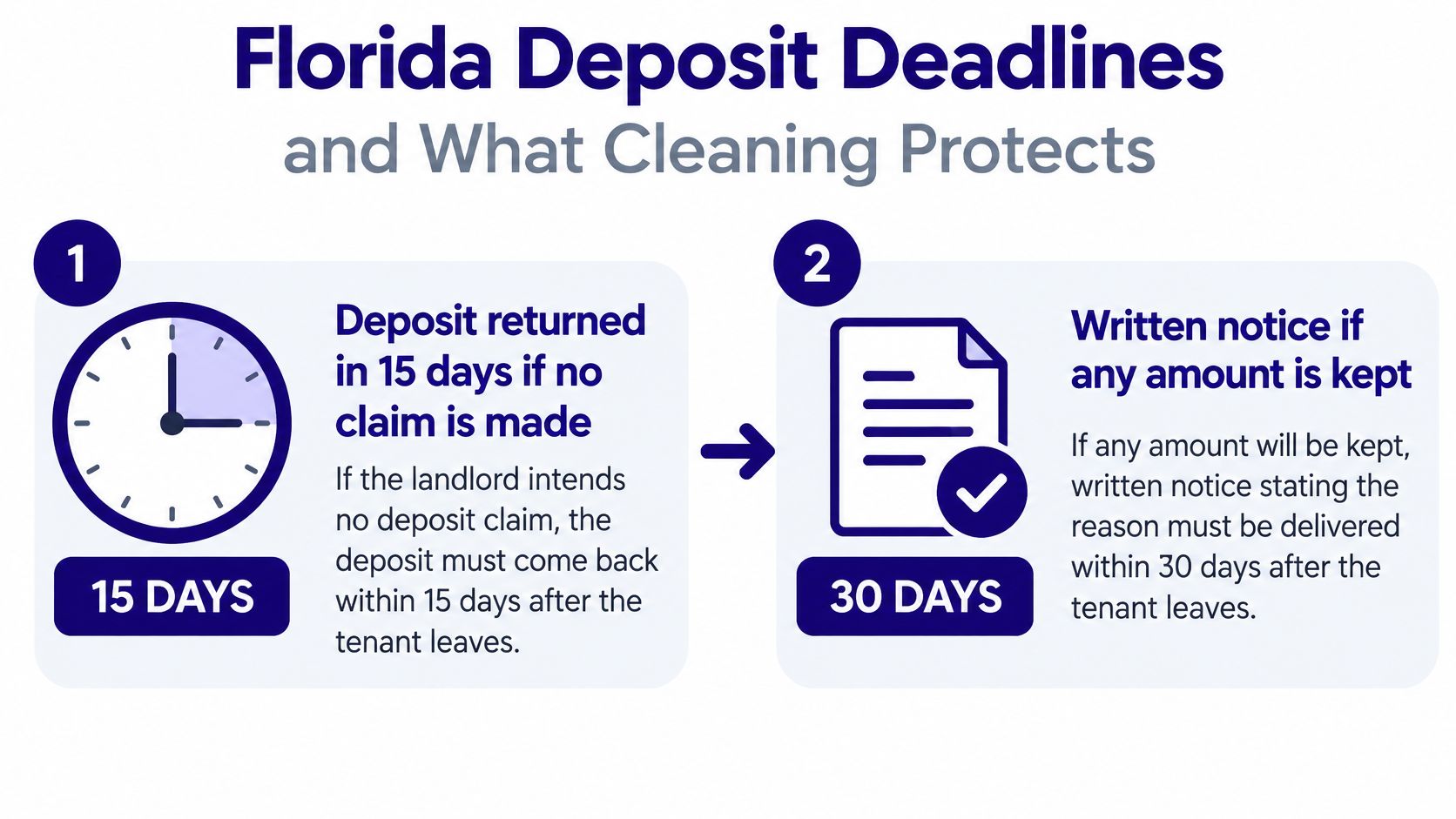
Under Florida Statutes section 83.49, a landlord who intends no deposit claim must return the deposit within 15 days after the tenant vacates; a landlord intending a claim must send written notice within 30 days, and the tenant has 15 days after receiving that notice to object in writing. These are separate clocks, and the objection period runs from receipt of the claim notice.
The timeline makes those different steps easier to distinguish.
<a id="match-the-notice-to-the-condition"></a>
Match the notice to the condition
The Florida Department of Agriculture and Consumer Services landlord-tenant guidance distinguishes tenants' duties to maintain clean, sanitary premises, remove garbage sanitarily, and keep plumbing fixtures clean from ordinary wear that landlords can't automatically charge against a deposit. Routine cleaning alone generally isn't chargeable unless the condition exceeds normal use.
That distinction matters before you spend money. A crew can remove greasy fingerprints from a cabinet door, but cleaning won't repair a delaminated cabinet panel.
Florida move-out deposit deadlines and tenant actions
| Scenario | Deadline | Tenant action |
|---|---|---|
| No deposit claim intended | Statutory return period after vacancy described above | Confirm the return arrangements and keep the cleaning record |
| Landlord keeps any part of deposit | Statutory written-notice period after vacancy described above | Review the claimed amount and reason line by line |
| Tenant disputes a retained amount | Statutory objection period after receiving notice described above | Send a written objection with supporting photos and checklist |
| Final walkthrough requested | Agree on timing in writing before inspection | Keep the written request and walkthrough notes |
The walkthrough entry is a scheduling recommendation, not an additional statutory deposit deadline. Don't assume that requesting an inspection changes either party's legal obligations.
<a id="sort-soil-from-damage-before-paying-for-more-work"></a>
Sort soil from damage before paying for more work
Divide the remaining conditions into practical categories:
- Cleanable soil: Grease on the range and cabinet fronts, bathroom grime, pet waste, trash, appliance residue, and loose dust.
- Physical damage: Torn flooring, chipped surfaces, broken hardware, or other defects that require repair rather than cleaning.
- Possible ordinary wear: Worn carpet, faded paint, and minor nail holes should be evaluated against the move-in condition and circumstances, not automatically treated as cleaning failures.
Grout is a useful example. Surface grime may respond to detergent and agitation, while missing grout needs repair. Repeatedly applying stronger chemicals to a damaged joint can waste money and make the surrounding finish worse.
Spend cleaning money on conditions a cleaner can change. Address disputed damage or ordinary wear through documentation, not another round of scrubbing.
Don't accept a vague instruction to make an old surface look new. Ask which observable condition needs correcting, then decide whether the proposed work can correct it.
<a id="schedule-around-possession-and-access"></a>
Schedule around possession and access
The safest arrangement is usually to finish cleaning before surrendering access. If the keys must be returned first, obtain written authorization for the crew to enter afterward.
Say you return the keys on Friday and arrange an authorized Monday clean. The landlord needs to agree that the crew can enter, and the inspection should be coordinated around that appointment. Otherwise, an earlier walkthrough may document the unfinished condition.
Complete the checklist and photographs when the work ends. Capture room-wide views for context and close-ups of appliance interiors, bathroom fixtures, and any condition likely to be disputed.
Retain your move-in photos, completion record, invoice, key-return confirmation, and walkthrough correspondence together. Timestamped before-and-after images are more useful when the room and surface are identifiable, so avoid a collection of unlabeled close-ups.
If money is retained, request an itemized explanation and compare each item with your records. Challenge unrelated damage or wear separately from a cleaning charge. If the notice or deduction is disputed, seek advice promptly rather than assuming a cleaner's invoice resolves the legal question.
<a id="how-to-sequence-soil-removal-before-disinfection"></a>
How to Sequence Soil Removal Before Disinfection
Spraying disinfectant over a greasy handle isn't a substitute for washing it. Cleaning removes soil; disinfection is a separate treatment, and not every turnover needs whole-home disinfection.
The CDC's cleaning and disinfecting guidance says visibly dirty surfaces should be cleaned first because dirt and organic matter can reduce disinfectant effectiveness; disinfection is generally most relevant when someone is ill or at higher infection risk. Where it's needed, the surface must remain visibly wet for the product's specified contact time.
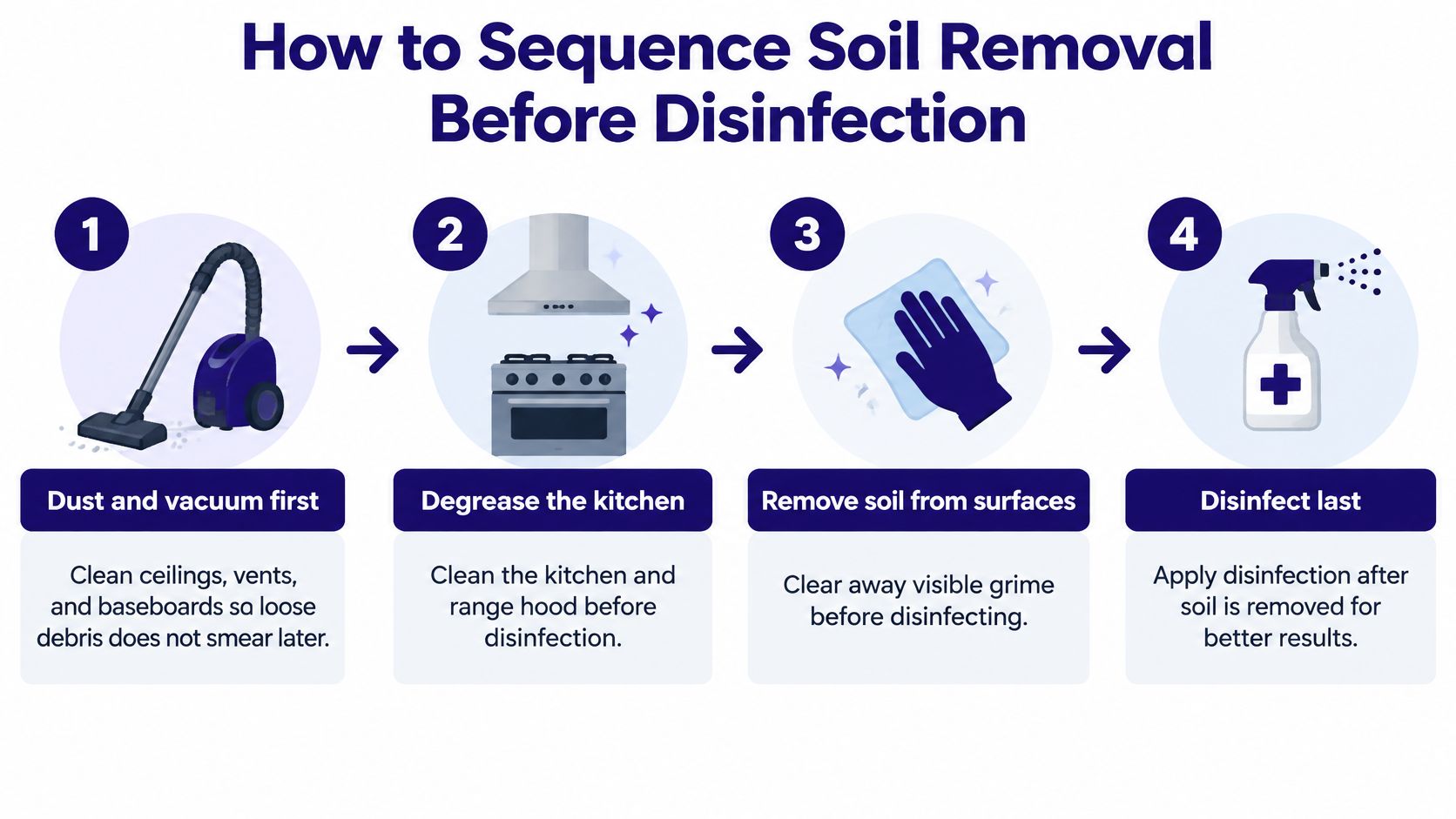
Use this sequence to keep loose debris and cleaning residue from interfering with the final treatment.
<a id="work-from-loose-debris-to-targeted-treatment"></a>
Work from loose debris to targeted treatment
1. Dust and vacuum first. Use an extension duster for ceiling corners and a brush attachment on accessible vent covers and baseboards. Capture loose material before wet wiping turns it into streaks.
2. Degrease kitchen surfaces. Apply a compatible detergent to the range hood, backsplash, and cabinet fronts, then agitate with a non-scratch pad where appropriate. Remove the greasy film rather than covering it with another product.
3. Remove bathroom deposits. Treat mineral buildup and soap scum with products suited to the fixture material. Don't use acidic descalers on sensitive stone, and keep descaling work separate from bleach-containing products.
4. Remove cleaner residue. Rinse or wipe as the cleaning product directs, using fresh cloth faces instead of a saturated rag. The surface should be free of loosened soil before the next product goes on.
5. Treat selected high-touch points when warranted. Focus on door handles, light switches, cabinet pulls, faucets, appliance handles, and compatible countertops. Apply products to a cloth when necessary to avoid wetting electrical openings.
6. Complete the wet contact time. Follow the disinfectant label rather than immediately buffing the surface dry. Check material compatibility and any required rinse instructions, especially for food-contact surfaces.
7. Record what was done. Log the product name, treated surfaces, ventilation, and completed contact time. Identify anything excluded because the material wasn't compatible.
<a id="judge-the-result-without-guessing"></a>
Judge the result without guessing
A finished bathroom should have no visible film or standing cleaning residue. If disinfection was included, the completion record should show the actual product and contact-time procedure, not just a statement that the room was sanitized.
A shiny faucet demonstrates appearance. A documented cleaning and disinfection sequence explains how it was treated.
<a id="indoor-air-and-low-residue-handoffs"></a>
Indoor Air and Low-Residue Handoffs
A strong lemon or floral scent doesn't prove that an empty home is clean or ready to occupy. It can make it harder to identify lingering paint, moisture, or cleaning-product odors.
The EPA's guidance on volatile organic compounds explains that cleaning supplies, air fresheners, paints, and furnishings can release VOCs, with concentrations of many VOCs consistently higher indoors than outdoors, sometimes by up to ten times. EPA emphasizes source reduction and ventilation as basic strategies for improving indoor air, rather than adding air-cleaning products.
<a id="reduce-sources-instead-of-masking-odors"></a>
Reduce sources instead of masking odors
A low-residue handoff means removing soil and excess product without adding unnecessary fragrance. Don't use an air freshener to conceal an odor that needs investigation.
- Ventilate appropriately: Open windows when weather, outdoor conditions, security, and property rules allow.
- Keep products separate: Never mix cleaners, and don't apply a new chemical over residue from another.
- Review product information: Identify the actual products used and their ventilation, rinsing, and re-entry instructions.
- Specify renovation dust: Treat post-construction dust removal as a distinct scope, not an incidental wipe-down.
A non-toxic label isn't a standardized guarantee of zero emissions. Evaluate product instructions and disclosure rather than assuming that a reassuring label eliminates every exposure concern.
<a id="account-for-the-next-occupant"></a>
Account for the next occupant
Where children, pets, or people with respiratory sensitivities will occupy the home, identify those needs before product selection. Fragrance-free options may be preferable to heavily scented products, but they still need correct application and residue removal.
Check the property's HVAC and filter instructions before cleaning. Accessible grille cleaning isn't duct cleaning, and a dirty filter or unresolved moisture source won't be fixed by wiping counters.
After ventilation, can someone enter without encountering a strong chemical smell? That's a useful handover check, not proof of air safety. Persistent odors deserve investigation rather than another fragranced spray.
<a id="book-your-orlando-move-out-clean"></a>
Book Your Orlando Move-Out Clean
Choose the handover date around access, completed work, and the final walkthrough, not just the moving truck's departure. Leave an opportunity to check the finished property before the landlord or incoming occupant inspects it.
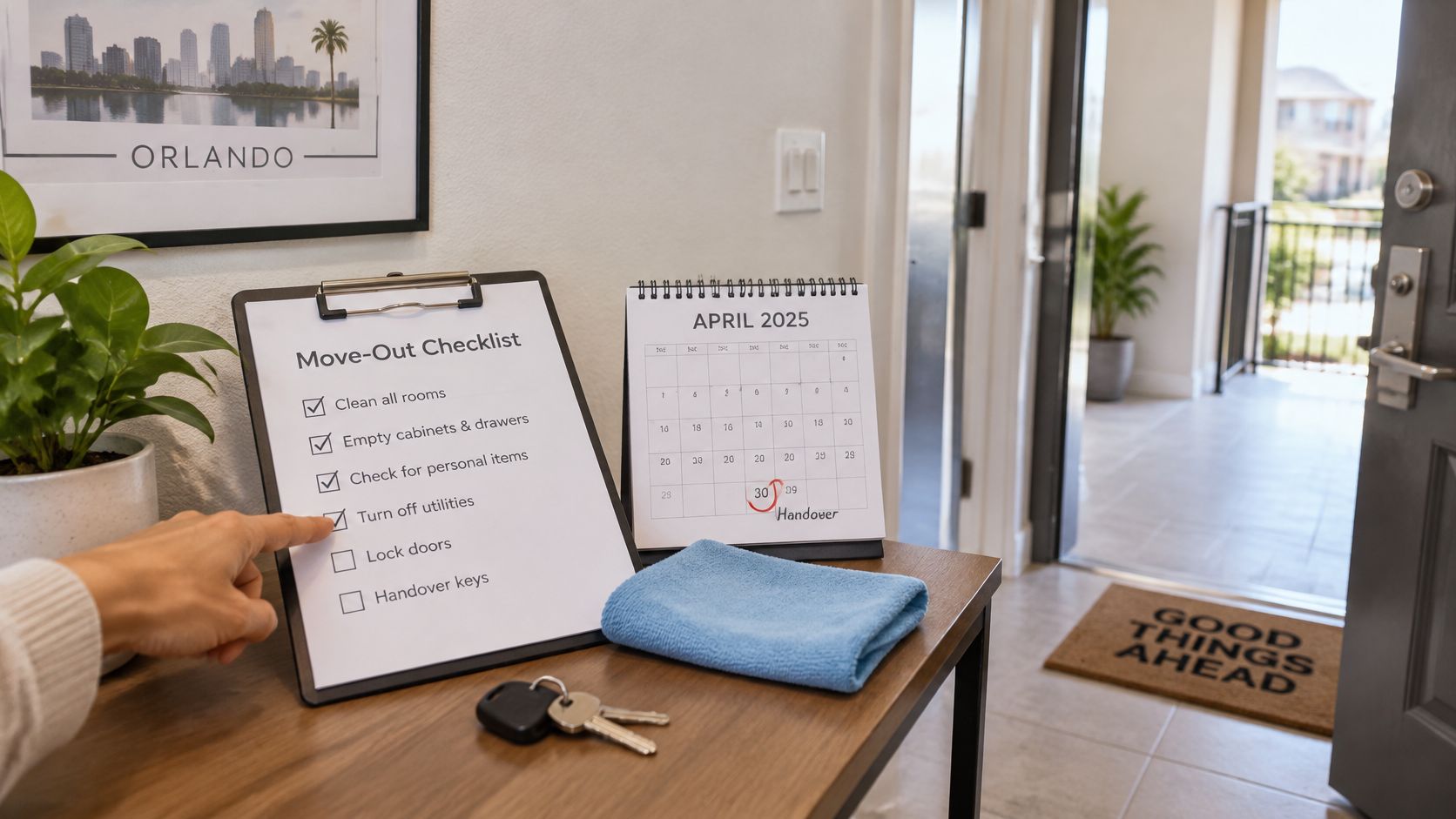
Keep the room checklist and calendar together while arranging the appointment.
<a id="arrange-access-without-staying-at-the-property"></a>
Arrange access without staying at the property
You don't need to be home during the cleaning. Many of our Orlando clients provide lockbox codes, keypad access, or leave a key with the front desk. Our background-checked team secures the home upon completion.
Every cleaning professional we deploy in Orlando is fully bonded and insured. Those credentials matter when people are entering a vacant property during a change of possession, but they don't replace clear instructions about authorized access and key handling.
For location details, visit our Orlando cleaning service page. Use the property information and photos prepared for the quote rather than relying on a brief description such as lightly dirty.
This video is available alongside the booking information.
<iframe width="100%" style="aspect-ratio: 16 / 9;" src="https://www.youtube.com/embed/Ry1suZ8ipSQ" frameborder="0" allow="autoplay; encrypted-media" allowfullscreen></iframe>
<a id="finish-the-booking-arrangements"></a>
Finish the booking arrangements
Book through our instant online quote system with the home's details and schedule, or call (407) 668-0041. Make sure the appointment fits the authorized access window and that anyone responsible for the walkthrough knows when cleaning is expected to finish.
Before confirming:
- Match the scope to the room checklist: Identify included tasks and any excluded areas.
- Document known problem areas: Provide photos that show both the condition and its location.
- Set the walkthrough in writing: Confirm the time and who will review the completed home.
---
J&M Cleaning Team offers customized move-in and move-out cleaning for homes being handed over to new owners or tenants. Visit J&M Cleaning Team to arrange a quote, identify the tasks your property needs, and schedule cleaning around your Orlando handover.