Mintel's 2025 US Cleaning the House Consumer Report puts average home cleaning time at 29 minutes a day, a benchmark that reframes cleaning as steady household upkeep rather than an occasional all-day project.
That daily time goes furthest when you split it into three separate jobs: removing dust, washing away grime, and disinfecting the few surfaces that need it. Each one calls for different tools and belongs at a different point in the session. I treat fragrance as a finishing step, never a substitute for soil removal. Work in the right order and you stop rewiping surfaces, leave less residue in the air, and finish faster.
Table of Contents
- [Cleaning Frequency and Time for Each Task](#cleaning-frequency-and-time-for-each-task)
- [Read the weekly total sensibly](#read-the-weekly-total-sensibly)
- [Supplies Worth Keeping and Where Not to Use Them](#supplies-worth-keeping-and-where-not-to-use-them)
- [Match the tool to the soil](#match-the-tool-to-the-soil)
- [Top-to-Bottom Order for One Cleaning Session](#top-to-bottom-order-for-one-cleaning-session)
- [Room Priorities When Time Is Short](#room-priorities-when-time-is-short)
- [Adjust the plan to your household](#adjust-the-plan-to-your-household)
- [Disinfecting High-Touch Surfaces Correctly](#disinfecting-high-touch-surfaces-correctly)
- [Cleaning Dust Without Spreading It Around](#cleaning-dust-without-spreading-it-around)
- [Set Your Weekly Routine or Book a Professional Clean](#set-your-weekly-routine-or-book-a-professional-clean)
<a id="cleaning-frequency-and-time-for-each-task"></a>
Cleaning Frequency and Time for Each Task
Use the table as a starting schedule, not a stopwatch for every household. Mintel's 29-minute daily average works out to roughly 3.4 hours a week; the US Cleaning the House Consumer Report gives a broad consumer benchmark, not a promise that every home takes that long. The 2025 American Time Use Survey from the Bureau of Labor Statistics measures a different group and activity: 23.4% of people aged 15 and older performed interior cleaning on an average day, spending an average of 0.33 hours, about 20 minutes, on it. These figures describe different measures, so don't treat either as a personal target.
The times below are practical estimates for one session in a typical three-bedroom home. A frequency is the default rhythm, not a rule that overrides visible buildup or household needs.
| Task | How often | Time per session | What happens if skipped |
|---|---|---:|---|
| Wipe kitchen counters and sink | Daily | 5–10 minutes | Grease and food residue set and get harder to remove |
| Clean bathroom sink, toilet and mirror | Weekly | 15–20 minutes | Soap scum and odor build up |
| Clean shower or tub | Weekly | 15–25 minutes | Mildew and hard water stains take hold |
| Vacuum high-traffic floors | Twice weekly | 10–15 minutes | Tracked-in grit wears down floor finishes |
| Vacuum and mop all floors | Weekly | 30–45 minutes | Dust and dirt spread through the house |
| Dust surfaces, baseboards and fans | Every two weeks | 20–30 minutes | Dust builds up and redistributes |
| Clean fridge shelves and door bins | Monthly | 20–30 minutes | Spills and odors linger |
| Clean inside the oven | Every three months | 30–45 minutes | Baked-on grease starts to smoke and smell |
| Wash windows and blinds | Quarterly | 30–60 minutes | Film and dust collect on glass |
<a id="read-the-weekly-total-sensibly"></a>
Read the weekly total sensibly
Counters are worth a brief daily wipe because fresh grease and food residue come off more easily than dried-on mess. A monthly fridge check catches drips before they become stubborn or smelly; it doesn't mean deep-cleaning the whole appliance every week. Pets, children, frequent cooking and humid bathrooms can all justify cleaning those areas more often.
Count the floor sessions as part of the weekly budget, not extra time to tack on afterward. In a survey of 1,000 US consumers, Ecovacs found that respondents spent an average of 56.6 minutes per week vacuuming, mopping or sweeping floors; the Ecovacs survey summary offers a separate reference point for floor care. Your household's actual time may be higher or lower.
Add the timed weekly tasks, but don't invent weekly totals for monthly and quarterly work. If the weekly rows with session times push past about four hours, keep the essentials and put less frequent work on a lighter rotation. Cut repeated polishing or unnecessary rewiping before dropping a useful floor or bathroom clean.
<a id="supplies-worth-keeping-and-where-not-to-use-them"></a>
Supplies Worth Keeping and Where Not to Use Them
A compact kit is faster to manage than a cupboard crowded with sprays that do nearly the same thing. Keep one all-purpose cleaner for compatible sealed surfaces, several clean microfiber cloths, a toilet bowl cleaner, and a vacuum suited to your floors. Add a disinfectant only if you'll use it according to its label. For a more detailed list of household basics, see this guide to house cleaning supplies.
| Supply | Best use | Avoid it on |
|---|---|---|
| All-purpose cleaner | Counters, appliances and sealed surfaces | Unsealed natural stone, which acidic formulas can etch |
| Color-coded microfiber cloths | Dusting, wiping, glass and mirrors | Heavy grease, which needs a degreaser |
| Disinfectant labeled for the surface | High-touch points when disinfection is needed | Any surface not listed on the label |
| Toilet bowl cleaner | Inside the bowl and under the rim | Chrome and metal fixtures unless the label allows it |
| HEPA-filter vacuum | Carpets, rugs, upholstery and floors | Wet spills, unless it's a wet-dry model |
| Extendable microfiber duster | Ceiling fans, high shelves and vents | Dry feather duster on open shelves, which only moves dust |
| Baking soda | Scrubbing sinks, tubs and stubborn grime | Marble and natural stone, which it can scratch |
<a id="match-the-tool-to-the-soil"></a>
Match the tool to the soil
Microfiber is useful for routine dust and light surface soil, but a greasy stovetop may need a degreaser rather than more pressure with a cloth. Use separate cloth colors for kitchens and bathrooms, and launder or replace cloths when they stop picking up soil. Store them clean and dry so a damp, used cloth doesn't become the default for the next room.
A HEPA-filter vacuum is for dry debris. Don't use a household vacuum on liquid spills unless it's designed for wet pickup. An extendable microfiber duster can reach fan blades and high shelves; a feather duster often scatters dust instead of collecting it. Baking soda can help with some stubborn sink grime, but it isn't a safe abrasive for every finish. Test an unfamiliar cleaner on a small, inconspicuous area and follow the surface and product instructions.
<a id="top-to-bottom-order-for-one-cleaning-session"></a>
Top-to-Bottom Order for One Cleaning Session
The time-saver is the sequence. Clear surfaces before wiping them, work from high areas toward low ones, and leave floors until dust and debris have settled. For a full pass in a three-bedroom home, allow roughly two to three hours, with more time if there's significant buildup or clutter.
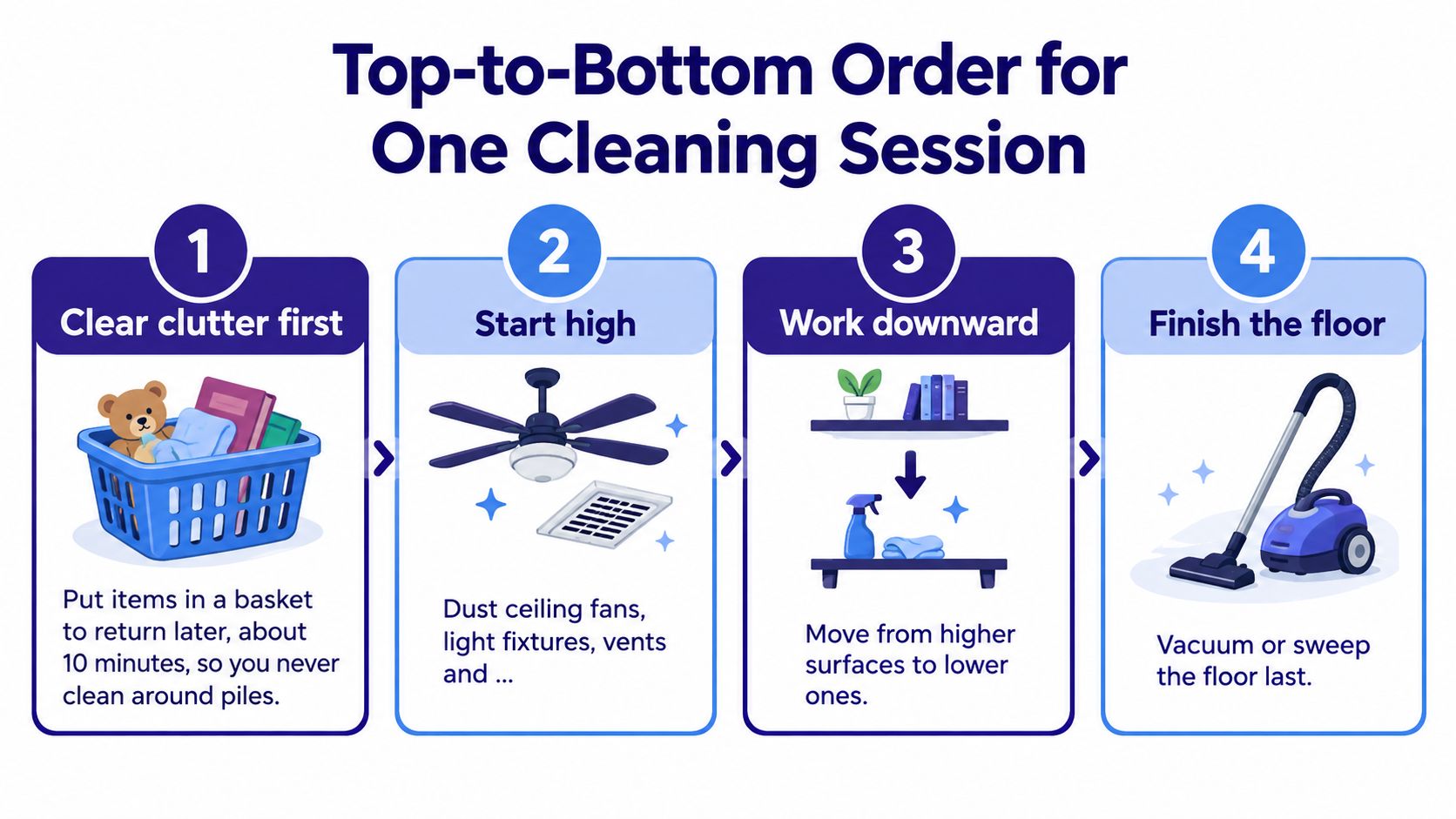
1. Clear clutter first. Spend about 10 minutes gathering loose items into a basket to return to their proper rooms later. Cleaning around piles takes longer and leaves dirt beneath the objects.
2. Start high. Use a damp microfiber cloth or suitable duster on ceiling fans, light fixtures, vents and cabinet tops. Dust that falls can then be picked up when you clean lower surfaces and floors.
3. Work downward through rooms. Wipe switch plates, door frames, handles and baseboards, then clean bathroom fixtures before moving to the kitchen. In the bathroom, scrub the toilet, sink and shower, then finish mirrors and glass; in the kitchen, wipe counters, the sink, stovetop exterior, appliance fronts and microwave interior.
4. Reset living spaces, then finish the floors. Make beds, wipe nightstands and tables, and straighten cushions before vacuuming from the farthest room toward the exit. Mop hard floors last, because vacuuming after mopping tracks grit across wet surfaces and can turn loose dirt into muddy streaks.
For bathroom buildup that needs more than a weekly wipe, use a focused method rather than rushing the room. This guide to how to deep-clean a bathroom can help you plan that heavier reset.
<a id="room-priorities-when-time-is-short"></a>
Room Priorities When Time Is Short
Start with the kitchen and bathrooms, where food residue, grease, soap scum and moisture make neglected surfaces harder to maintain. Then address the entry and other high-traffic zones, followed by bedrooms and living areas. If the clock is tight, clean the surfaces people touch and the spots where soil accumulates first.
| Time available | Do these now | Leave for the full pass |
|---|---|---|
| 30 minutes | Kitchen counters and sink; bathroom toilet and sink; vacuum the main room | Shower, mirrors, entry, bedrooms and dusting |
| 60 minutes | The 30-minute list plus shower, mirrors, entry doorknob, light switches and the floor by the door | Bedroom reset, baseboards, fans and low-traffic rooms |
| 2 hours | Full top-to-bottom pass of a typical home, about the two-to-three-hour three-bedroom session | Monthly fridge, oven interior, and quarterly windows and blinds |
<a id="adjust-the-plan-to-your-household"></a>
Adjust the plan to your household
In the kitchen, prioritize the counters, sink, stovetop and microwave interior. In the bathroom, spend the available time on the toilet, sink and shower glass. At the entry, wipe the doorknob and switches, then vacuum or sweep the floor where shoes bring in grit. A bedroom reset can be as simple as making the bed, clearing the nightstand and vacuuming; in the living room, straighten cushions and wipe the remote and coffee table.
For example, a family of four with two dogs in a 1,800-square-foot Orlando home could use the 60-minute version on weekdays and reserve a longer Saturday session for the full pass. That's a planning scenario, not a fixed schedule: adjust it for shedding, muddy paws, cooking habits and how quickly surfaces show soil. In Central Florida, give bathrooms extra attention when humidity encourages mildew. Short sessions work best when they protect the high-priority tasks instead of trying to squeeze every detail into one rushed clean.
<a id="disinfecting-high-touch-surfaces-correctly"></a>
Disinfecting High-Touch Surfaces Correctly
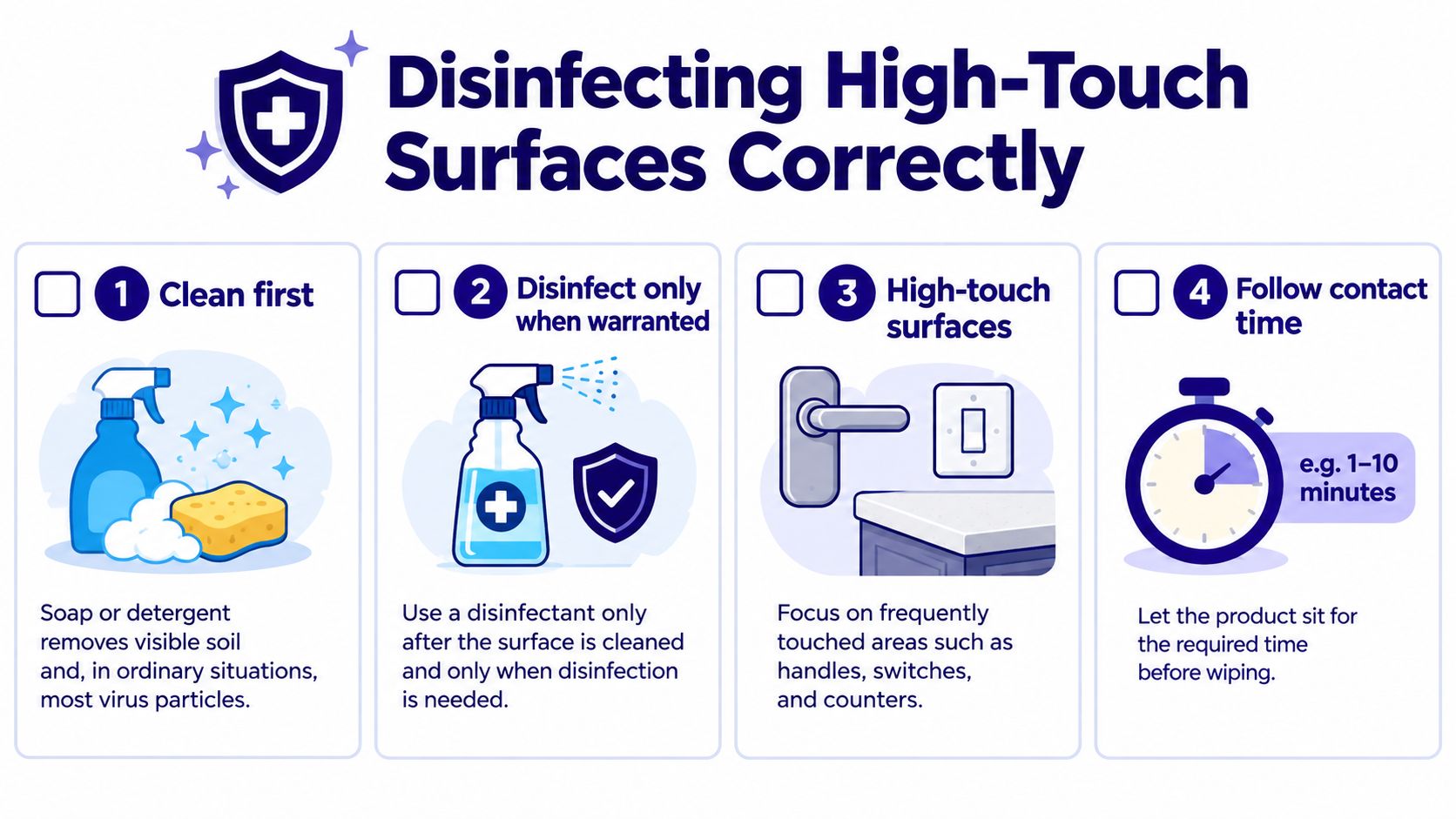
Cleaning and disinfecting are separate jobs. Remove visible dirt first with a compatible soap or detergent cleaner; then disinfect only when it's warranted, such as after illness, and only on surfaces covered by the product label. The CDC home cleaning and disinfecting guidance explains that cleaning alone removes most virus particles in ordinary situations, while disinfection provides an additional reduction of remaining germs.
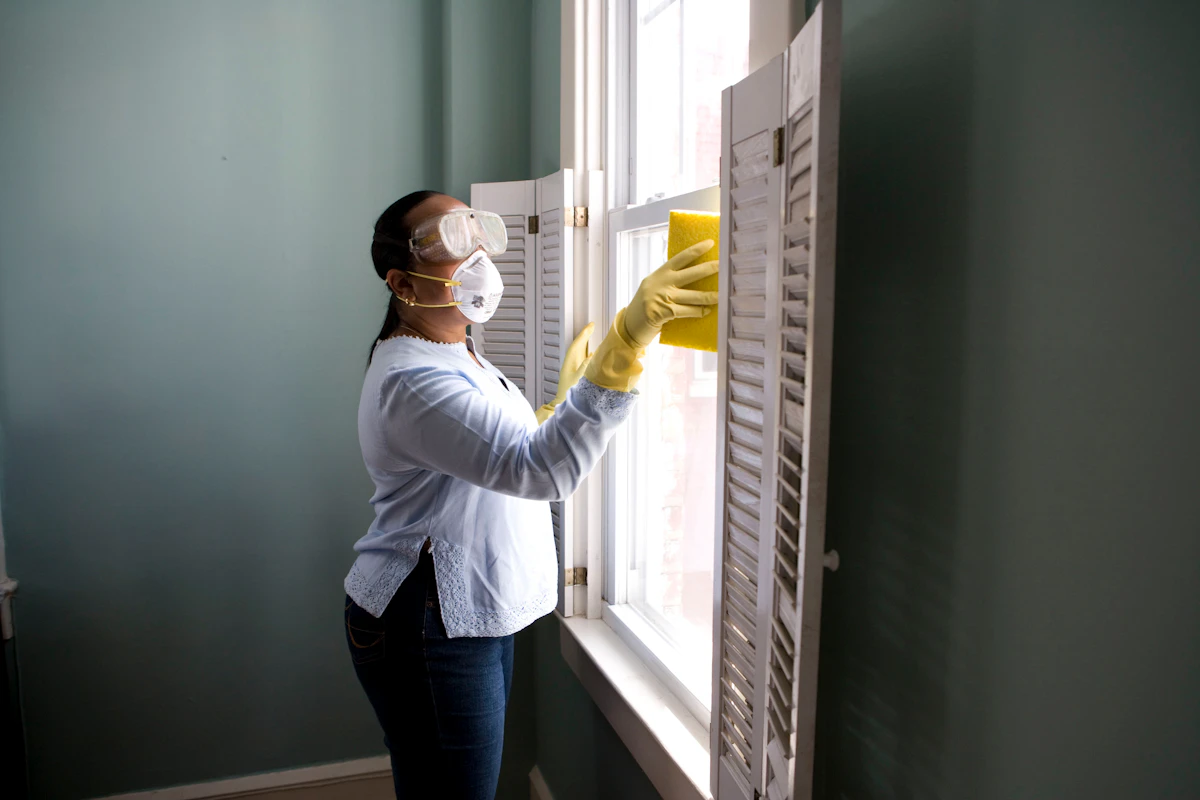
1. Ventilate and prepare. Open a suitable airflow route or run an exhaust fan. Wear gloves, and use eye protection if splashing is possible.
2. Clear and clean the surface. Move clutter so the cleaner reaches the whole area, then remove grime before applying disinfectant. Soil can interfere with contact, so spraying a dirty counter and wiping straight away isn't reliable disinfection.
3. Apply the disinfectant and keep the surface wet. Check the product label for its approved surface, organism claims, dilution and contact time. The EPA guidance on disinfectant contact time says products may inactivate 99.999% of germs on hard, nonporous surfaces when they remain visibly wet for the recommended dwell time.
4. Time the dwell, then finish as directed. Start a timer and reapply if the surface dries before the required time. Work on large counters in sections; wipe or rinse only when the label tells you to do so.
Prioritize doorknobs, light switches, faucet handles, cabinet pulls, remotes, tables and countertops. Never mix cleaning products, especially bleach with ammonia or acids. Use room-temperature water for dilution unless the label specifies otherwise, and don't assume a general-purpose cleaner disinfects unless its label identifies germ-kill claims and contact time.
<a id="cleaning-dust-without-spreading-it-around"></a>
Cleaning Dust Without Spreading It Around
A stronger scent or a more forceful scrub doesn't automatically make a home healthier. Dry dusting can send fine particles back into the air, while a heavily fragranced product adds another exposure rather than removing dust.
The University of Miami account of a 2025 household-dust study reports that smaller dust particles can carry higher concentrations of toxic chemicals than larger particles and may travel deeper into the lungs. The study included dust from homes and from the hands of 101 children across Miami-Dade County, Greensboro and Tucson. The practical point is not that ordinary cleaning prevents disease. It's that removing settled dust carefully is preferable to stirring it up.
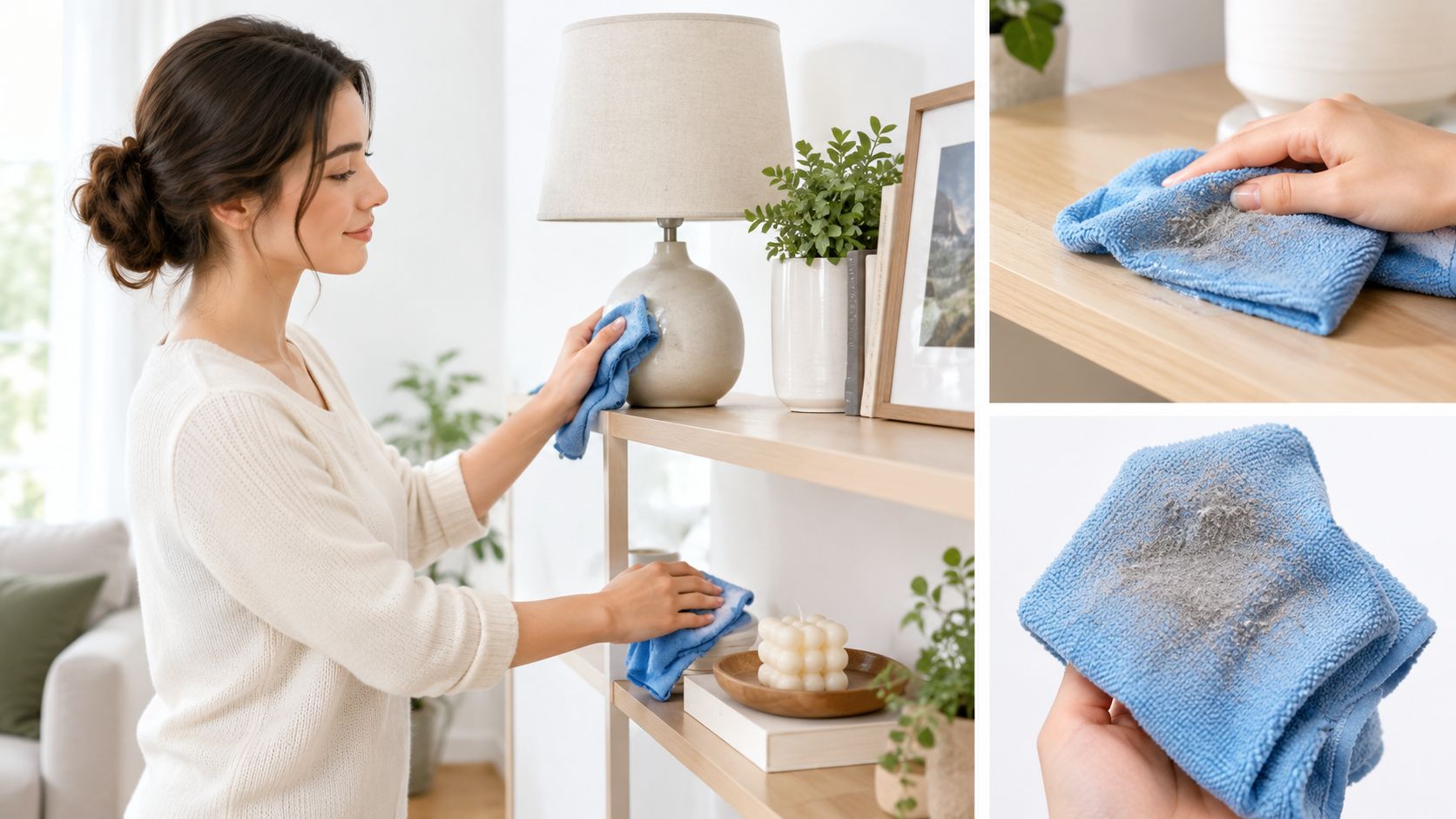
Use this order: ventilate briefly if conditions allow, HEPA-vacuum, damp-wipe surfaces, launder washable textiles such as throws, then clean floors last. Use a lightly damp microfiber cloth on shelves and baseboards instead of a dry feather duster. Prioritize rugs, upholstery, floors and low surfaces in homes with pets, young children or recent renovation work.
Purdue University researchers reported that scented cleaners, air fresheners, wax melts and essential-oil products can react with indoor ozone and generate nanoscale particles. Read the Purdue University report on indoor air and everyday products, and don't assume “natural” fragrance is automatically a safer choice. Fragrance-free products are a sensible option when you want to avoid adding scent; ventilation also matters, especially during cooking and cleaning.
<iframe width="100%" style="aspect-ratio: 16 / 9;" src="https://www.youtube.com/embed/iEJB34SjmPg" frameborder="0" allow="autoplay; encrypted-media" allowfullscreen></iframe>
In hot, humid Central Florida, opening windows may not always be practical; run exhaust fans during cooking and cleaning, and choose a cooler, less humid time to air out the home when possible. Keep infants, older adults and people with asthma away from the work area while you clean, and let the room air out before they return.
<a id="set-your-weekly-routine-or-book-a-professional-clean"></a>
Set Your Weekly Routine or Book a Professional Clean
Use the timed weekly rows as your decision point. If the essentials fit within about four hours and you can maintain that pace, split the work into a shorter weekday block for the kitchen, bathroom and entry, plus a longer session for the full pass. Don't turn monthly fridge work or quarterly oven and window tasks into weekly chores.
If the house is overdue, reset the neglected areas first, then establish a maintainable routine. A deep clean is recommended for first-time visits and homes that haven't been professionally cleaned in over 30 days. If pet hair, children, frequent cooking or a long workweek pushes routine cleaning beyond your available time, consider handing off the repeating work instead of letting essentials slide.
J&M Cleaning Team offers weekly cleaning in Orlando and Central Florida. Clients don't need to be home during a cleaning. Compare the time a recurring routine would take with the quote for a one-time reset or scheduled visits, then choose the option you can keep up with.
---
J&M Cleaning Team provides one-time and recurring house cleaning for Orlando and nearby Central Florida communities, helping you reset a home or keep up with a dependable routine. Visit J&M Cleaning Team to request a flat-rate quote and choose the cleaning option that fits your home.